Revenue.
Margin.
Valuation.
Three numbers your board reads. AI is rewriting all three in your industry.
This briefing tells you where revenue, margin, and valuation move in accounting and CFO advisory as AI rewrites the industry. Read it before your competitors decide what your next decade looks like.
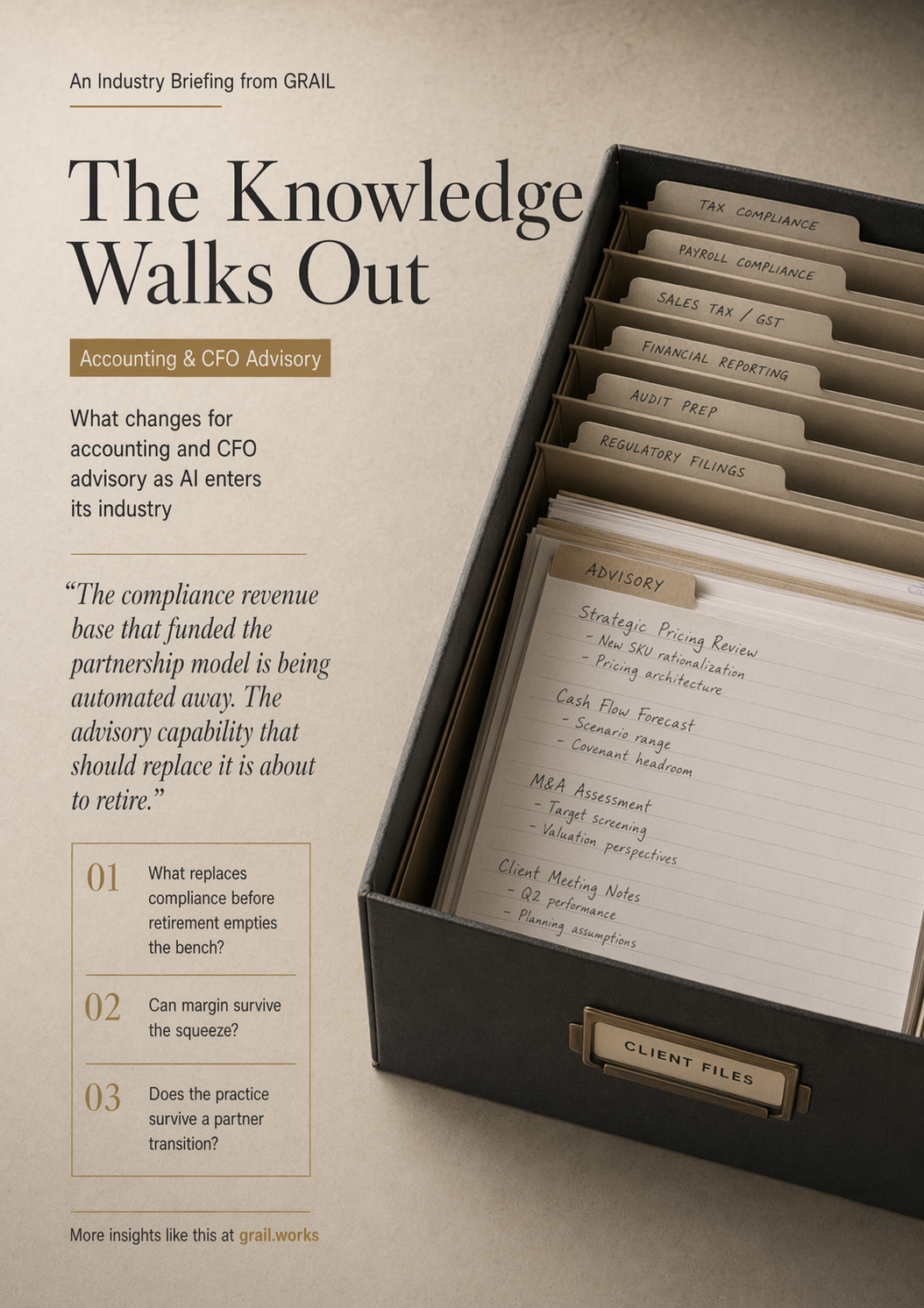
The 10-page briefing. Worth 20 minutes.
One email. One PDF. Worth twenty minutes of your week.
We send it once. Work emails only.
Mid-market accounting firms built their value on two pillars: recurring compliance revenue and deep advisory relationships with owner-managed businesses. AI is attacking both at the same time. Compliance work is being automated at scale by networks from above and PE-backed roll-ups from below. Advisory capability depends on client-specific knowledge that partners accumulated over twenty years. Those partners are approaching retirement, and most firms have no structured process for capturing what they know.
Your practice is worth what your best partners know. The question is how much of that knowledge will still be in the firm in five years.
The compliance-to-advisory migration has been discussed for a decade. AI makes it existential. Standard tax preparation, statutory accounts, and routine audit are now automatable at a cost base that mid-market firms cannot match. The only defensible position is deep, trust-based advisory built on decades of client-specific knowledge. But that knowledge exists only in partner heads. When the next partner retires, the relationship either transfers or leaves.
For the managing partner, this is not a technology question. It is a revenue question, a profit question, and a practice valuation question.
Revenue. Profit. Valuation.
Three lenses. Three answers the partnership needs before the next annual review.
Revenue
Compliance revenue is being compressed from three directions simultaneously. Large networks invest in AI to automate at scale. PE-backed roll-ups offer commoditized compliance at prices your cost structure cannot match. Client AI tools reduce the scope of standard advisory. The revenue that funded the partnership model for thirty years is structurally declining.
Profit
Compliance margins have compressed for years. Defending them requires investment in technology your firm cannot fund at the scale of a network or PE-backed platform. Advisory margins remain strong at 30 to 45 percent. But advisory capacity is constrained by the number of partners with deep client knowledge. When a partner retires without transferring that knowledge, both the revenue and the margin disappear.
Valuation
A practice where the top fifteen client relationships survive a partner transition is worth multiples more than one where they do not. Buyers and successors price the risk of relationship concentration. Personal knowledge held in partner heads is a discount. Institutional knowledge captured in firm infrastructure is a premium. The same book of business, at very different valuations, depending on one architectural choice.
What you'll get when you download
A 10-page report for mid-market accounting and CFO advisory managing partners. Designed to be read in one sitting before your next partnership review.
The strategic choice, side by side
The default path (defend compliance, hope succession works through personal introduction, invest in technology to match network scale) and the repositioning path (capture partner knowledge, migrate to deep advisory, build institutional infrastructure that outlasts individual partners), with the financial logic of each.
The four levers that compound
Capture partner knowledge before retirement through structured extraction, not documentation. Use AI to handle compliance production, freeing partner time for advisory. Migrate the value proposition from compliance-adjacent to genuinely strategic. Build succession as a capability transfer, not a relationship gamble.
Five questions for your partnership review
Diagnostic questions the managing partner should test the leadership group against before the next annual review. The questions where the room cannot agree are the ones worth a longer conversation.
Calibrated for each seat at the table.