Revenue.
Margin.
Valuation.
Three numbers your board reads. AI is rewriting all three in your industry.
This briefing tells you where revenue, margin, and valuation move in audit and assurance as AI rewrites the industry. Read it before your competitors decide what your next decade looks like.
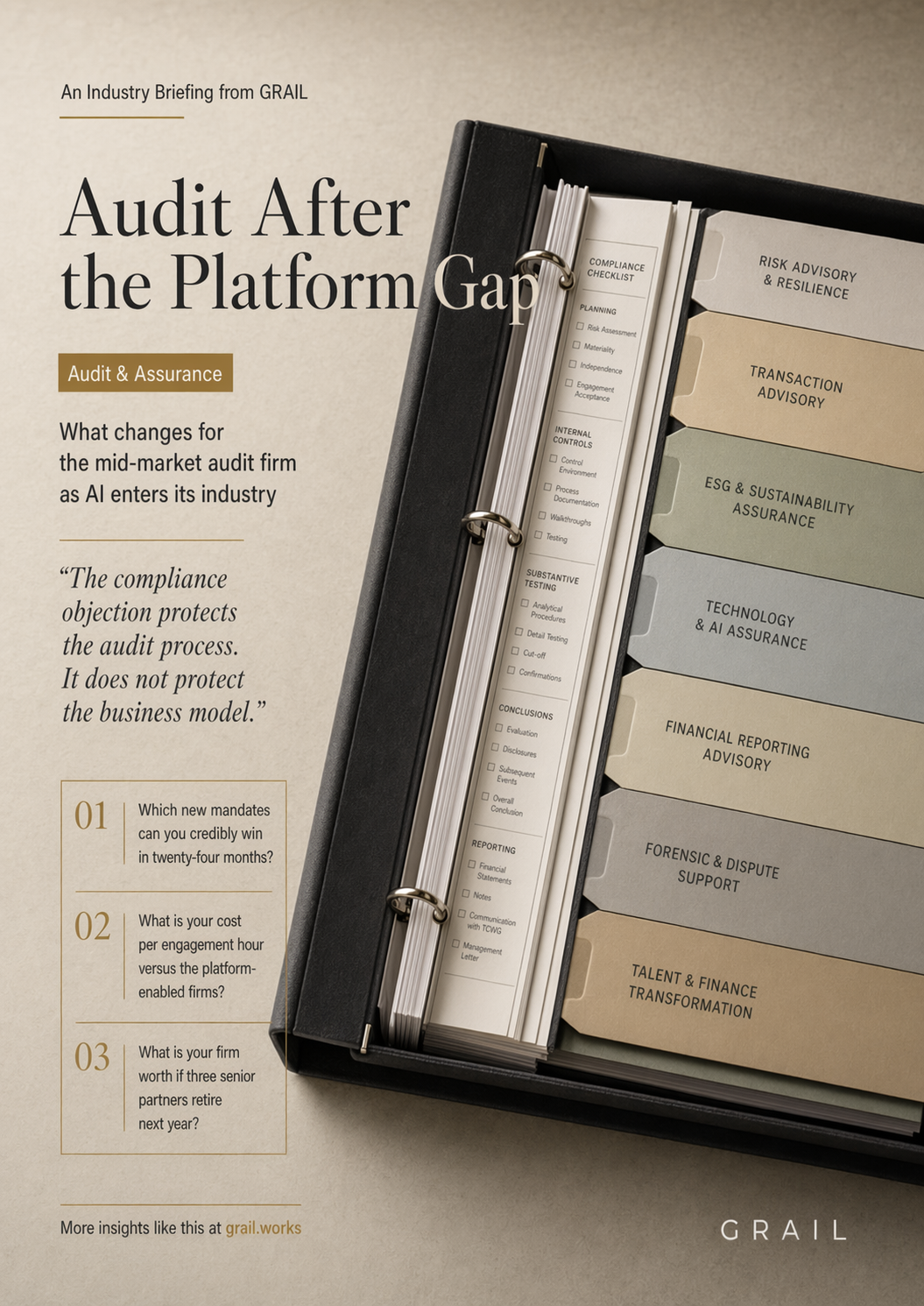
The 10-page briefing. Worth 20 minutes.
One email. One PDF. Worth twenty minutes of your week.
We send it once. Work emails only.
A mid-market audit firm competes on two things: the quality of its people and the depth of its client relationships. AI is restructuring both. The Big Four have invested hundreds of millions in proprietary audit platforms that compress delivery by thirty to forty percent. At the same time, sustainability assurance has opened the first new audit market in a generation. And forty-one percent of graduates leave within three years because the work is not what they signed up for.
The compliance objection protects the audit process. It does not protect the business model.
These three forces are not separate problems. They are one problem: how the firm builds, encodes, and deploys knowledge. The managing partner who treats them as three budget lines will underfund all three. The one who sees them as a single knowledge infrastructure question will move faster and spend less.
For the managing partner of a mid-market audit firm, this is not a technology question. It is a revenue question, a profit question, and a valuation question.
Revenue. Profit. Valuation.
Three lenses. Three answers the partnership needs before the next strategic planning session.
Revenue
CSRD sustainability assurance is a concentrated, high-value market. The firms that build structured expertise infrastructure fastest capture these relationships for a decade. The Omnibus I Directive reduced scope by eighty-five percent, but the remaining mandates are larger and more valuable. Winning them requires demonstrable methodology, not a staffing plan.
Profit
A thirty to forty percent efficiency gap is structural. Every year the gap widens as the networks refine their platforms. Competing on price against a structurally lower cost base erodes margin quarter by quarter. The mid-market profit answer is specialist depth and client intimacy that the networks cannot replicate at scale.
Valuation
Partner equity depends on the firm's ability to retain clients and capability through leadership transitions. When CSRD expertise lives in one partner's head, that partner's retirement is a revenue event. Institutional knowledge encoded into methodology, training systems, and engagement intelligence survives transitions and protects the equity.
What you'll get when you download
A 10-page report for mid-market audit and assurance firm managing partners. Designed to be read in one sitting before your next partnership meeting.
The strategic choice, side by side
The default path (wait for validated tools, staff CSRD reactively, accept graduate attrition as normal) and the repositioning path (build knowledge infrastructure now, sprint on CSRD expertise, redesign junior work), with the financial logic of each.
The four levers that compound
Build CSRD expertise as institutional infrastructure. Redesign junior work so the best people stay. Capture client-specific context as a compounding asset. Compete on specialist depth where the networks are spread thin.
Five questions for your next partnership meeting
Diagnostic questions the managing partner should test the partnership against before the next strategic planning session. The questions where the room cannot agree are the ones worth a longer conversation.
Calibrated for each seat at the table.