Revenue.
Margin.
Valuation.
Three numbers your board reads. AI is rewriting all three in your industry.
This briefing tells you where revenue, margin, and valuation move in high-end architecture and design as AI rewrites the industry. Read it before your competitors decide what your next decade looks like.
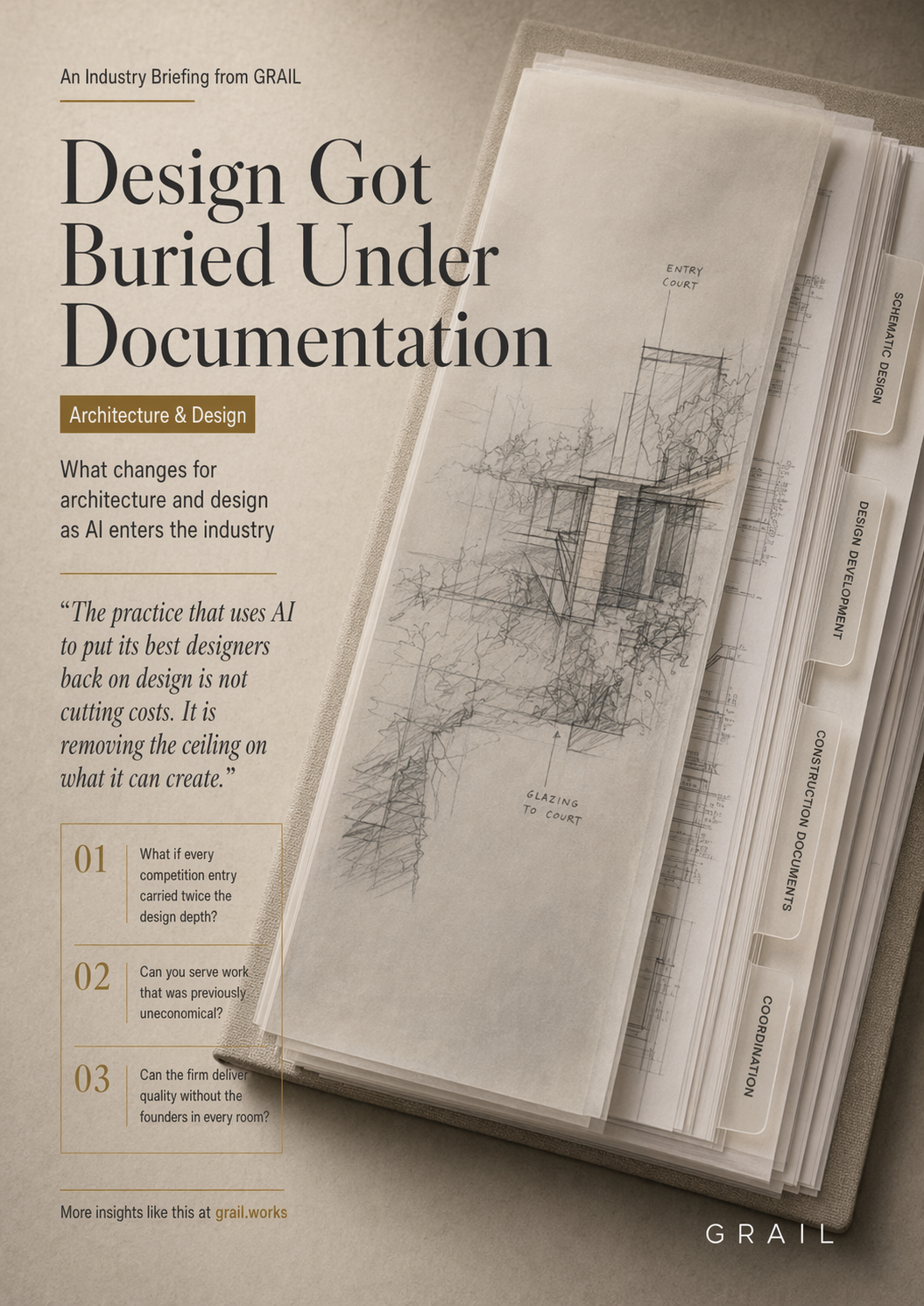
The 10-page briefing. Worth 20 minutes.
One email. One PDF. Worth twenty minutes of your week.
We send it once. Work emails only.
Architecture practices built their value on three things: creative vision, deep client relationships, and the ability to translate both into built form. The production layer that makes translation possible has always consumed more senior time than anyone wanted to admit. Specification writing, BIM coordination, sustainability calculations, regulatory submissions. The work that has to happen but that nobody entered architecture to do.
What would your practice look like if your best designers spent 80% of their time on design instead of 40%?
AI compresses the production layer. Specification drafting, standard detail generation, whole-life carbon calculations, compliance checking. These tasks are substantially AI-augmentable today. The question is not whether the technology works. The question is what you do with the capacity it creates. One path treats it as a cost reduction opportunity. The other treats it as a creative redeployment opportunity. Same technology. Very different practices three years from now.
For the principal of a high-end architecture firm, this is not a technology question. It is a commission revenue question, a project margin question, and a firm valuation question.
Revenue. Margin. Valuation.
Three lenses. Three answers the leadership team needs before the next partnership meeting.
Commission Revenue
High-end commissions are won on design depth, client relationship quality, and the ability to carry a concept through to built form without losing it in production. Every hour a senior designer spends on documentation is an hour not spent on the concept work that wins the next commission. The practice that redirects senior capacity toward design quality wins projects that competitors cannot match at current production loads.
Project Margin
Architecture margins sit between 12% and 20%. The production layer is the largest single cost driver after salaries. When AI compresses specification writing, BIM coordination, and compliance checking, the cost of the production phase drops. But the real margin gain comes from the sustainability analytical capability: whole-life carbon analysis at scale opens projects that competitors cannot serve at current billing rates. New capability, not just lower cost.
Firm Valuation
Architecture firms are valued on three things: the reputation of the principals, the quality of the project pipeline, and the ability to deliver without the founding partners in every room. A practice where senior design capacity is consumed by production is a practice that cannot scale. A practice where AI handles production and seniors focus on design and client relationships is a practice that can grow without diluting quality.
What you'll get when you download
A 10-page report for architecture and design firm principals. Designed to be read in one sitting before your next partnership meeting.
The strategic choice, side by side
The default path (treat AI as the next BIM transition, focus on production efficiency, reduce headcount) and the repositioning path (redirect senior capacity to design, build sustainability analytical capability, redesign the junior architect role). With the financial logic of each.
Four levers that compound
Redirect senior design time from production to concept. Build AI-augmented sustainability analysis as a competitive differentiator. Redesign the junior architect role around design judgment. Turn every project into training data for the next one.
Five questions for your next partnership meeting
Diagnostic questions the principal should test the leadership team against before the next strategic review. The questions where the room cannot agree are the ones worth a longer conversation.
Calibrated for each seat at the table.