Cheaper.
Better.
Faster.
The triple threat that used to be a tradeoff is now table stakes.
This briefing tells you where the triple threat lands in high-margin distribution operations as AI rewrites the cost structure. Read it before your competitors decide who is table stakes.
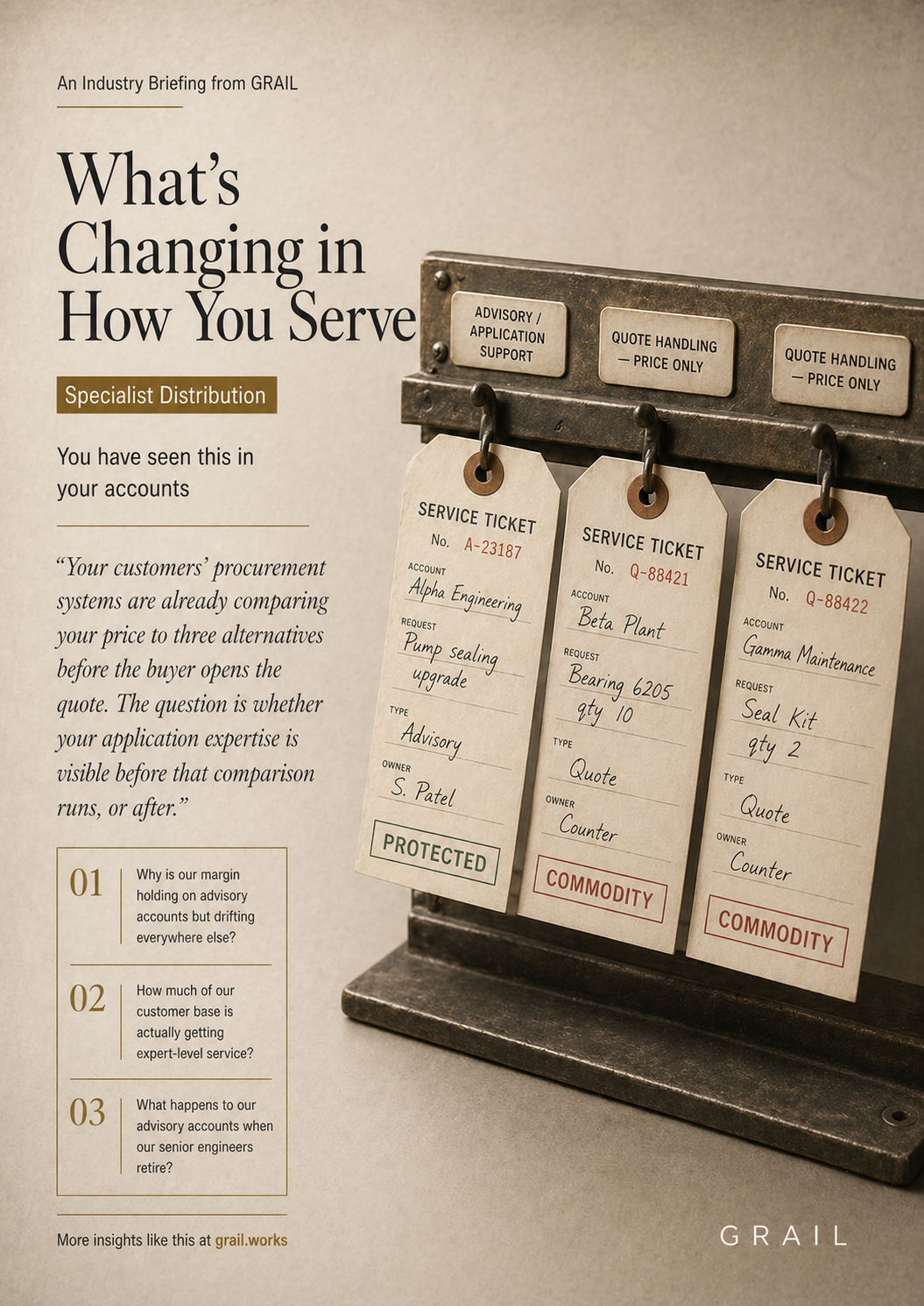
The 10-page briefing. Worth 20 minutes.
One email. One PDF. Worth twenty minutes of your week.
We send it once. Work emails only.
Every operations leader at a mid-sized specialist distributor in Europe has had a version of the same morning. An order came in that needed an ATEX-certified pump for a washdown area at 80°C. Your senior application engineer was on holiday. Three other sellers looked at the catalogue. Two specified the wrong product. One escalated and lost two days. By afternoon you had delivered a wrong specification or lost the order to a competitor who caught the combination automatically.
You have run this operation for ten to fifteen years. The pattern used to hold. Hire the best application engineers. Protect the quality of advice. Hold the margin at the number. Something changed.
Product-availability margin is compressing as digital procurement platforms cover the catalogue at lower cost. The remaining defensible margin is application expertise. But that expertise still lives in individual heads. This is not a you problem. It is an industry structure problem, and it is happening to every specialist distributor who has not yet made application knowledge institutional.
Can you point to one product category where every seller on your bench specifies correctly without calling the senior?
Your CEO is already asking this. The briefing below is what you want in your hand before the next commercial review.
Knowledge Margin. Service Coverage. Bench Resilience.
Three questions every specialist distribution COO is tracking. None of them used to be the same question. They are now.
Why is our margin holding on advisory accounts but drifting everywhere else?
Your advisory-heavy accounts run fifteen to twenty points above commodity lines. The difference is application depth. But that depth only reaches the accounts your senior engineers manage directly. Every account outside that radius gets catalogue service at commodity margin, whether your rate card says otherwise or not.
How much of our customer base is actually getting expert-level service?
Your three or four most experienced application engineers cover forty accounts between them at advisory depth. The other two hundred accounts get catalogue responses. When application knowledge is encoded as firm capability rather than personal competence, every seller gives the recommendation that justifies the premium. Coverage expands without adding headcount.
What happens to our advisory accounts when our senior engineers retire?
One to two major accounts shift to competitive quotes within eighteen months of each senior departure. At three hundred thousand to eight hundred thousand in revenue per account, each departure event puts one to two million at risk. Application-knowledge infrastructure is the only defence that works before the retirement conversation, not after it.
What you get when you download
An 11-page report for Chief Operating Officers and Heads of Operations at mid-market specialist distributors. Designed to be read in one sitting before your next commercial or margin review.
Your industry, your operations, and why they are one problem
What is happening in specialist distribution as a sector. What is happening inside your application engineering team, your seller bench, your senior experts, and your account continuity right now. And the intersection most distribution COOs have not named yet: application expertise is the only margin premium that survives, and it still lives in individual heads.
Four moves across application engineering, bench, senior experts, and account continuity
Map every product category to a knowledge profile and close the gaps. Give every seller access to encoded senior judgment on complex specifications. Extract application knowledge as a side-effect of daily work, not documentation sprints. Treat every major account as an intelligence asset, not a personal relationship.
Five questions for your next operations review
The advisory-coverage question. The departure-risk question. The specification-error question. The measurably-smarter question. The seller-of-2027 question. Where your operations team cannot agree on the answer is the conversation worth an hour on the agenda.
Calibrated for each seat at the table.