Revenue.
Margin.
Valuation.
Three numbers your board reads. AI is rewriting all three in your industry.
This briefing tells you where revenue, margin, and valuation move in industrial process as AI rewrites the industry. Read it before your competitors decide what your next decade looks like.
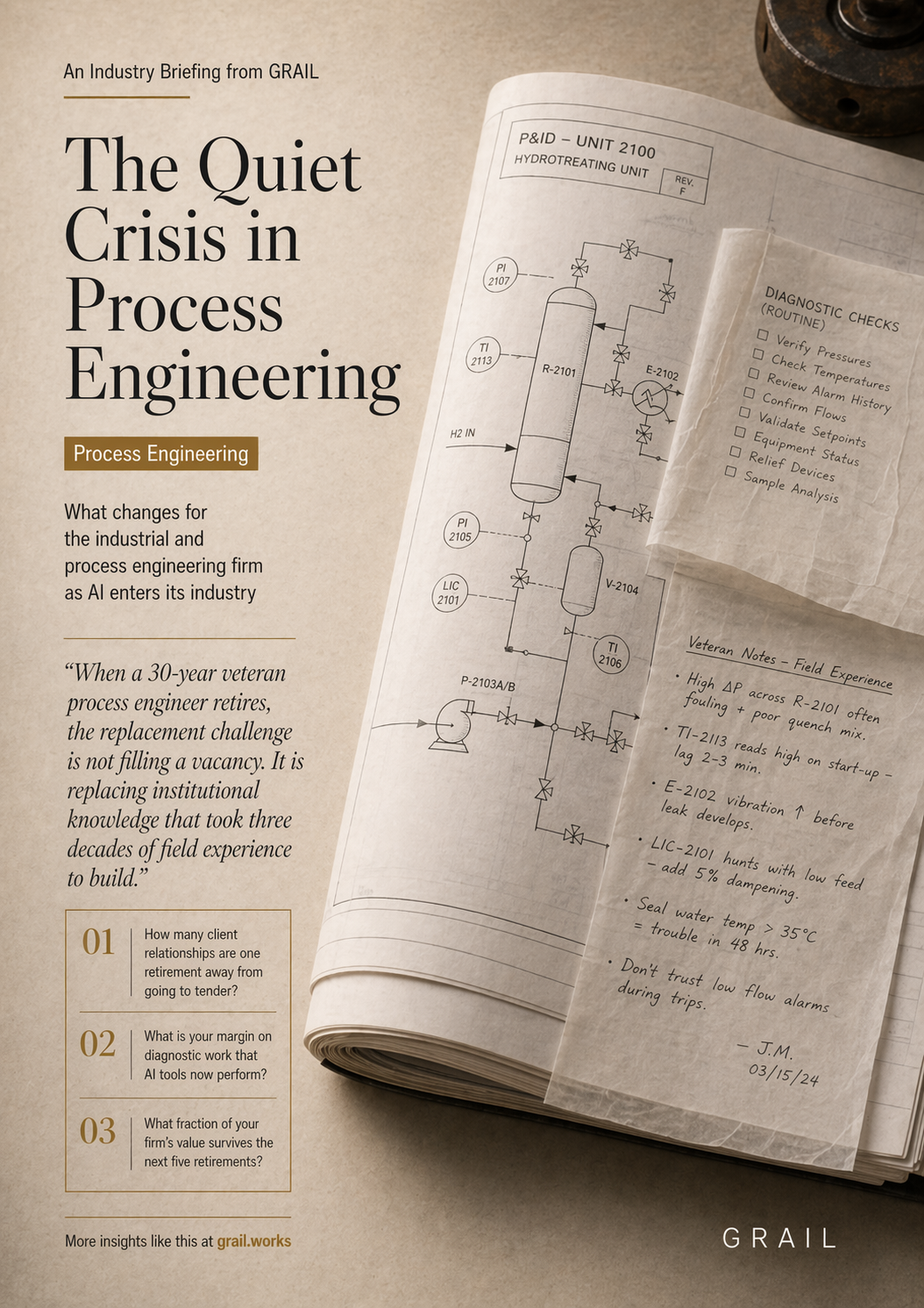
The 10-page briefing. Worth 20 minutes.
One email. One PDF. Worth twenty minutes of your week.
We send it once. Work emails only.
Process engineering firms sell expertise that took decades to develop. The knowledge required to advise on complex process design, hazardous materials handling, or specialty chemistry application is expensive and slow to build. Client relationships are long-term, trust-based, and almost entirely personal. Clients buy the expert, not the firm brand.
When a 30-year veteran process engineer retires, the replacement challenge is not filling a vacancy. It is replacing institutional knowledge that took three decades of field experience to build.
Two forces are compressing this model simultaneously. AI diagnostic tools are commoditizing the analysis work that justified mid-level billing rates. And the senior specialists whose judgment commands the premium are aging out. Over 25% of the manufacturing workforce in major European economies is over 55. The pipeline of replacements is thin because the training period is measured in decades, not years.
For the CEO of a process engineering firm, this is not a technology question. It is a revenue question, a profit question, and a valuation question.
Revenue. Profit. Valuation.
Three lenses. Three answers the management team needs before the next retirement announcement.
Revenue
In process engineering, clients buy the person. When that person retires, the relationship does not transfer automatically. A 15-year retainer that funded overhead, built trust, and generated referrals becomes an open competitive bid. The revenue impact is not the project fee. It is the decade of accumulated trust that disappears with it.
Profit
AI simulation and diagnostic tools are compressing the analysis work that justified mid-level billing rates. The revenue base for mid-tier engineers is eroding. Defending those rates against clients who have seen the alternatives is a losing position. The margin question is whether the firm can move upmarket fast enough to replace what the mid-tier is losing.
Valuation
A firm whose competitive advantage is three specialists with 30 years of experience each is priced as a collection of personal practices. A firm whose knowledge is institutional, transferable, and encoded into its operating infrastructure is priced as an enterprise. Same revenue. Very different multiples. The distinction comes down to one architectural choice.
What you'll get when you download
A 10-page report for industrial and process engineering CEOs. Designed to be read in one sitting before your next leadership meeting.
The strategic choice, side by side
The default path (hope knowledge transfers naturally, defend mid-level billing rates, let client transitions happen informally) and the repositioning path (capture knowledge systematically, move the mid-tier upmarket, build formal transition infrastructure), with the financial logic of each.
The four levers that compound
Capture senior knowledge while the specialists are still available. Extend mid-level engineers with AI-powered analytical capability. Build formal client relationship transition protocols. Reprice the firm around institutional capability, not individual expertise.
Five questions for your leadership team
Diagnostic questions the CEO should test the management team against before the next retirement announcement arrives. The questions where the room cannot agree are the ones worth a longer conversation.
Calibrated for each seat at the table.