Revenue.
Margin.
Valuation.
Three numbers your board reads. AI is rewriting all three in your industry.
This briefing tells you where revenue, margin, and valuation move in infrastructure and civil engineering as AI rewrites the industry. Read it before your competitors decide what your next decade looks like.
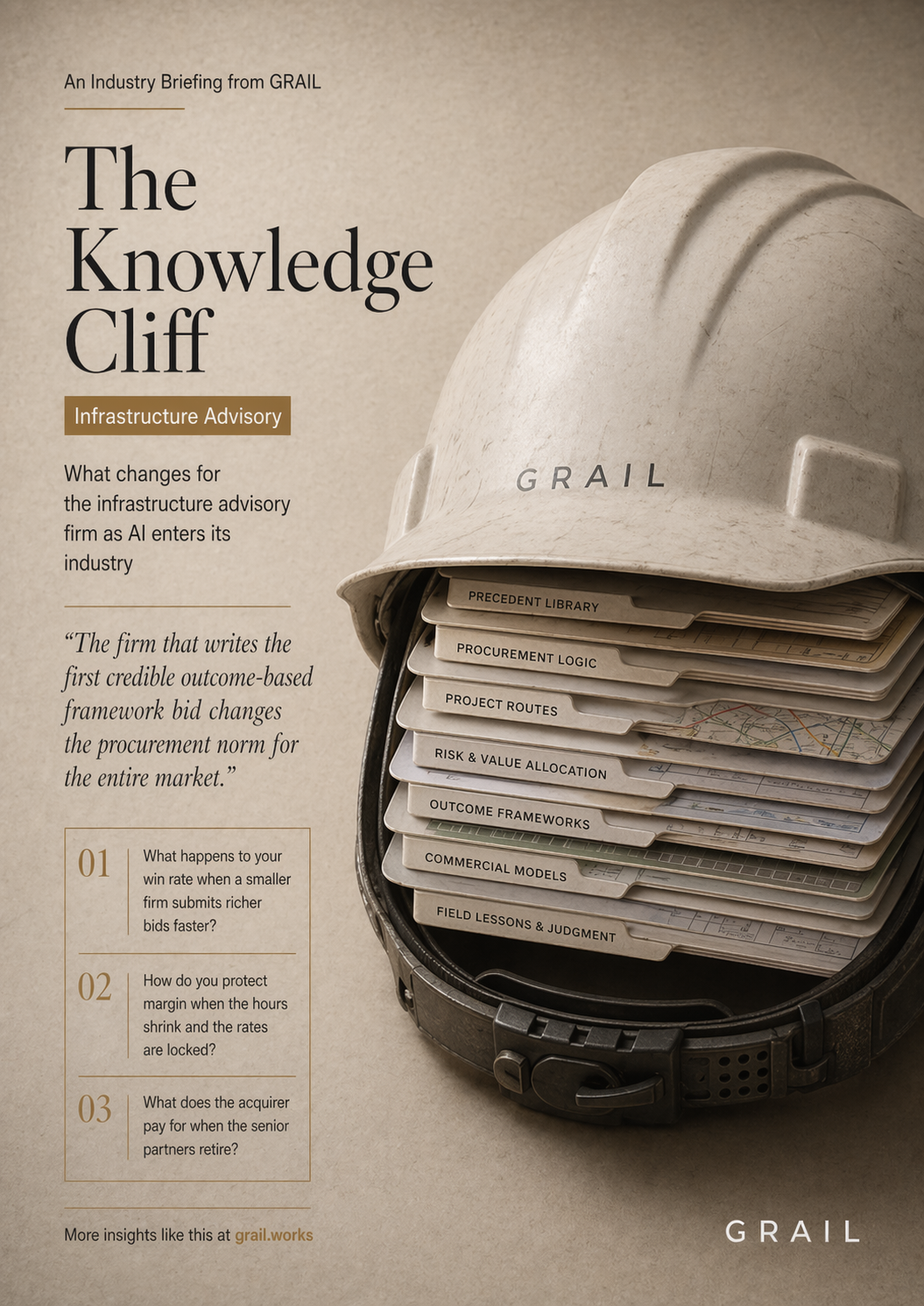
The 10-page briefing. Worth 20 minutes.
One email. One PDF. Worth twenty minutes of your week.
We send it once. Work emails only.
Infrastructure advisory built its competitive position on three assets: depth of specialist technical knowledge, regulatory relationship intelligence across planning authorities, and decades of project precedent. All three are personal. They live in the heads of senior principal engineers who are approaching retirement. AI compresses the production layer around those people. Structural analysis, environmental documentation, regulatory submissions, and specification writing all get faster. Under hourly billing locked into multi-year framework agreements, that compression destroys revenue without replacing it.
The firm that writes the first credible outcome-based framework bid changes the procurement norm for the entire market.
The strategic question is not whether to adopt AI for production efficiency. Every firm will. The question is what to build around the efficiency. Firms that capture senior knowledge into institutional infrastructure before retirement closes the window, and then use the next framework tender to reprice the relationship on outcome terms, create a competitive position that compounds with every project completed. Firms that automate production under hourly rates will deliver faster, bill less, and watch the margin erode until the next tender round.
For the CEO of an infrastructure advisory firm, this is not a technology question. It is a revenue question, a profit question, and a valuation question.
Revenue. Profit. Valuation.
Three lenses. Three answers the management team needs before the next framework renewal.
Revenue
A competitor that encodes project precedent into retrievable infrastructure can assemble evidence-rich tender responses in days instead of weeks. Every framework renewal, every competitive bid, they produce more detailed technical submissions with fewer people. The win rate shifts quietly. By the time the pipeline data confirms it, the pattern is structural.
Profit
AI compresses production hours. Framework agreements lock hourly rates for years. The margin trap is mechanical: you deliver faster, bill less, and the rate cannot adjust until the next tender round. Every efficiency gain under hourly billing transfers value to the client, not the firm. The profit question is whether the pricing model can change before the margin erodes further.
Valuation
An acquirer values institutional capability that persists after the leadership team transitions. Knowledge that lives in three principals' heads is a discount. Knowledge encoded into project precedent databases, regulatory pathway maps, and structured decision histories is a premium. The same firm, at very different valuations, depending on where the knowledge sits.
What you'll get when you download
A 10-page report for infrastructure and civil engineering CEOs and management teams. Designed to be read in one sitting before your next framework renewal.
The strategic choice, side by side
The default path (automate production, accept locked rates, lose knowledge to retirement) and the repositioning path (encode senior knowledge, structure project precedent, bid outcome-based in the next tender round), with the financial logic of each.
The four levers that compound
Capture senior knowledge before retirement closes the window. Structure project precedent into retrievable institutional memory. Position for outcome-based framework bids. Make every project smarter than the last. Four levers that compound when pulled together.
Five questions for the leadership team
Diagnostic questions the CEO should test the management team against before the next framework renewal. The questions where the room cannot agree are the ones worth a longer conversation.
Calibrated for each seat at the table.