Cheaper.
Better.
Faster.
The triple threat that used to be a tradeoff is now table stakes.
This briefing tells you where the triple threat lands in legal and compliance operations as AI rewrites the cost structure. Read it before your competitors decide who is table stakes.
The 10-page briefing. Worth 20 minutes.
One email. One PDF. Worth twenty minutes of your week.
We send it once. Work emails only.
Every Head of Operations at a mid-sized European law firm or compliance advisory has the same Monday morning. Three files open on the desk. The associate covering your biggest regulatory matter is capable, but running blind on a decade of unwritten client-specific decisions the partner took on sabbatical. A major compliance retainer renewal is in ten weeks, and the client's general counsel has not replied to two emails. The in-house team is now running contract review and regulatory monitoring themselves. A Nordic industrial client just hired a Legal Operations lead who wants a flat-fee contract, and the partner handling the matter does not have a number for that conversation.
You have run this function for fifteen years. The model used to be predictable. Hire strong fee earners, protect the quality floor, hold utilisation at the target. Something changed.
Your CEO is already asking the question your operations team needs to answer before the next board cycle: are we building the infrastructure this firm runs on for the next decade, or are we waiting until the billing pressure forces it? The briefing below is what you want in hand before that conversation.
Can you point to one thing in your delivery function that is measurably better this quarter than last quarter?
Most advisory firms cannot. The ones that can have already made the shift. They are already quoting the matters you thought were yours.
Matter Margin. Client Continuity. Matter Velocity.
Three questions every advisory COO is tracking. None of them used to be the same question. They are now.
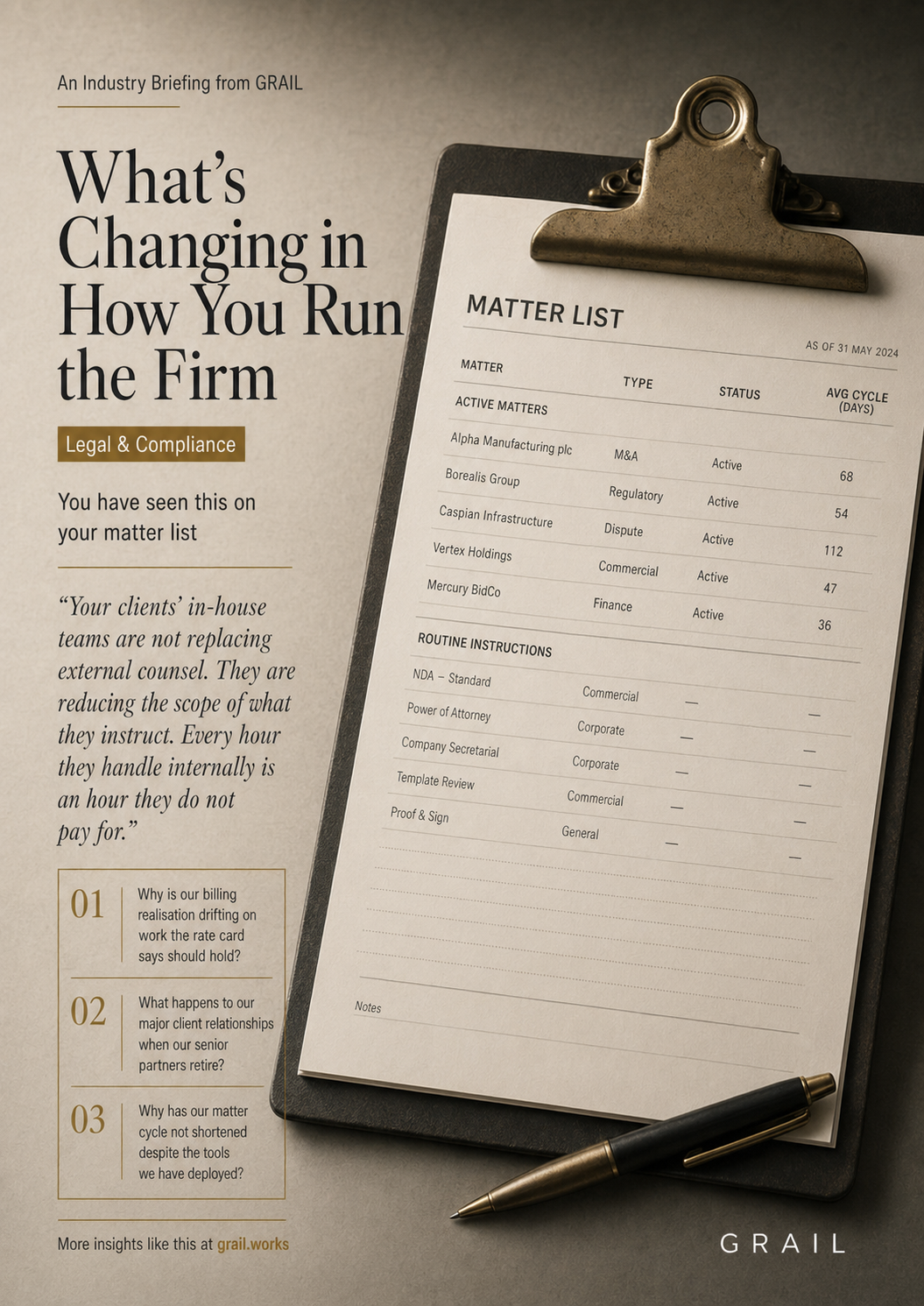
Why is billing realisation drifting on work the rate card says should hold?
The rate card has not moved. Utilisation is within target. But realisation on routine compliance and research-heavy matters is down year-on-year. Your clients are comparing your quotes against what their in-house AI tools now produce. The pricing model is the question, not the rate.
What happens to our major client relationships when senior partners retire?
Four to eight of your most senior fee earners are within five years of retirement. Each carries client-specific knowledge that took fifteen to twenty years to build and has never been written down. When they leave, one of their major retainers goes to tender. You already know which conversations are on your calendar.
Why has our matter cycle not shortened despite the tools we have deployed?
A standard regulatory compliance review takes ten to fourteen weeks. Half of that elapsed time is research, document review, and compliance cross-checking that AI-assisted delivery now compresses to days. The firms rebuilding around this close the same matter in six to eight weeks, multiplying their senior capacity without hiring.
11 pages. Three chapters. One architecture.
What the briefing delivers, chapter by chapter. Each section is written for the operations leader who runs the delivery engine, not for the fee earner at the front of it.
Your industry, your function, and why they are one problem
Pages 3, 4, and 5. Your sector is compressing from two directions simultaneously: AI tools cut your delivery cost while the same tools make your clients more capable in-house. Inside your delivery function, the same shift is playing out across your matter pipeline, your fee-earner bench, and your senior partner succession calendar. The briefing shows why these are not two problems and why the COO is the only person in the firm who can see the intersection before the partners and the CFO do.
Four moves across matter delivery, quality, bench, and client continuity
Page 8. Four concrete moves calibrated for the legal and compliance operations function. Decompose matter types to the task level and reprice around what still commands your rate card. Extract senior fee-earner judgment from the matters they are already running. Redesign the associate pathway around judgment and client work from the start. Treat every major client relationship as an institutional asset under active construction. One move per sub-function. Each addressable this quarter.
Five questions for your next operations review
Page 11. Five questions your operations team cannot answer without honest conversation. The ones where the team cannot agree are the ones worth an hour on the agenda. Covers billing realisation variance, partner succession readiness, senior fee-earner time allocation, what the firm has built that is measurably better than last quarter, and which associates are already working the way the rest of the bench will need to work by 2028.
Calibrated for each seat at the table.