Revenue.
Margin.
Valuation.
Three numbers your board reads. AI is rewriting all three in your industry.
This briefing tells you where revenue, margin, and valuation move in pharma sales as AI rewrites the industry. Read it before your competitors decide what your next decade looks like.
The 10-page briefing. Worth 20 minutes.
One email. One PDF. Worth twenty minutes of your week.
We send it once. Work emails only.
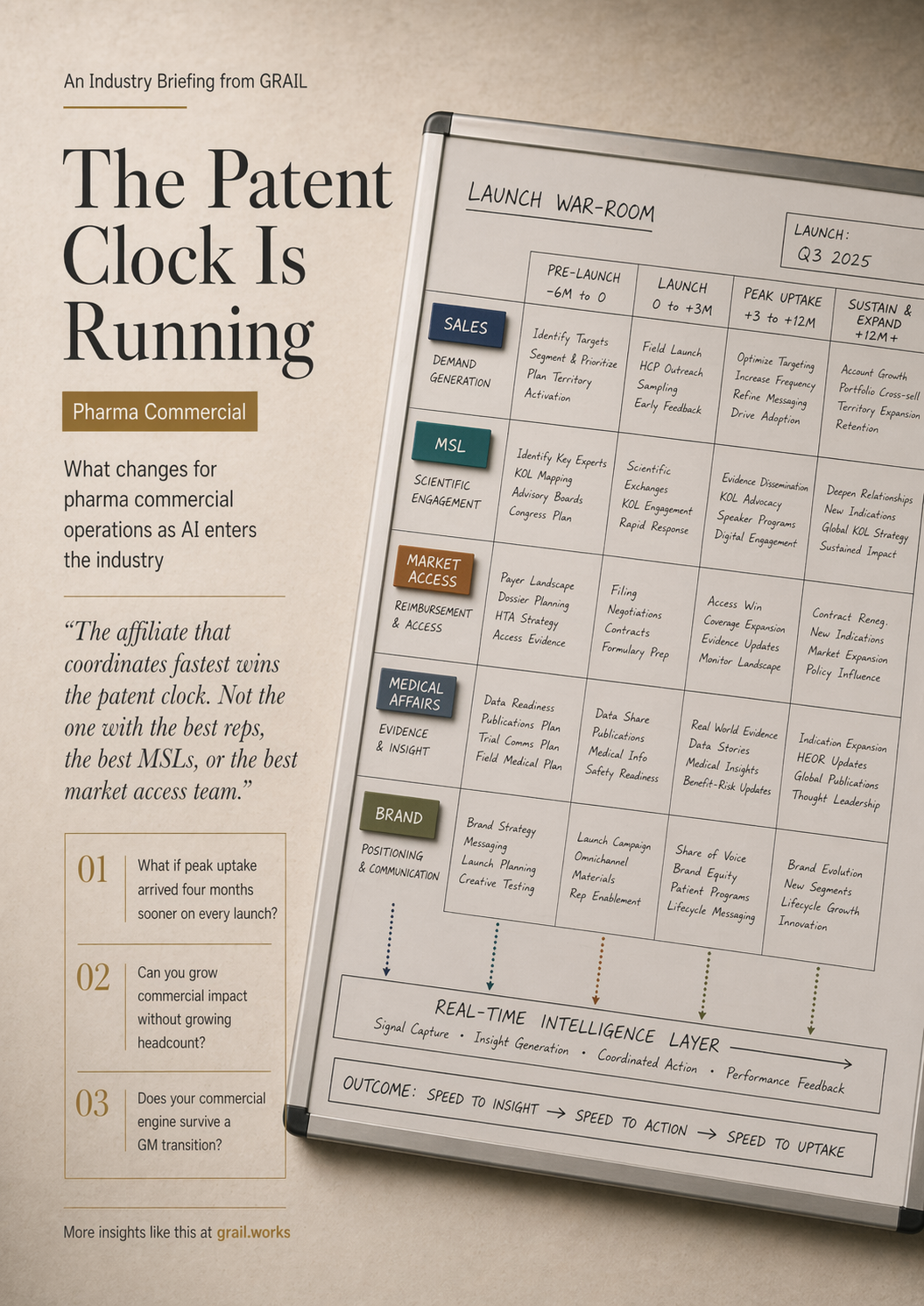
Pharmaceutical affiliates have optimized each commercial function to a high standard. Market access wins reimbursement decisions. Medical affairs builds scientific credibility. The field force executes call plans. Public affairs manages the regulatory landscape. Each function performs well on its own KPIs. The uptake curve, the metric that actually determines how much gross profit a molecule captures under the patent clock, tells a different story.
The affiliate that coordinates fastest wins the patent clock. Not the one with the best reps or the best MSLs. The one where intelligence moves between all five functions in real time.
An MSL hears in a hospital corridor that a regional formulary committee is reconsidering inclusion criteria. That signal takes days to reach market access, weeks to change field force priorities. By then, the window may have closed. This is not a coordination problem fixable with better meetings. It is an information metabolism problem. The organization digests signals too slowly relative to the speed at which the competitive and regulatory landscape moves.
For the GM of a pharma affiliate, this is not a technology question. It is a revenue question, a profit question, and a valuation question.
Revenue. Profit. Valuation.
Three lenses. Three answers the management team needs before the next portfolio review.
Revenue
Every month of delayed peak uptake on a 50M SEK product is millions in gross profit that never returns. For an affiliate running three to five active launches, compressing the uptake curve by four months recovers an estimated 40 to 80M SEK across the pipeline. The revenue question is not whether AI helps. It is how many months of peak uptake the current coordination speed is costing you.
Profit
An MSL who spends three hours preparing for a KOL meeting could spend thirty minutes with AI-augmented preparation and invest the remaining time in a second meeting. The same capacity, doubled in effective output. When preparation, monitoring, and documentation run on AI, the cost structure shifts. The same team covers more ground at higher quality without adding headcount.
Valuation
When the cross-functional intelligence lives in the GM's head and the relationships of three senior directors, the organization is fragile. Institutional coordination infrastructure that routes signals regardless of who sits in the chair is worth more than personal networks. The valuation question is whether the commercial capability is personal or structural.
What you'll get when you download
A 10-page report for pharmaceutical commercial leaders. Designed to be read in one sitting before your next portfolio review.
The strategic choice, side by side
The default path (adopt vendor AI per function, optimize existing KPIs, wait for global playbook) and the repositioning path (build cross-functional intelligence, measure coordination velocity, lead locally). With the financial logic of each under the patent clock.
The four levers that compound
Build cross-functional signal routing. Augment the intelligence layer across all five functions. Treat uptake acceleration as the strategic north star. Build unified stakeholder intelligence that compounds with every interaction.
Five questions for your next leadership meeting
Diagnostic questions the GM should test the leadership team against before the next portfolio review. The questions where the room cannot agree are the ones worth a longer conversation.
Calibrated for each seat at the table.