Revenue.
Margin.
Valuation.
Three numbers your board reads. AI is rewriting all three in your industry.
This briefing tells you where revenue, margin, and valuation move in professional services as AI rewrites the industry. Read it before your competitors decide what your next decade looks like.
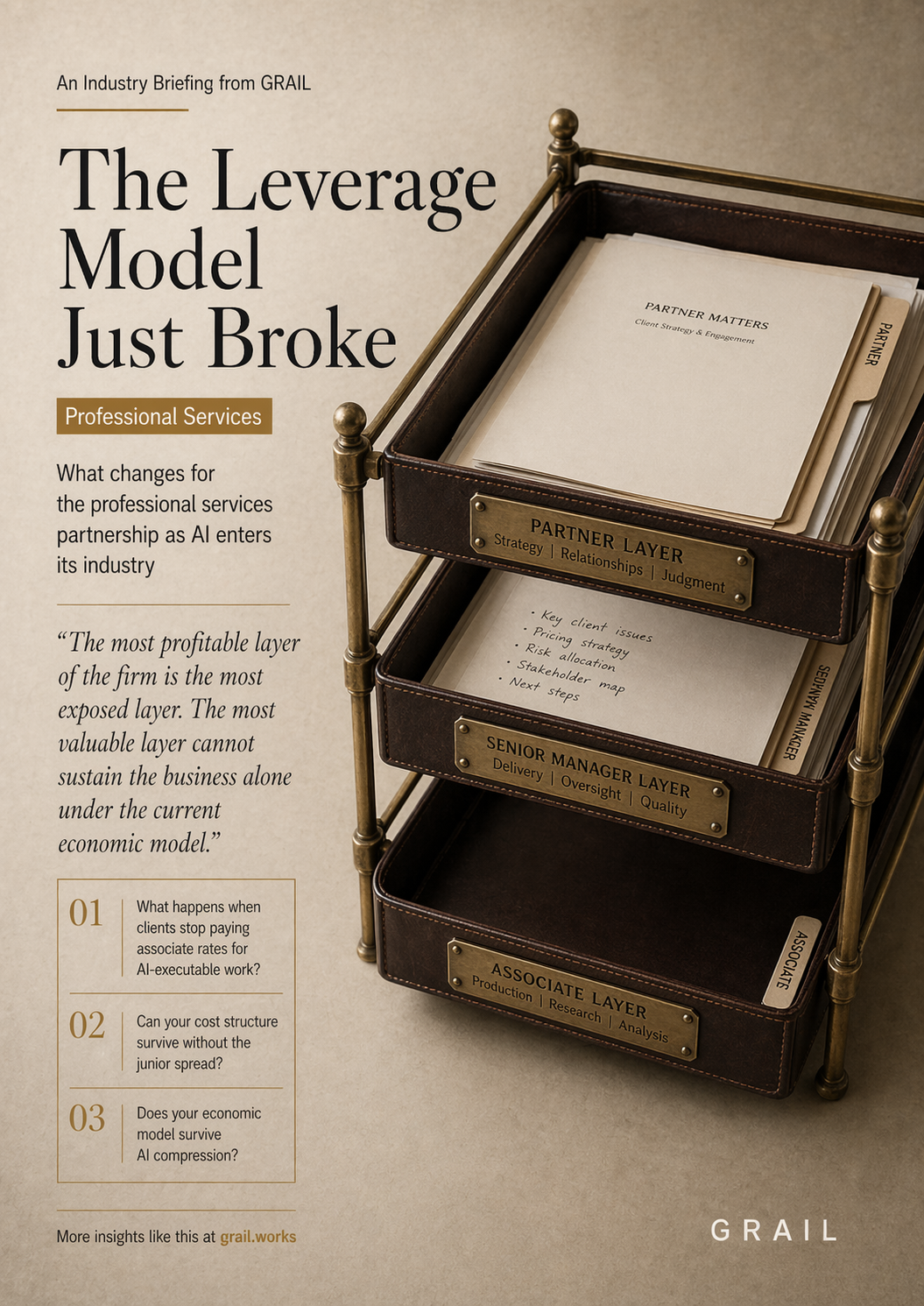
The 10-page briefing. Worth 20 minutes.
One email. One PDF. Worth twenty minutes of your week.
We send it once. Work emails only.
Professional services built its profitability on a single structural advantage: bill clients at partner rates, deliver through junior production staff at a fraction of the cost, pocket the spread. Margins of 25 to 40 percent for well-run firms. The model has worked for fifty years because junior production was genuinely necessary. Research, analysis, document drafting, compliance checks, reporting. Real work that required real people.
The layer that generates most of your revenue is the layer most exposed to AI. The layer that carries the most value cannot sustain the business alone under the current economic model.
AI changes the math. Not incrementally. Structurally. The production layer that generates 50 to 70 percent of billable revenue is now compressible. And the consequences extend beyond cost: if juniors are not doing production work, the apprenticeship model that produces future partners breaks. The firm that restructures around separating intelligence from judgment wins. The firm that defends the pyramid loses.
For the managing partner, this is not a technology question. It is a revenue question, a profit question, and a valuation question.
Revenue. Profit. Valuation.
Three lenses. Three answers the partnership needs before the next board meeting.
Revenue
Clients are already asking why they are paying associate rates for work that AI can perform. 73% prefer outcome-based pricing. Firms retaining time-based pricing grew 2.1% annually. Value-based adopters grew 8.7%. The pricing transformation is not optional. Clients are forcing it. The question is whether you lead the change or get repriced on worse terms.
Profit
Current partner compensation, office infrastructure, and support costs were designed for a business where junior hours carried the commercial weight. Industry EBITDA is at a five-year low of 9.8%. Utilization sits at 68.9%. The junior spread that funded the partnership is compressing. The senior layer was never designed to carry the full commercial load alone.
Valuation
Partnership equity or enterprise value for PE-backed firms depends on whether the firm can demonstrate a sustainable economic model post-AI. Firms that restructure around judgment pricing trade at premium multiples. Firms defending the pyramid trade at a discount. The same revenue, at very different valuations, depending on one architectural choice.
What you'll get when you download
A 10-page report for professional services managing partners and leadership teams. Designed to be read in one sitting before your next partnership meeting.
The strategic choice, side by side
The default path (add AI tools, keep blended billing, defend the pyramid) and the repositioning path (separate intelligence from judgment, price the judgment explicitly, redesign the apprenticeship model), with the financial logic of each laid out in a comparison table.
The four levers that compound
Separate intelligence from judgment in your delivery model. Redesign the apprenticeship for the AI era. Move first on transparent human-plus-AI pricing. Build institutional knowledge systems that survive partner transitions. Four principles that are modest alone but compound together.
Five questions for your next partnership meeting
Diagnostic questions the managing partner should test the leadership team against. The questions where the partners cannot agree are the ones worth a longer conversation. Designed to surface the real tensions before a major client forces them.
Calibrated for each seat at the table.