Margin.
Pace.
Position.
The whole GTM playbook is being rewritten in real time, across every commercial team at once.
This briefing tells you how the GTM playbook gets rewritten in specialist methodology firms as AI compresses every commercial team. Read it before your competitors hit their first AI-native quarter.
The 10-page briefing. Worth 20 minutes.
One email. One PDF. Worth twenty minutes of your week.
We send it once. Work emails only.
Every commercial director at a mid-market European methodology firm has had the same week. Your head of certification reported Q1 seat counts down 8% year-over-year. A long-time client, the one who put three cohorts through your master-trainer programme, emailed Friday asking for a 60-day engagement at €85K. Her L&D team built an internal facilitator group on your framework. Your founder-CEO forwarded you a Forbes piece about a boutique whose revenue per practitioner doubled after it repositioned to senior diagnostic advisory.
You have done this job for fifteen years. The pattern used to be simple. Build a great methodology. Train practitioners to deploy it. Certify client teams so they come back for the next wave. Margins held at 25 to 35 percent. The moat was that the methodology was genuinely better than alternatives, and accessing it required engaging your firm. Both pillars held for decades. Something changed.
Every methodology-firm commercial director is living one industry shift and one firm shift at the same time. Most are treating them as two. The ones who see them as one will own the next decade.
Same framework. Same twelve months. Opposite outcomes. The difference is the operator, not the AI.
Your founder-CEO is already asking what a firm-wide answer looks like. The briefing below is what you want in your hand before that conversation.
Advisory Premium. Practitioner Leverage. Renewal and Expansion.
Three questions every methodology-firm commercial director is tracking. None of them used to be the same question. They are now.
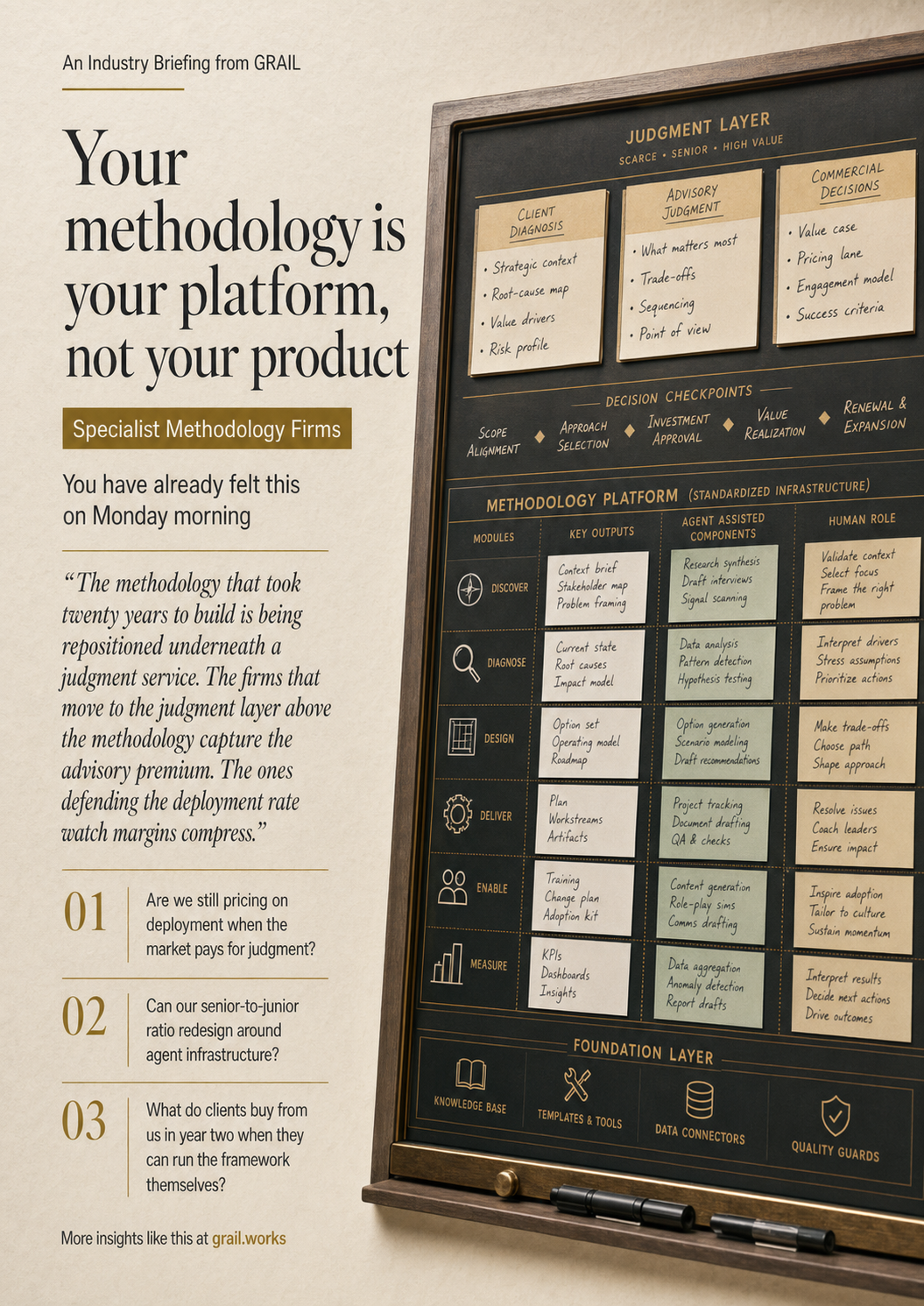
Are we still pricing on deployment when the market pays for judgment?
Your senior practitioners are booked six months out on diagnostic and advisory work. The margin on that work is double what deployment carries. A listed firm you know saw EBITA margin slide from 13 to 10.2 percent in one year because the mix stayed on deployment pricing. Moving senior work to the judgment rate is the defensive argument. It also funds everything else.
Can our senior-to-junior ratio redesign around agent infrastructure?
Your senior practitioners carry the judgment work. Your juniors carry standard deployment. AI takes hours out of the junior layer. The old leverage ratio does not hold. The firms pulling ahead are redesigning the ratio: fewer junior practitioner days per senior, agent ensembles carrying the compressible deployment, senior capacity redirected to judgment.
What do clients buy in year two when they can run the framework themselves?
60 to 70 percent of profitable revenue comes from existing clients. The dependency that drove renewal is weakening. Clients who went through two deployments can now run the framework internally. The answer is senior judgment on problems the framework has not seen before, delivered with agent tooling the client keeps.
What you get when you download
An 11-page briefing for commercial leaders at mid-market specialist methodology firms. Designed to be read in one sitting before your next leadership meeting.
Your industry, your function, and why they are one problem
What is happening in specialist methodology firms as a sector. What is happening in your pitches, your certification programme, your renewals, and across your senior practitioners right now. And the intersection most commercial directors have not named yet. Plain language you can use at the next board meeting.
Four moves across pricing, senior amplification, deployment, and pattern graph
How to move 30 percent of senior-practitioner work to the judgment rate. How to equip every senior with a custom agent ensemble. How to ship client-deployed agent tooling with every engagement. How to capture twenty years of engagement history as firm infrastructure.
Five questions for your next leadership meeting
Ten deployment mandates that came back smaller. The percentage of senior time billed at the judgment rate. The pattern recognition your top three seniors carry in their heads. The engagements that would have closed at a higher rate with a senior diagnostic upstream. Ask these honestly.
Calibrated for each seat at the table.