Moat.
Speed.
Allocation.
The platform moat that survives 2028 is being chosen this year.
This briefing tells you which platform moats survive 2028 in asset management as AI rewrites build economics. Read it before your R&D allocation locks for the decade.
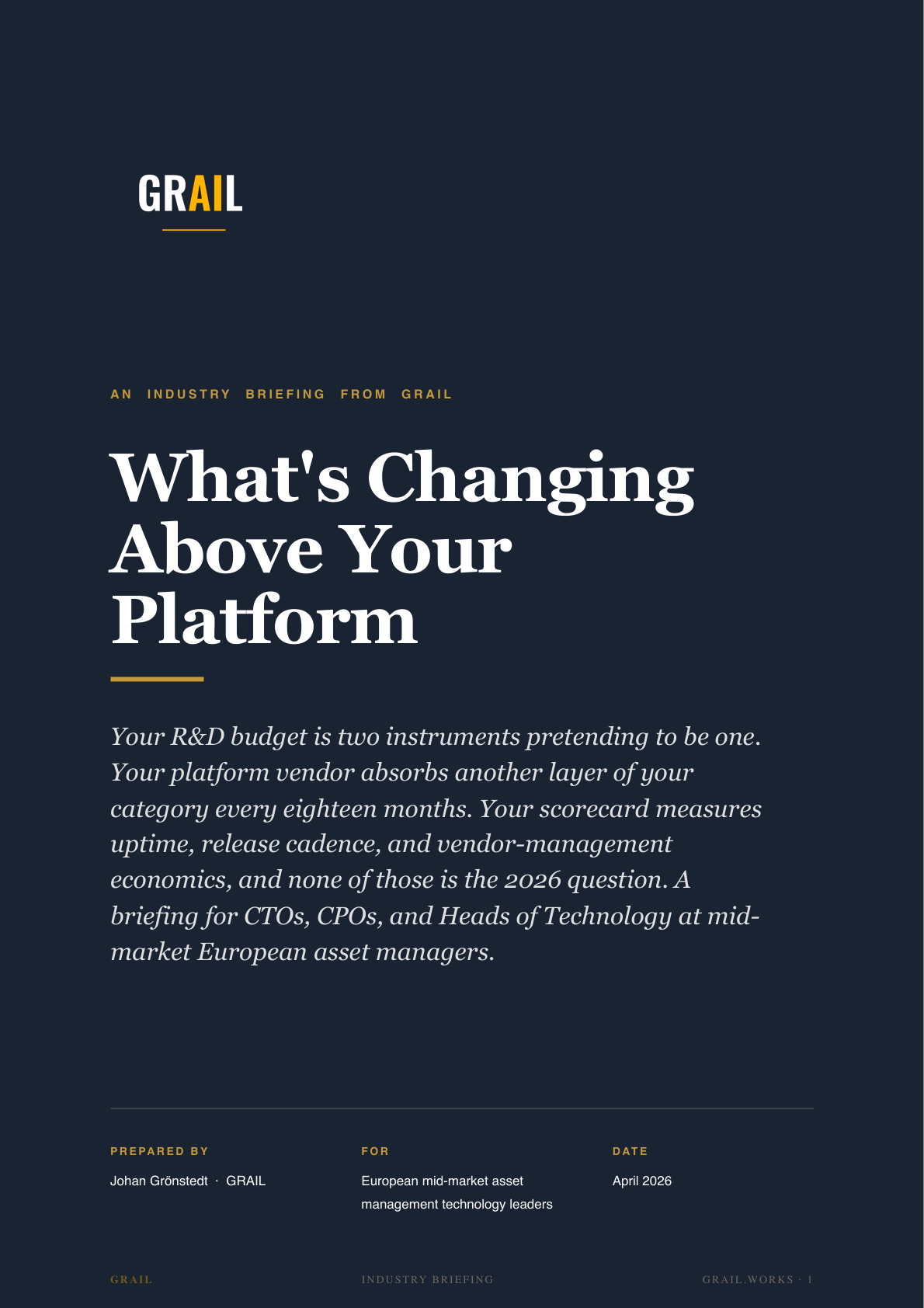
The 10-page briefing. Worth 20 minutes.
One email. One PDF. Worth twenty minutes of your week.
We send it once. Work emails only.
Monday 9:15, platform review. Your Head of Platform opens with the Aladdin renewal slide: three-year commitment, fourteen percent uplift, three new Studio modules positioned as the AI answer. Your phone buzzes. Your Head of Research Engineering is in a Canary Wharf coffee shop with a recruiter from an AHL-adjacent London quant fund. Your CFO forwarded the FundLP screening report: three of the five allocators on next quarter's target list subscribe to it. Your CIO wants to talk about whether you should just buy SimCorp One and be done.
You are not running one R&D function. You are running two, and only one is on your scorecard. One funds the platform maintenance book that keeps the lights on and the regulator off your back. The other funds the thin layer above Aladdin, SimCorp, or SS&C that absorbs your PMs' and analysts' judgment into institutional signal before the vendor absorbs the category from underneath.
The moat that matters in 2028 is not inside your Aladdin tenant. It is the thin layer you build above it.
This is the question your CEO is already asking. The briefing below is what you want in your hand before the next platform review.
Build Velocity. Product Defensibility. R&D Capital Allocation.
Three questions every asset management CTO is tracking. The second is the crux. The first and third are how you earn the right to answer it.
Is our platform capacity shipping differentiation, or absorbing vendor releases?
DORA pipeline ate a quarter of the platform budget. MiFID reporting is a permanent tax. Aladdin absorbed three capabilities last release you had built in-house. Five platform engineers now run what fifty used to, but only if the capacity gets redirected above the platform line.
What does our firm do that Aladdin cannot absorb in two releases?
Every feature you ship inside Studio becomes an Aladdin feature in eighteen months. The thin layer above, anchored in your PMs' and analysts' specific judgment absorbed into structured signal, is the only thing the vendor cannot build because they do not have the signal source.
Is our R&D budget one instrument or two?
One funds platform licences, DORA, MiFID, custody, data feeds. The other builds the thin layer above. On one hurdle rate the first wins every quarter. On one scorecard the second does not exist. The CTO who walks in with one budget runs the same programme every peer is running.
What you get when you download
An 11-page report for CTOs, CPOs, and Heads of Technology at mid-market European asset managers. Designed to be read in one sitting before your next platform review.
Your industry, your technology function, and why they are one problem
What is happening to mid-market active asset management: platform vendor absorption, the feature layer commoditising every eighteen months, and LP DDQ screening that did not exist in 2023. What is happening inside your technology function: DORA and MiFID as permanent tax, vendor releases absorbing your in-house build, and the board AI-strategy ownership list your seat is not on. And the intersection: same force, two altitudes, one problem.
Four moves across build engine, platform and data, product thesis, and R&D bench
Run a quarterly kill-list review on what the vendor absorbed. Build the thin institutional-signal layer above the platform through data rights, a model-agnostic signal store, and proprietary integration depth. Publish LP-DDQ-ready process documentation as a capital-raising asset. Rebuild the junior pathway through quant-and-platform pairing from day one.
Five questions for your next platform review
Is your R&D budget one instrument or two, and what is the kill criterion on each? Name the three capabilities Aladdin, SimCorp, or SS&C absorbed in the last four releases. If your lead PM took six months off tomorrow, how much thesis-construction judgment would the firm retain in structured form? Where is your DORA and MiFID capacity actually being spent? Is your Q1 boundary agreement with the CIO and CFO written?
Calibrated for each seat at the table.