Cheaper.
Better.
Faster.
The triple threat that used to be a tradeoff is now table stakes.
This briefing tells you where the triple threat lands in B2B SaaS and tech operations as AI rewrites the cost structure. Read it before your competitors decide who is table stakes.
The 10-page briefing. Worth 20 minutes.
One email. One PDF. Worth twenty minutes of your week.
We send it once. Work emails only.
Every Chief Operating Officer or Head of Customer Success at a mid-market B2B SaaS firm has had the same Monday morning. Three post-sale reviews this week. A mid-market CRM rollout, go-live slipped twice because the customer's data has not landed again. A seven-figure expansion where the customer asked a configuration question in Friday's call that nobody on your side could answer without pulling three people into a Slack huddle. Your ten-year senior CSM resigned Friday. She carried six accounts up for renewal in Q3. You know the status of two.
You have run this function for three years. The pattern used to be simple. Hire good CSMs. Build playbooks. Hold gross retention. Keep NRR moving. Something changed.
This is not a you problem. It is an industry problem and a post-sale-engine problem, happening at the same time. Most SaaS COOs are treating them as two. The ones who see them as one are going to own the next decade of European mid-market SaaS.
Can you name one thing about your top ten customers that you know better this quarter than last quarter?
Your CEO is already asking this. The briefing below is what you want in your hand before the next operations review.
Unit Economics. Customer Outcomes. Time-to-Value.
Three questions every SaaS COO is tracking. None of them used to be the same question. They are now.
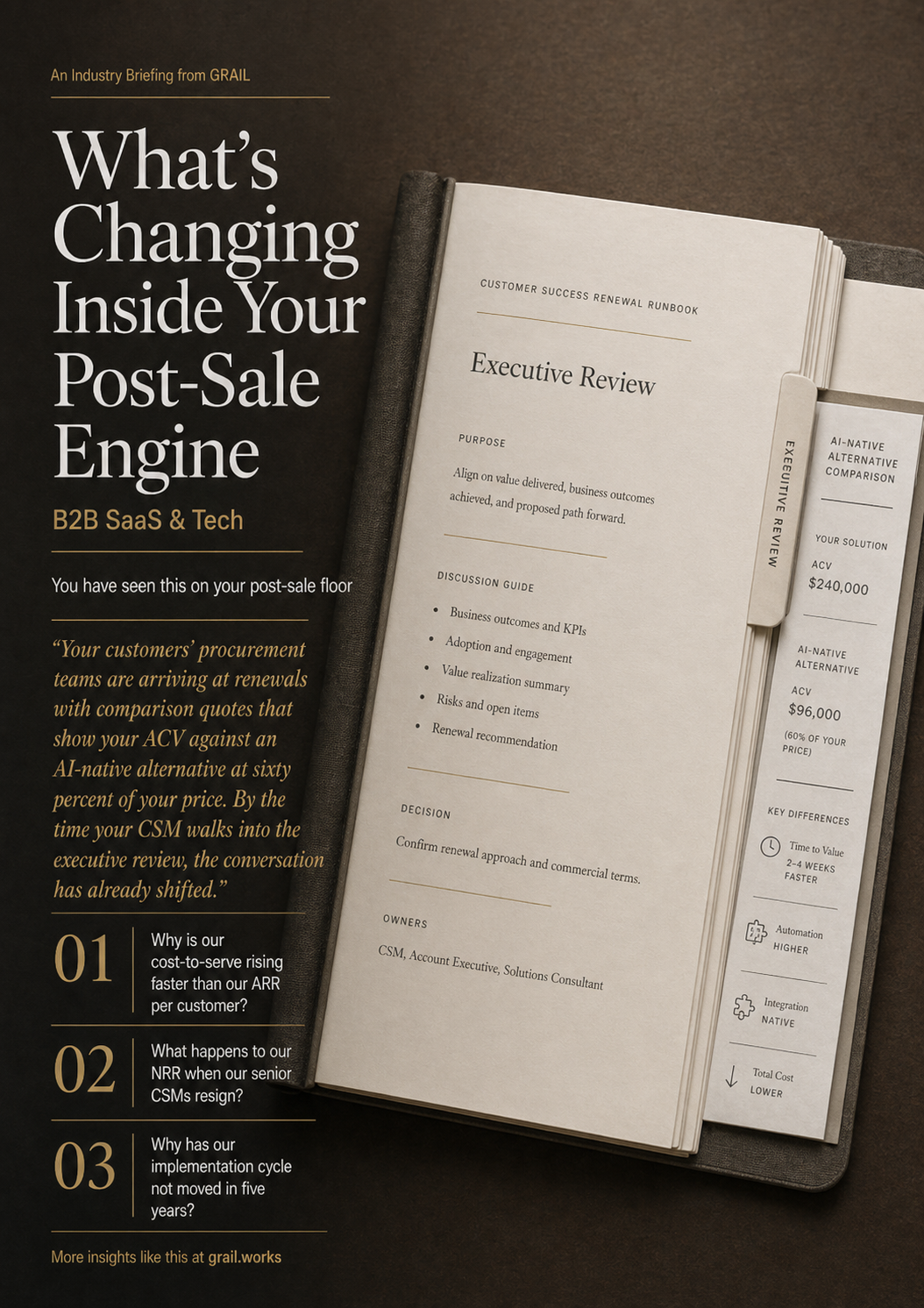
Why is our cost-to-serve rising faster than our ARR per customer?
The ACV has not moved. Headcount is within plan. But cost per ARR dollar on CS, implementation, and support is up quarter over quarter, and AI-native entrants are quoting the same customer at a materially lower implementation cost.
What happens to our NRR when our senior CSMs resign?
Four to ten of your most senior CSMs are within eighteen months of their next role. Each one carries customer-specific context that took four to ten years to build and has never been written down. The next renewal slips before the dashboard changes colour.
Why has our implementation cycle not moved in five years?
A mid-market implementation takes twelve to sixteen weeks on a standard rollout. Roughly half is requirements gathering, configuration mapping, data migration, and standard integration work that now compresses to hours not weeks. The firms that rebuild delivery around this close the same implementation in four to six.
What you get when you download
An 11-page report for Chief Operating Officers and Heads of Customer Success at mid-market B2B SaaS firms. Designed to be read in one sitting before your next operations review.
Your industry, your operations, and why they are one problem
What is happening in mid-market SaaS as a sector. What is happening inside your implementation engine, your customer success function, your support operation, your senior CSMs, and your customer continuity right now. And the intersection most COOs have not named yet: you do not have three problems, you have one.
Four moves across implementation, CS, bench, and continuity
Decompose every implementation template to the task level and build configuration agents around the tasks that still make money. Extract CSM judgment as a side-effect of daily work. Redesign the junior CSM pathway around judgment from day one. Institutionalise the customer relationship so it transfers on architecture, not biography.
Five questions for your next operations review
The NRR-by-cohort question. The senior-CSM hours question. The resignation-exposure question. The measurably-smarter question. The junior-of-2027 question. Where your operations team cannot agree on the answer is the conversation worth an hour on the agenda.
Calibrated for each seat at the table.