Capacity.
Capability.
Promise.
The biggest talent transition of a career. Compete on capacity, not headcount.
This briefing tells you what the talent transition looks like in engineering and technical consulting as AI rewrites the firm-worker promise. Read it before someone else writes it for you.
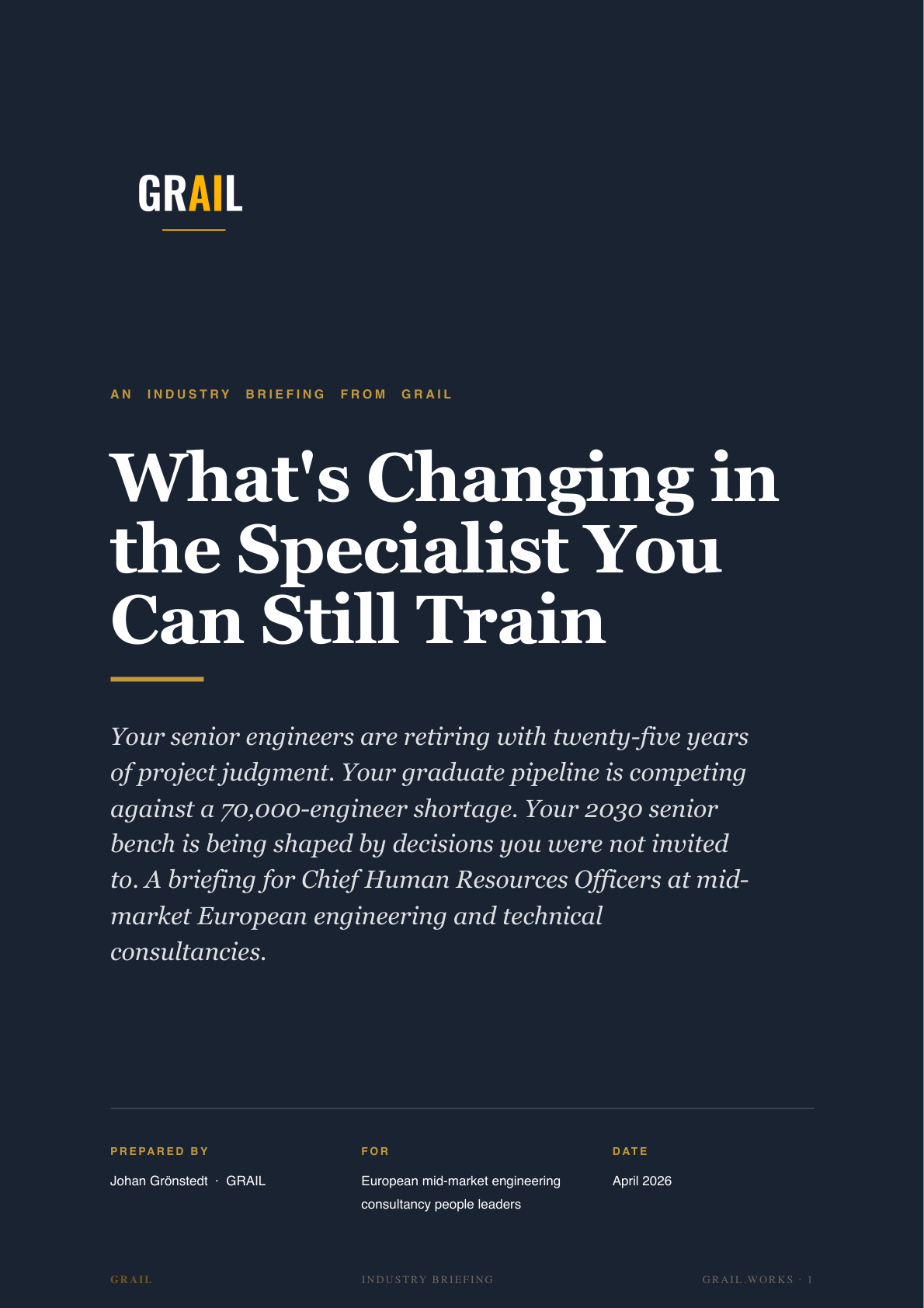
The 10-page briefing. Worth 20 minutes.
One email. One PDF. Worth twenty minutes of your week.
We send it once. Work emails only.
Every CHRO at a mid-market European engineering consultancy has had the same Monday, 9:14 a.m. Three things in the inbox. Your Head of Talent forwarded Friday's resignation from your best mid-level structural engineer in Stockholm. He went to an AI-native engineering startup. Your Norway country CEO copied you on a retirement notice from two senior engineers in the Oslo office. Between them, fifty-six years of project judgment. Your CFO attached the Mercer thriving report to the GMT calendar invite with a single-line note.
You do not have a people problem. You have an authorship problem. Your firm's workforce strategy is being written every week in decisions you were not invited to. The question is not whether to have one. It is whose handwriting the one you already have is in.
Your workforce strategy is being written every week in decisions you were not invited to. Your senior engineers read the handwriting last month.
This is the question your CEO is already asking. The briefing below is what you want in your hand before the next GMT.
Talent Gravity. Capability Compounding. Succession Readiness.
Three questions every CHRO is tracking. None of them used to be the same question. They are now.
Are your senior engineers staying because of you, or despite you?
Your best mid-level engineer resigned on Friday to an AI-native engineering startup. Your best lateral hire last quarter came from a tech firm. A-players watch which way you lean the first time something goes wrong. The ones who start looking quietly have already decided.
Is the median engineer sharper in December than they were in January?
The top decile is using AI daily on tender preparation, BIM modelling, and design iteration, building judgment that compounds weekly. The rest is doing what they did in 2022. Your L&D budget funds compliance modules and certifications. Neither moves the median.
Of your 2030 senior bench, how many came through work that still exists?
At least three of the six names came through routine drawing and calculation work agents have absorbed. Two of the seniors above them carry twenty-five years of project judgment that has not been encoded into firm infrastructure.
What you get when you download
An 11-page report for Chief Human Resources Officers at mid-market European engineering and technical consultancies. Designed to be read in one sitting before your next GMT.
Your industry, your people function, and why they are one problem
The forty-year tech-wave pattern just broke. Routine production work compressing through 2024 and 2025. Senior engineers reading every deployment as a signal. The works council opening consultations on country-level shadow AI. The intersection most CHROs have not named yet: you do not have two problems, you have one.
Four moves across talent, L&D, succession, and trust
Publish the memo the CEO co-signs in your first 100 days. Ship one engineering role redesigned as a triad unit, senior, graduate, and agent ensemble as one delivery unit. Encode the retiring senior's project judgment before the window closes. Publish three rules, one escalation, one red line for what your engineers can do with AI without asking.
Five questions for your next GMT
What your three best engineers would say privately about whether the firm's AI strategy is being done for them or to them. The role redesigned at task level in the last twelve months. The 2030 senior bench and which pathways still exist. The retiring senior engineers paired with named successors. The deployment fragments you authored versus decoded.
Calibrated for each seat at the table.