Cheaper.
Better.
Faster.
The triple threat that used to be a tradeoff is now table stakes.
This briefing tells you where the triple threat lands in engineering and technical consulting operations as AI rewrites the cost structure. Read it before your competitors decide who is table stakes.
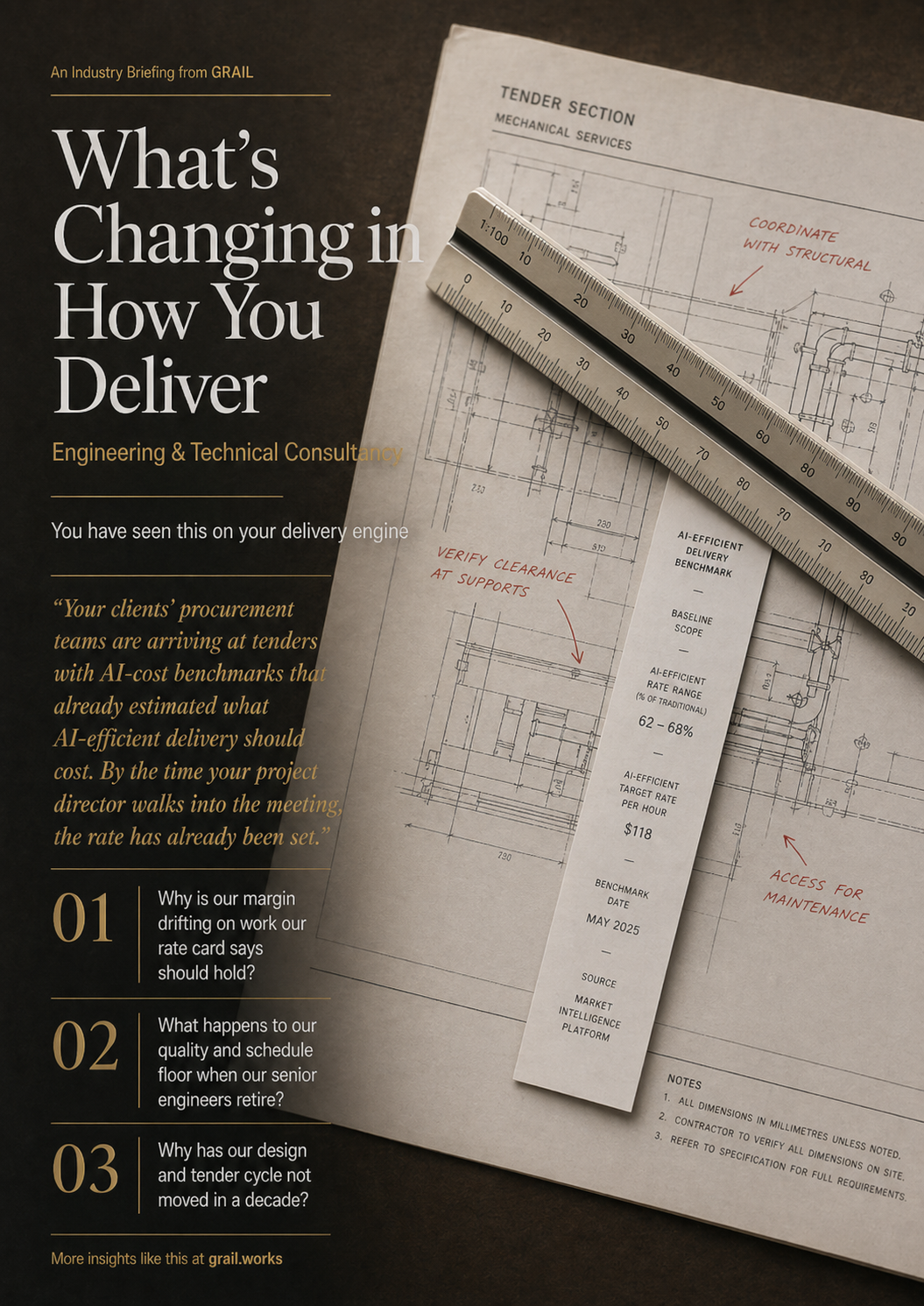
The 10-page briefing. Worth 20 minutes.
One email. One PDF. Worth twenty minutes of your week.
We send it once. Work emails only.
Every Chief Operating Officer or Head of Delivery at a mid-sized engineering consultancy has had the same Monday morning. Three project reviews this week. Henrik is the only one who can run the peer review on the rail infrastructure upgrade, and Henrik has been at a client in Stuttgart. A mid-tier engineer spent eighteen hours last week on code-compliance cross-checks and standard calculation runs AI-assisted tooling could have produced in three. The senior who has carried your twenty-year bridge maintenance framework agreement since 2008 scheduled thirty minutes with you for Thursday. The subject line says succession.
You have run this function for fifteen years. The pattern used to be simple. Hire the best structural, civil, and MEP engineers. Protect the quality floor. Hold utilisation at the number. Something changed.
This is not a you problem. It is an industry problem and a delivery-engine problem, happening at the same time. Most engineering COOs are treating them as two. The ones who see them as one are going to own the next decade of European engineering consulting.
Can you point to one thing in your delivery engine that is measurably smarter this quarter than last quarter?
Your CEO is already asking this. The briefing below is what you want in your hand before the next operations review.
Project Margin. Delivery Certainty. Cycle Time.
Three questions every engineering COO is tracking. None of them used to be the same question. They are now.
Why is our margin drifting on work our rate card says should hold?
The rate card has not moved. Utilisation is within target. But realisation on your mid-tier book is down three to six points against two years ago. AI-assisted design tools are delivering the calculation, compliance, and drawing work that justified the mid-tier rate.
What happens to our quality and schedule floor when our senior engineers retire?
Fifteen to forty of your most senior engineers are within six years of retirement. Each one carries project-specific judgment that took twenty-five years to build and has never been written down. The floor drops before the client notices, and the framework agreement goes to tender the quarter after.
Why has our design and tender cycle not moved in a decade?
A standard structural or MEP design phase takes ten to fourteen weeks on a mid-complexity project. Roughly half of that elapsed time is drawing production, code-compliance cross-check, and iteration that now compresses to hours not weeks. The firms that rebuild delivery around this close the same phase in five to eight.
What you get when you download
An 11-page report for Chief Operating Officers and Heads of Delivery at mid-market European engineering consultancies. Designed to be read in one sitting before your next operations review.
Your industry, your operations, and why they are one problem
What is happening in engineering consulting as a sector. What is happening inside your delivery engine, your engineer bench, your senior engineers, and your framework agreements right now. And the intersection most COOs have not named yet: you do not have three problems, you have one.
Four moves across delivery, quality, bench, and continuity
Decompose every engagement to the task level and price around the tasks that still make money. Extract senior judgment as a side-effect of daily work. Redesign the graduate pathway around composite work from day one. Institutionalise the framework agreement so it transfers on architecture, not biography.
Five questions for your next operations review
The realisation question. The senior-engineer hours question. The retirement-exposure question. The measurably-smarter question. The mid-tier-of-2027 question. Where your operations team cannot agree on the answer is the conversation worth an hour on the agenda.
Calibrated for each seat at the table.