Revenue.
Margin.
Valuation.
Three numbers your board reads. AI is rewriting all three in your industry.
This briefing tells you where revenue, margin, and valuation move in industrial automation as AI rewrites the industry. Read it before your competitors decide what your next decade looks like.
The 10-page briefing. Worth 20 minutes.
One email. One PDF. Worth twenty minutes of your week.
We send it once. Work emails only.
The mid-market industrial automation firm runs on a small number of load-bearing individuals. Every complex client relationship is held by a specific engineer who knows the legacy equipment, the undocumented workarounds, and the production environment at a level no one else can replicate. Those engineers are either retirement risks or acquisition targets for clients who would rather hire them than keep paying project fees.
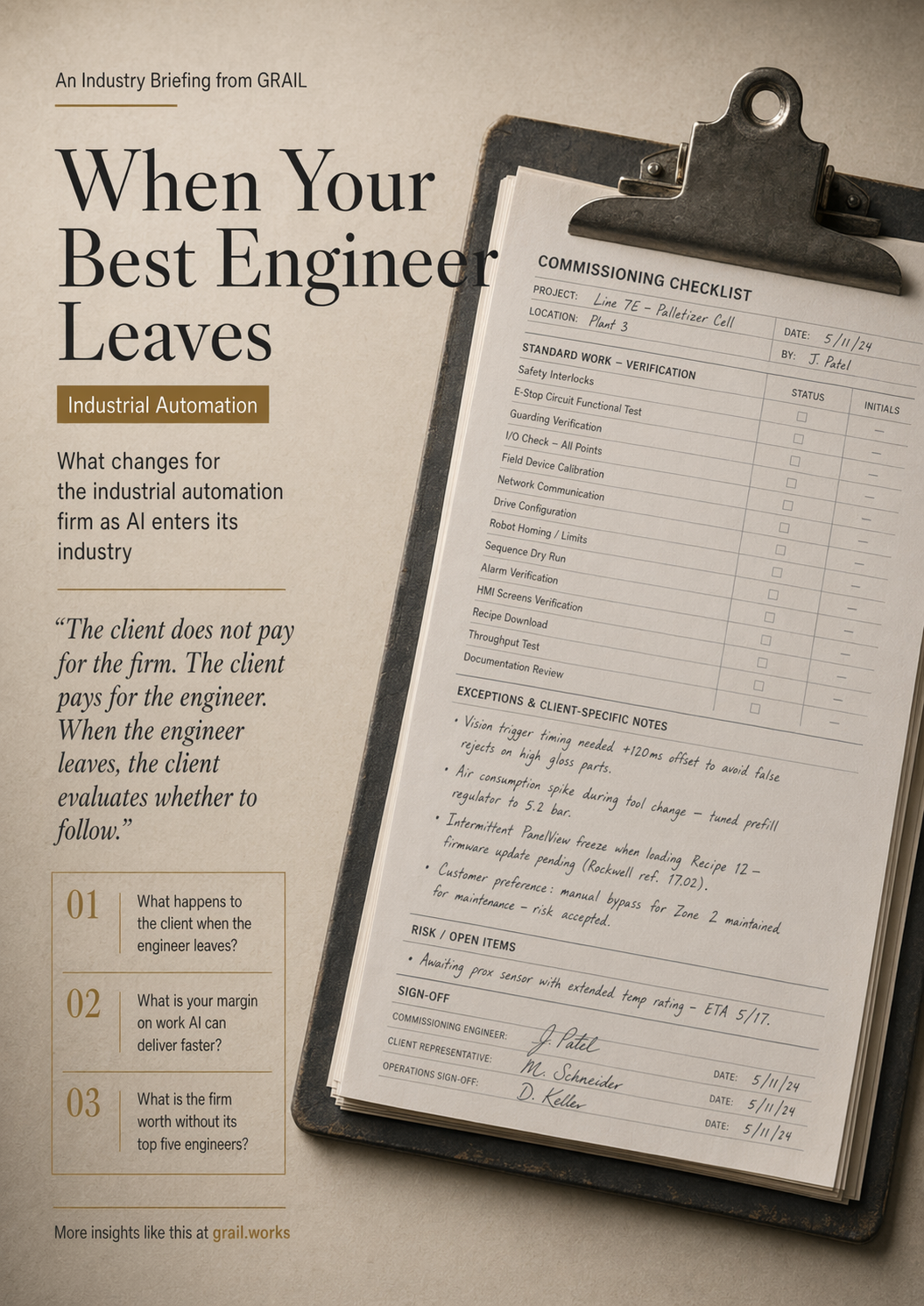
The client does not pay for the firm. The client pays for the engineer. When the engineer leaves, the client evaluates whether to follow.
AI is compressing the model from two directions. Standard automation work is accelerating by 30 to 50 percent through code generation and commissioning tools. Clients are forming new expectations about delivery timelines. The defensible work moves upmarket to complex integration. But that complex integration depends on the same five people who carry the irreplaceable knowledge.
For the CEO of an industrial automation firm, this is not a technology question. It is a revenue question, a profit question, and a valuation question.
Revenue. Profit. Valuation.
Three lenses. Three answers the management team needs before the next key engineer gives notice.
Revenue
Every key engineer departure is a client retention event. The client valued the individual, not the firm. When that engineer accepts an offer elsewhere, the client evaluates whether to follow them, bring the work in-house, or go to tender for the first time in a decade. The revenue at risk is 12 to 18 months of relationship rebuilding, if the client stays at all.
Profit
Standard PLC programming, documentation, and commissioning are compressing by 30 to 50 percent. Clients forming expectations around shorter timelines will not pay legacy rates for manual delivery. The firm still quoting twelve-week projects that AI-augmented competitors deliver in seven is losing bids or compressing margin on every standard engagement.
Valuation
A buyer or investor prices the firm on delivery capability that persists through personnel changes. Five irreplaceable engineers is a key-person discount. Institutional knowledge encoded into systems any team can access is a delivery capability premium. Same revenue, same client list, very different multiples depending on one architectural choice.
What you'll get when you download
A 10-page report for industrial automation CEOs and management teams. Designed to be read in one sitting before your next leadership meeting.
The strategic choice, side by side
The default path (buy AI tools, speed up standard work, hope senior engineers stay) and the repositioning path (encode client knowledge, build institutional delivery capability, shift revenue toward complex integration), with the financial logic of each.
The four levers that compound
Encode client-specific knowledge before departures force it. Compress standard delivery to match market expectations. Build systematic handoff protocols. Shift the revenue mix toward complex, high-margin integration where deep knowledge is the moat.
Five questions for your next leadership meeting
Diagnostic questions the CEO should test the management team against before the next key engineer transition. The questions where the room cannot agree are the ones worth a longer conversation.
Calibrated for each seat at the table.