Cheaper.
Better.
Faster.
The triple threat that used to be a tradeoff is now table stakes.
This briefing tells you where the triple threat lands in industrial automation operations as AI rewrites the cost structure. Read it before your competitors decide who is table stakes.
The 10-page briefing. Worth 20 minutes.
One email. One PDF. Worth twenty minutes of your week.
We send it once. Work emails only.
Every Head of Delivery or COO at a mid-sized European automation integrator has had the same Monday morning. Project review one: Marcus is the only engineer who understands the client's legacy PLC configuration from 2014, and Marcus is in Düsseldorf. Project review two: a mid-tier engineer spent forty-one hours last week on standard code generation and documentation that AI tools now handle in an afternoon. Project review three: a call from your Head of Sales. A long-term account just went to tender. The senior who held it for nine years accepted a promotion at the client last month.
You have run this delivery function for fifteen years. The pattern used to be clear. Hire the best PLC specialists. Protect the quality floor. Hold utilisation at the number. Something changed.
This is not a you problem. It is an industry problem and a delivery-function problem, happening at the same time. Most automation COOs are treating them as two. The ones who see them as one are going to own the next decade of European automation delivery.
Can you point to one thing in your firm that is measurably smarter this quarter than last quarter?
Your CEO is already asking this. The briefing below is what you want in your hand before the next operations review.
Margin per Deployment. Field-Service SLA. Ramp-to-Revenue.
Three questions every automation COO is tracking. None of them used to be the same question. They are now.
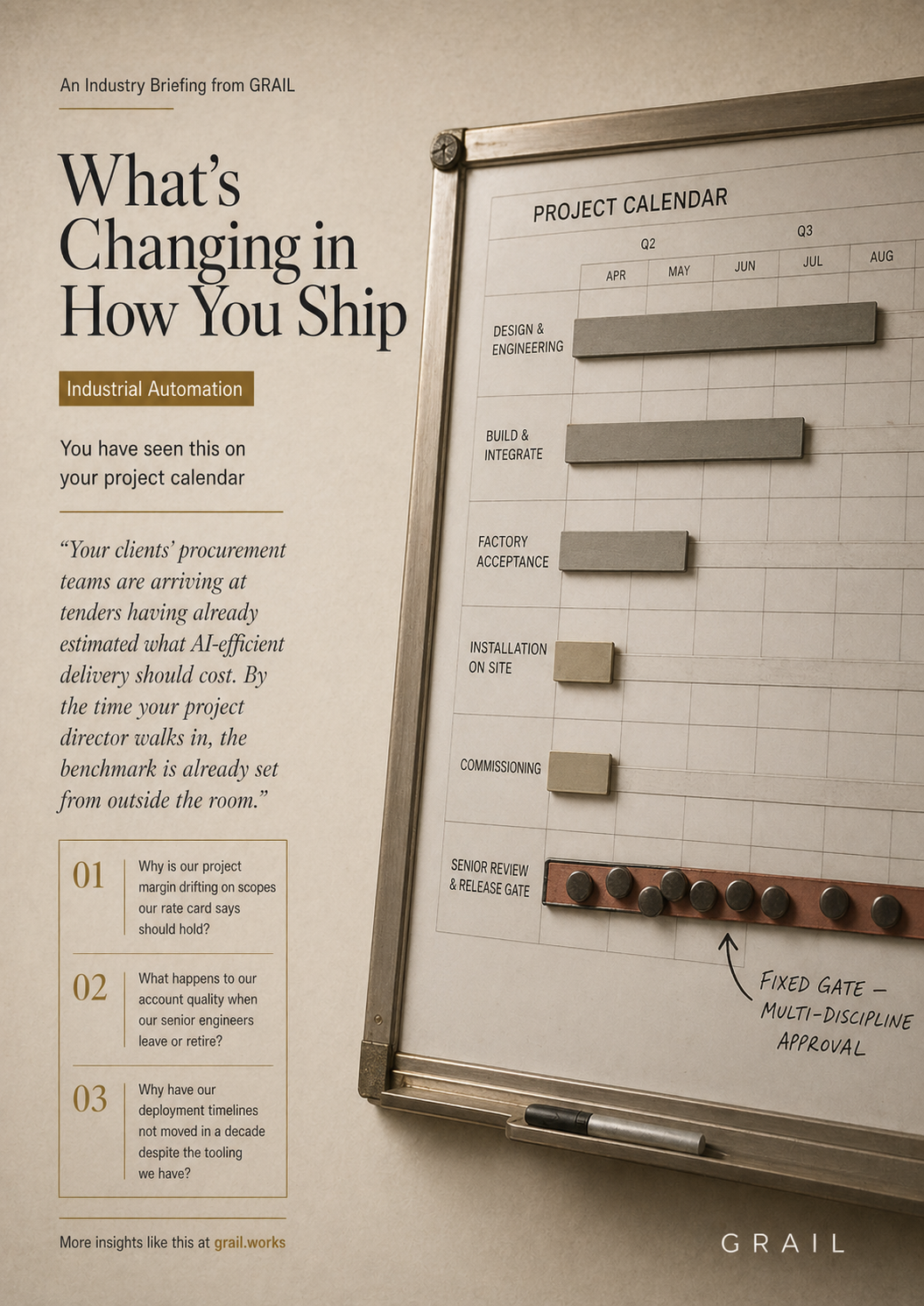
Why is our project margin drifting on scopes our rate card says should hold?
The day rate has not moved. Engineers are billing to target. But realisation on standard integration and commissioning work is down across the book, and clients are arriving at tenders with cost benchmarks that were not there two years ago. AI tools from leading platform vendors compress standard delivery hours by 30 to 50 percent. Under time-and-materials billing, that efficiency belongs to the client. Under fixed-price contracts, it belongs to the firm.
What happens to our account quality when our senior engineers leave or retire?
Your four or five most experienced engineers each carry two to five client accounts worth €400K to €1.2M per year. Those accounts were built on a decade of client-specific knowledge: the configuration choices from 2014, the undocumented workarounds in the safety interlock, the relationship with the plant manager who keeps renewals sole-sourced. None of it is written down. The departure conversations are already on your calendar.
Why have our deployment timelines not moved in a decade despite the tooling we have?
A standard mid-complexity systems integration runs twelve to sixteen weeks. Roughly half of that elapsed time is standard code generation, documentation, and commissioning drafts that AI tools now complete in a fraction of the hours. The firms that rebuild delivery around this close the same project in seven to nine weeks. Same quality. Same engineers. Forty percent more projects per senior per year, at the same headcount.
What you get when you download
An 11-page report for Chief Operating Officers and Heads of Delivery at mid-market European automation integrators. Designed to be read in one sitting before your next operations review.
Your industry, your delivery engine, and why they are one problem
What is happening in automation delivery as a sector. What is happening inside your project delivery engine, your specialist bench, your senior engineers, and your client continuity right now. And the intersection most COOs have not named yet: you do not have three problems, you have one shift to meet.
Four moves across delivery, quality, bench, and continuity
Rebuild project delivery around AI-handled standard scope. Extract senior engineer knowledge as a side-effect of daily work, not a retirement programme. Restructure mid-tier roles around the judgment layer that AI tools cannot reach. Institutionalise client relationships so accounts transfer on architecture, not biography.
Five questions for your next operations review
The margin question. The senior-engineer hours question. The departure-exposure question. The measurably-smarter question. The mid-tier-of-2027 question. Where your operations team cannot agree on the answer is the conversation worth an hour on the agenda.
Calibrated for each seat at the table.