Moat.
Speed.
Allocation.
The platform moat that survives 2028 is being chosen this year.
This briefing tells you which platform moats survive 2028 in insurance as AI rewrites build economics. Read it before your R&D allocation locks for the decade.
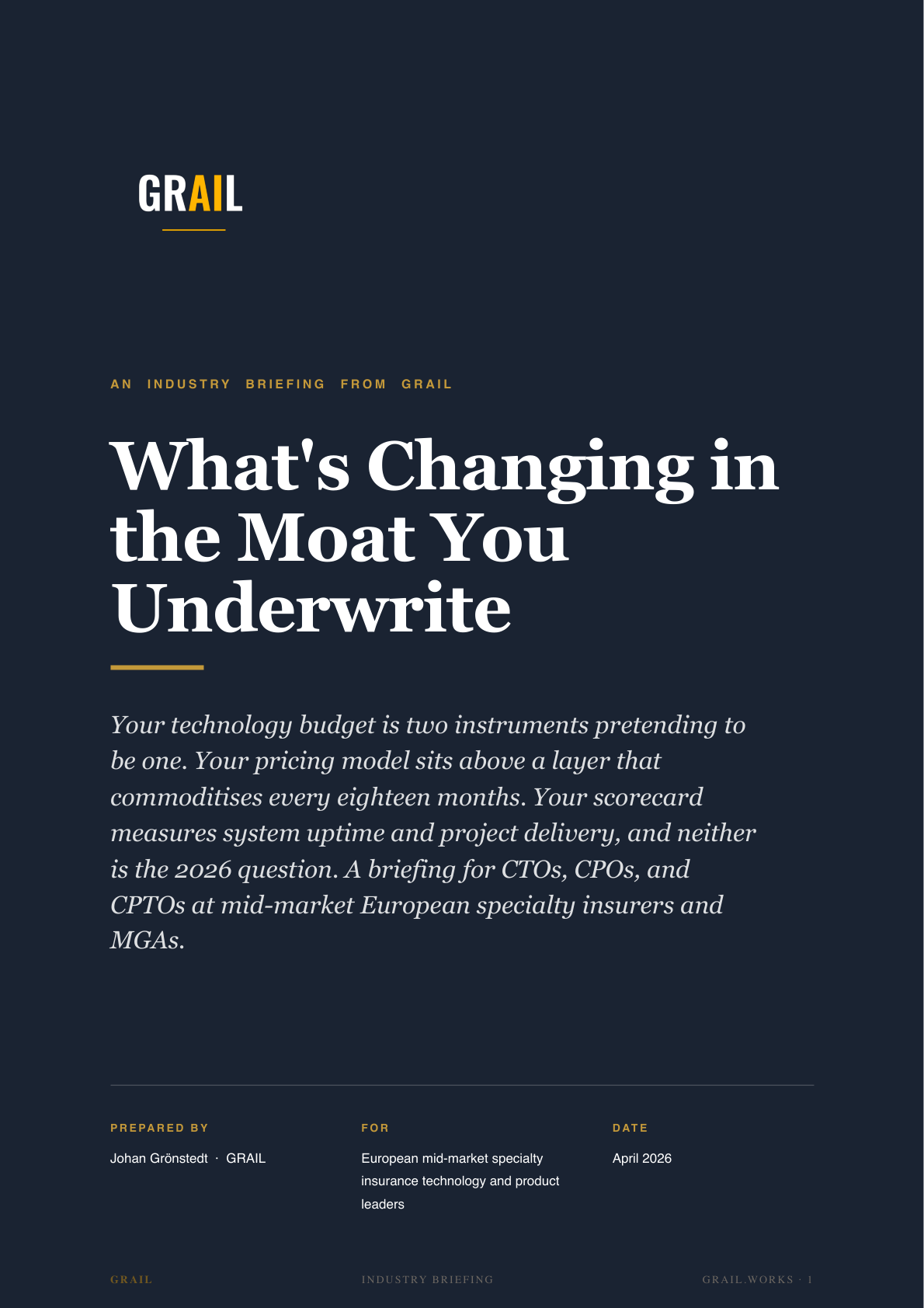
The 10-page briefing. Worth 20 minutes.
One email. One PDF. Worth twenty minutes of your week.
We send it once. Work emails only.
Monday 9:15, technology investment review. Q1 combined ratio at ninety-three. Coding-assistant adoption across the platform team at sixty-eight percent. Cycle time on the policy-admin release train flat against last quarter. Your VP Technology opens with the dashboard. He is mid-sentence when your phone buzzes. Broker note from one of your top distribution partners: "Corgi just quoted on seventeen of the specialty risks we sent you in March. Half the bind cycle. Sharper price." Your VP Technology mentioned a recruiter call from a London AI-native MGA over coffee Thursday. Your CEO has a Chief AI Officer shortlist from the board on his desk.
You are not running one technology function. You are running two, and only one is on your scorecard. One funds what already runs: policy-admin, claims operations, regulatory reporting. The other funds what has to exist by 2028: the broker-data rights you have not renegotiated, the override-rationale corpus you have not built, the broker-integration depth that outlasts three pricing-vendor swaps.
The moat that matters in 2028 is not above the pricing model. It is underneath it.
This is the question your CEO is already asking. The briefing below is what you want in your hand before the next investment review.
Build Velocity. Product Defensibility. R&D Capital Allocation.
Three questions every specialty insurance CTO is tracking. The third is the crux. The first two are how you earn the right to answer it.
Is our engineering speed shipping production-grade output, or releases that fail under DORA?
Coding-assistant adoption at sixty-eight percent. Cycle time flat. Large changes pushed barely reviewed. The platform discipline that lets agents ship cleanly into a regulated, capital-disciplined system took four years to build for the firms that have it. You cannot replicate four years in eighteen months. Buy what the tool layer can carry. Own the discipline that makes it ship.
What does our firm do that a Corgi at lower unit economics cannot copy?
Your pricing model commoditises every eighteen months when the next vendor API rolls. Your bound-risk loss data and broker-integration depth compound. Your override-rationale sits in three retiring underwriters' heads, and the combined-ratio impact of losing it lands twelve to eighteen months after they walk.
Is our technology budget one instrument or two?
One funds the policy-admin platform at lower unit cost. The other builds the 2028 moat. On one hurdle rate the first wins every quarter. On one scorecard the second does not exist. The CTO who walks into the investment review with one budget runs the same programme every peer is running.
What you get when you download
An 11-page report for CTOs, CPOs, and CPTOs at mid-market European specialty insurers and MGAs. Designed to be read in one sitting before your next technology investment review.
Your industry, your technology function, and why they are one problem
What is happening to mid-market specialty insurance: AI-native MGAs at lower unit economics binding outcomes-priced specialty risks, the pricing-model layer commoditising every eighteen months, and named broker losses. What is happening inside your technology and product function: coding-assistant adoption up, cycle time flat, the senior-underwriter retirement curve, and the board AI-strategy ownership list your seat is not on. And the intersection: same force, two altitudes, one problem.
Four moves across build engine, platform and data, product thesis, and R&D bench
Instrument review depth per change, not just cycle time, and make ADRs and eval harnesses first-class infrastructure. Build the moat underneath the pricing-model layer through override-rationale capture, a portable loss-experience graph, and an integration-depth platform for your top thirty broker partners. Stand one outcomes-priced specialty line on protected P&L. Rebuild the junior pathway around senior and agent pairing.
Five questions for your next technology investment review
Is your technology budget one instrument or two, and what is the kill criterion on each? Name the AI-native MGA in your specialty class. How many months to reconstruct override-rationale if your three most senior underwriters retire? Where did the freed hours from sixty-eight percent coding-assistant adoption go? Is your Q1 boundary agreement with the CEO and CUO written?
Calibrated for each seat at the table.