Revenue.
Margin.
Valuation.
Three numbers your board reads. AI is rewriting all three in your industry.
This briefing tells you where revenue, margin, and valuation move in IT consulting as AI rewrites the industry. Read it before your competitors decide what your next decade looks like.
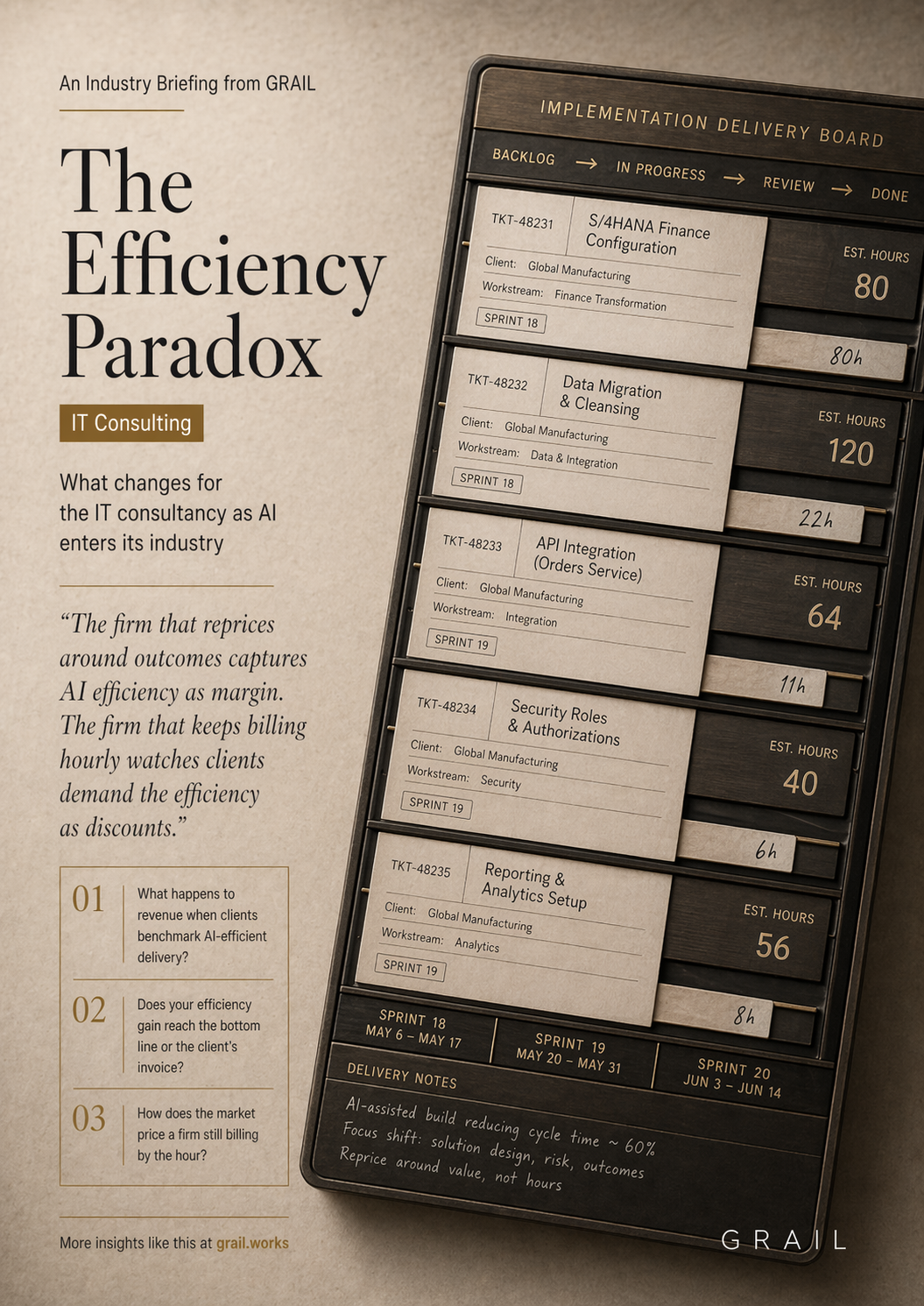
The 10-page briefing. Worth 20 minutes.
One email. One PDF. Worth twenty minutes of your week.
We send it once. Work emails only.
AI coding assistants deliver forty to sixty percent efficiency gains on exactly the work that generates the most billable hours. Clients are benchmarking AI-augmented delivery timelines against proposals still scoped in pre-AI hours. The firms that cannot explain why the same project now costs less are losing deals to firms that have already repriced around outcomes.
The firm that reprices around outcomes captures AI efficiency as margin. The firm that keeps billing hourly watches clients demand the efficiency as discounts.
The structural problem compounds. Clients now have their own AI tools. Their internal teams can estimate how long AI-augmented delivery should take. When your proposal says 1,000 hours and their benchmark says 600, the negotiation is over before it starts. The firms that have already moved to fixed-price delivery avoid this conversation entirely. They sell the result, not the hours.
For the CEO of a mid-market IT consultancy, this is not a technology adoption question. It is a revenue question, a profit question, and a valuation question.
Revenue. Profit. Valuation.
Three lenses. Three answers the management team needs before the next board meeting.
Revenue
Clients are comparing your proposals against AI-augmented timelines. A firm billing 1,000 hours on a project that AI benchmarks at 600 loses the deal or takes a thirty percent haircut. The revenue decline is not gradual. It arrives the quarter a major client renegotiates.
Profit
Under hourly billing, every productivity improvement goes to the client as fewer hours. Under outcome pricing, the same efficiency stays with the firm as margin. A mid-market IT consultancy at twelve percent operating margin could reach eighteen percent by shifting thirty percent of revenue to fixed-price delivery. Same work. Different pricing. Different P&L.
Valuation
Time-based IT consulting firms are growing at roughly two percent. Value-based firms at nearly nine percent. The valuation gap between the two widens every quarter because investors price the revenue model, not the revenue size. The pricing model is the valuation signal.
What you'll get when you download
A 10-page report for IT consulting CEOs and management teams. Designed to be read in one sitting before your next board meeting.
The strategic choice, side by side
The default path (deploy AI, keep billing hourly, watch revenue per project decline) and the repositioning path (reprice around outcomes, capture efficiency as margin, build proprietary delivery assets), with the financial logic of each.
The four levers that compound
Shift pricing from hours to outcomes. Build proprietary assets from every engagement. Encode relationship intelligence into firm infrastructure. Use DORA and NIS2 compliance as bridge revenue that funds the transformation.
Five questions for your next leadership meeting
Diagnostic questions the CEO should test the management team against before the next major client renegotiation. The questions where the room cannot agree are the ones worth a longer conversation.
Calibrated for each seat at the table.