Cheaper.
Better.
Faster.
The triple threat that used to be a tradeoff is now table stakes.
This briefing tells you where the triple threat lands in IT consulting operations as AI rewrites the cost structure. Read it before your competitors decide who is table stakes.
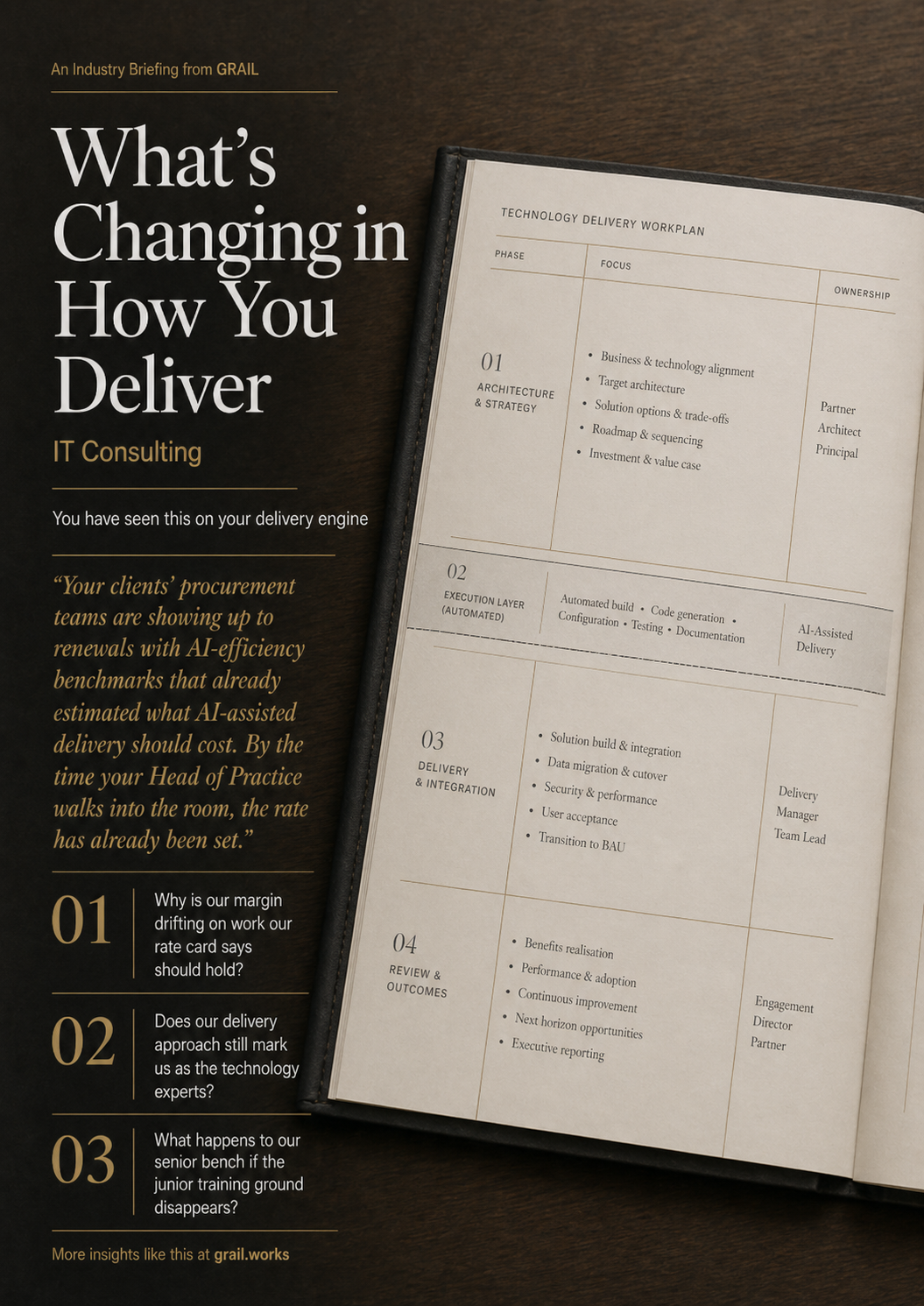
The 10-page briefing. Worth 20 minutes.
One email. One PDF. Worth twenty minutes of your week.
We send it once. Work emails only.
Every Chief Operating Officer or Head of Delivery at a mid-sized European IT consulting firm has had the same version of Monday morning. Three items before 9am. The client's procurement lead asked why your quoted hours didn't reflect what AI-assisted delivery should cost. A senior developer left for a client-side role. Three years of knowledge about a specific legacy integration system went with them. The bench report shows the junior cohort from 2024 is eighteen months in with a stalled promotion pipeline, because the routine work that would have built their judgment is now running on agents.
You have run this delivery engine for ten years. The pattern used to be predictable. Hold the utilisation number. Protect delivery quality. Grow the bench through repetition. Something changed.
This is not a you problem. It is an industry problem and a delivery-engine problem, happening at the same time. Most IT consulting COOs are treating them as two separate conversations. The ones who see them as one are going to own the next decade of European IT delivery.
Can you point to one engagement type that is measurably faster, at higher quality, and at better margin this quarter than six months ago?
Your CEO is already asking this. The briefing below is what you want in your hand before the next delivery review.
Delivery Margin. Technical Credibility. Bench Velocity.
Three questions every IT consulting COO is tracking. None of them used to be the same question. They are now.
Why is our margin drifting on work our rate card says should hold?
The rate card has not changed. Utilisation is within target. But realisation on mid-level engagements is sliding, and client procurement is arriving with AI-efficiency benchmarks on the RFPs where the comparison is clearest. The tools your clients already own are delivering the analysis work that justified the junior rate.
Does our delivery approach still mark us as the technology experts?
Your firm is supposed to be ahead on technology. If your delivery model in 2026 looks structurally similar to 2022, clients in procurement and technical leadership notice before they say anything. The firm visibly ahead on AI-augmented delivery is not just more efficient. It is more credible in the room where the next engagement is being scoped.
What happens to our senior bench when the junior training ground disappears?
The routine work that turned junior cohorts into reliable mid-level consultants in three to four years is now running on agents. No routine work, no training volume. The bench thins two to three years after the routine work disappears. Most delivery COOs are not tracking bench velocity as a metric yet. The ones who are have already started rebuilding the entry pathway.
What you get when you download
An 11-page report for Chief Operating Officers and Heads of Delivery at mid-market IT consulting firms. Designed to be read in one sitting before your next delivery review.
Your industry, your delivery engine, and why they are one problem
What is happening in IT consulting as a sector: billable-hour compression, pricing-model pressure, credibility gap. What is happening inside your delivery engine, your consultant bench, your senior consultants, and your knowledge continuity right now. And the intersection most COOs have not named: you do not have three problems, you have one.
Four moves across delivery, knowledge, bench, and credibility
Decompose every engagement to the deliverable task and price around the tasks that still make money. Extract senior consultant knowledge as a side-effect of active engagements. Redesign the junior entry around judgment work from day one. Build AI-augmented delivery as a visible capability inside the engagement itself.
Five questions for your next delivery review
The client-benchmark question. The senior-exit knowledge question. The one-engagement-measurably-better question. The junior judgment-ratio question. The mid-level-of-2028 question. Where your delivery team cannot agree on the answer is the conversation worth an hour on the agenda.
Calibrated for each seat at the table.