Cheaper.
Better.
Faster.
The triple threat that used to be a tradeoff is now table stakes.
This briefing tells you where the triple threat lands in medtech operations as AI rewrites the cost structure. Read it before your competitors decide who is table stakes.
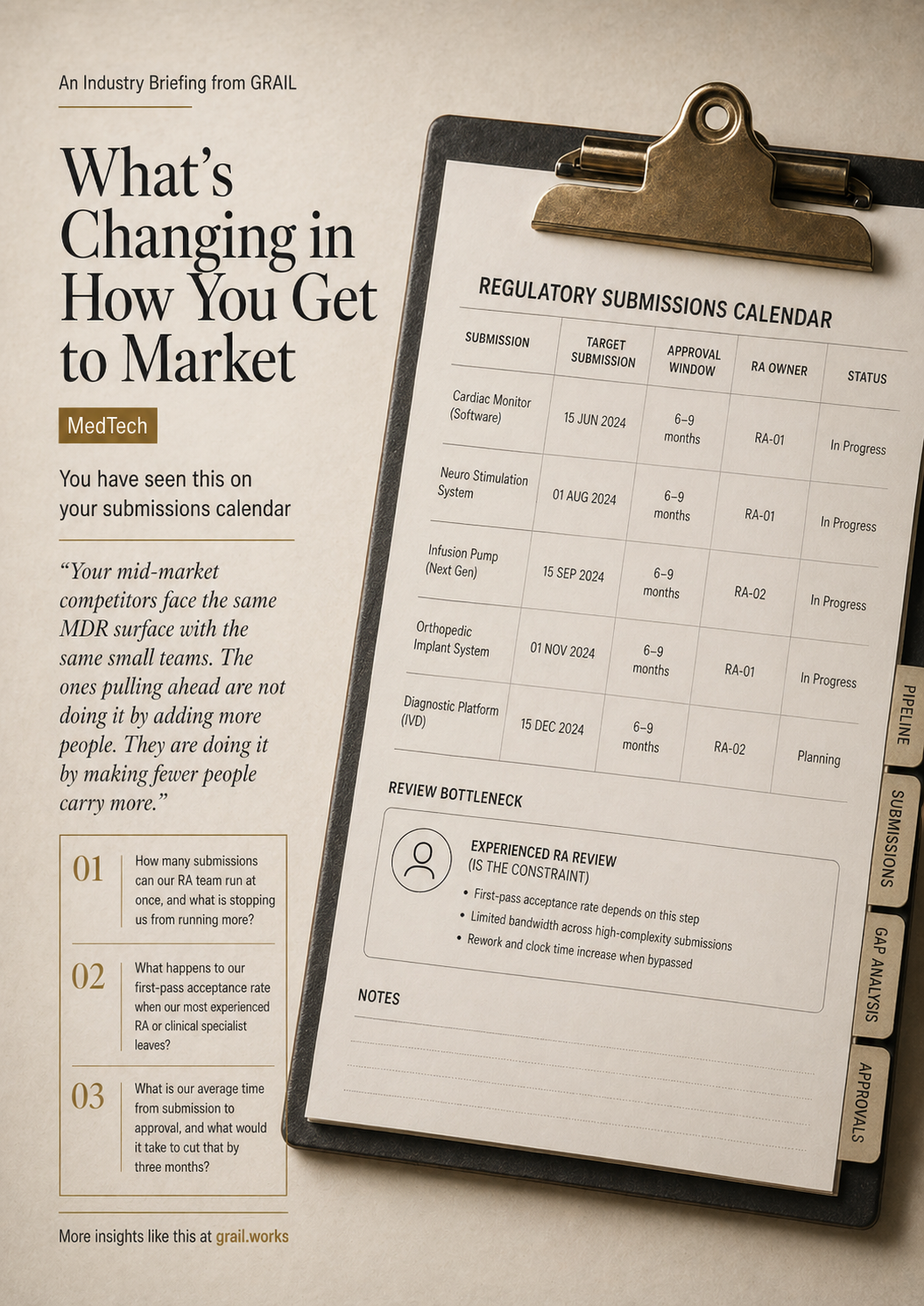
The 10-page briefing. Worth 20 minutes.
One email. One PDF. Worth twenty minutes of your week.
We send it once. Work emails only.
Every Chief Operating Officer at a mid-sized European medtech company has had the same Monday morning. A deficiency letter from the notified body on the Class IIb submission. Three questions about the clinical evidence architecture. The only person who can answer all three is your Head of Regulatory Affairs, flying back from a meeting in Cologne, available at 2 PM. The response is due by end of week. Separately, your market access team has flagged that the JCA submission window for the new device opens in six weeks. They have never done a Joint Clinical Assessment before. At 10 AM you have a quarterly review with the CFO, who wants to understand why the MDR compliance program has added two full-time equivalents without compressing the CE mark cycle.
You have a correct answer. It does not satisfy him.
You have run this function for years. The pattern used to be manageable. Hire the best regulatory specialists. Protect the quality floor. Keep the submission calendar moving. Something changed.
The regulatory expertise your firm depends on today lives in two or three people's heads. The COO who builds infrastructure that carries their accumulated judgment controls the commercial pipeline.
Your CEO is already asking this. The briefing below is what you want in your hand before the next operations review.
Regulatory Throughput. Dossier Quality. Market Access Speed.
Three questions every medtech COO is tracking. None of them used to be the same question. They are now.
How many submissions can our RA team run at once, and what is stopping us from running more?
Your RA specialists are the rate-limiting constraint on how many CE mark submissions you can run simultaneously. The MDR compliance surface has grown without proportional growth in specialist time. The routine documentation work is consuming the same hours that notified body strategy requires.
What happens to our first-pass acceptance rate when our most experienced RA or clinical specialist leaves?
Your notified body knows your senior RA director by name. Their judgment about what language survives scrutiny, what clinical data architecture holds, and what pre-submission notes reveal about review priorities has never been captured anywhere. When they leave, quality slips before anyone notices.
What is our current average time from submission to approval, and what would it take to cut that by three months?
Every month the CE mark cycle compresses is a month of commercial runway your firm captures before a competitor does. The firms moving from eighteen months toward twelve are not hiring faster. They are building infrastructure that carries the preparation and assembly work that previously consumed most of a specialist's calendar.
What you get when you download
An 11-page report for Chief Operating Officers and Heads of Operations at mid-market European medtech firms. Designed to be read in one sitting before your next operations review.
Your industry, your function, and why they are one problem
What MDR, EU HTA, and regulatory expertise scarcity are doing to every mid-market medtech COO's delivery engine. What is happening inside your RA team, your clinical specialists, your quality function, and your market access team right now. And the intersection most COOs have not named yet: you do not have three problems, you have one.
Four moves across regulatory, clinical, quality, and market access
Extract submission knowledge as a side-effect of active submissions, not as a separate project. Rebuild clinical evidence assembly so specialists concentrate on study strategy. Redesign CAPA so quality leads spend time on root cause judgment. Build HTA evidence infrastructure before the JCA window opens.
Five questions for your next operations review
The submission calendar question. The specialist hours question. The departure exposure question. The infrastructure question. The JCA readiness question. Where your operations team cannot agree on the answer is the conversation worth an hour on the agenda.
Calibrated for each seat at the table.