Capital.
Forecast.
Story.
What you allocate this year is the story your board reads next year.
This briefing tells you which capital-allocation decisions become 10x bets in private equity and venture capital as AI compresses the cost stack. Read it before your peers send their version to the board.
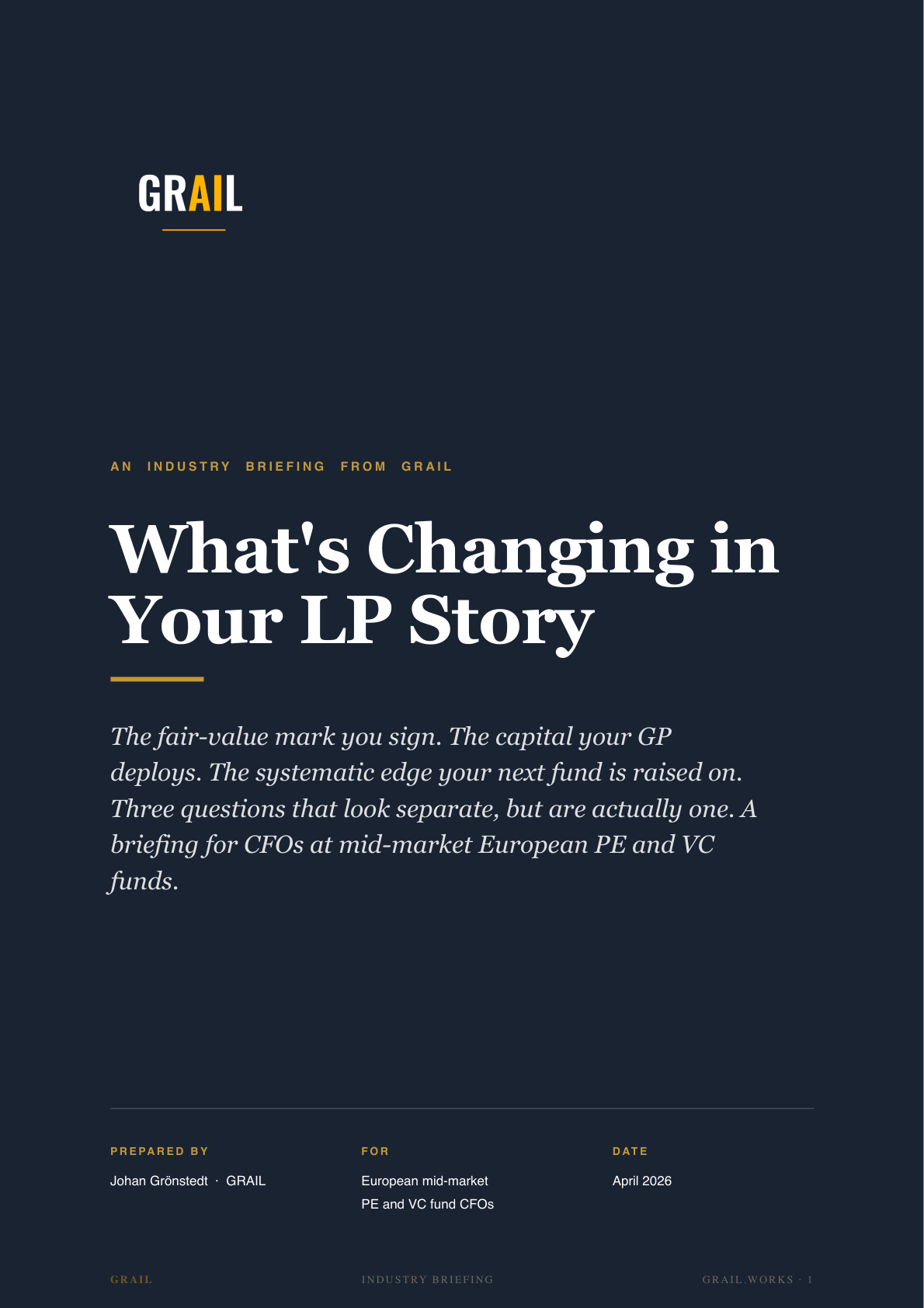
The 10-page briefing. Worth 20 minutes.
One email. One PDF. Worth twenty minutes of your week.
We send it once. Work emails only.
Every CFO at a mid-market European PE or VC fund has had the same Thursday morning. Four things on the screen at 8:30. The LPAC meets at two and three holdings are marked flat against a plan that called for a 1.2x step-up this quarter. The DDQ for the next fund raise came in Monday at fifty-two pages with a new operational section specifically on AI adoption and data governance. Your Managing Partner wants €3M next quarter for a portfolio-monitoring platform. Your newest LP on the committee emailed yesterday asking for a Friday walkthrough on how the fund is using AI in diligence and value creation.
You have signed ten fund annuals. The pattern used to be simple. Close the quarter clean. Mark the book defensibly. Hold the LPAC. Raise the next fund on the track record. The job has not changed in fifty years. The bar has risen on every measure of doing it, simultaneously, and the contradictions you have been running since you took the seat are suddenly re-openable.
The €3M the Managing Partner wants for the portfolio-monitoring platform is not a technology line. It is the largest single capital-allocation decision the GP will make this fund cycle.
This is the question your LP operational due diligence team is already preparing. The briefing below is what you want in your hand before the next Investment Committee.
Capital Allocation. Forecast Credibility. Value-Creation Narrative.
Three questions every mid-market fund CFO is tracking. The first is the crux. The other two are how you earn the right to answer it.
Where does GP capital actually compound, at the fund and across the portfolio?
Portfolio-monitoring platform? Fund-level AI infrastructure? Next-fund build? Reserves for follow-ons? The shared AI playbook that twenty portfolio CFOs will actually run off? Today's default: the portfolio-ops partner asks, the GP budget funds, the vendor contract gets signed, the capital-allocation authority slides in two directions at once.
Why did the mark hold flat, and what is the portfolio-level story?
Your plan called for a 1.2x step-up this quarter. Three holdings held flat. Your audit partner asked how the scenario spread was built. Your fund administrator produced one number. The LPAC's newest committee member wants a third using different comp-set assumptions.
What does this fund do that compounds faster than peers?
Your next raise is pitched on systematic edge. Your DDQ lands Monday at fifty-plus pages. Your LP's operational team asks for process evidence at depth, across sourcing, diligence, portfolio operations, and AI orchestration.
What you get when you download
An 11-page report for Chief Financial Officers at mid-market European PE and VC funds. Designed to be read in one sitting before your next Investment Committee.
Your industry, your fund finance function, and why they are one problem
What is happening in mid-market PE/VC as a sector. What is happening inside your marks, your GP capital, your LP reporting cycle, your portfolio-CFO orchestration, and your fund-finance bench right now. And the intersection most fund CFOs have not named yet: you do not have three scorecard problems, you have one.
Four moves across marks, J-curve, DDQ, and portfolio orchestration
Rebuild the quarterly fair-value close as a live scenario process. Rebuild the J-curve forecast as a live capital-call-and-distribution graph. Build the DDQ evidence layer continuously, not in fundraising-year Q3. Publish the AI-adoption playbook your portfolio CFOs run off.
Five questions for your next Investment Committee
The portfolio-monitoring-platform question. The three-holdings-flat-at-LPAC question. The DDQ-in-fundraising-year-Q3 question. The twenty-portfolio-CFOs-custom-projects question. The 2031-bench question. Where your finance leadership cannot agree on the answer is the conversation worth an hour on the agenda.
Calibrated for each seat at the table.