Cheaper.
Better.
Faster.
The triple threat that used to be a tradeoff is now table stakes.
This briefing tells you where the triple threat lands in technology and digital services operations as AI rewrites the cost structure. Read it before your competitors decide who is table stakes.
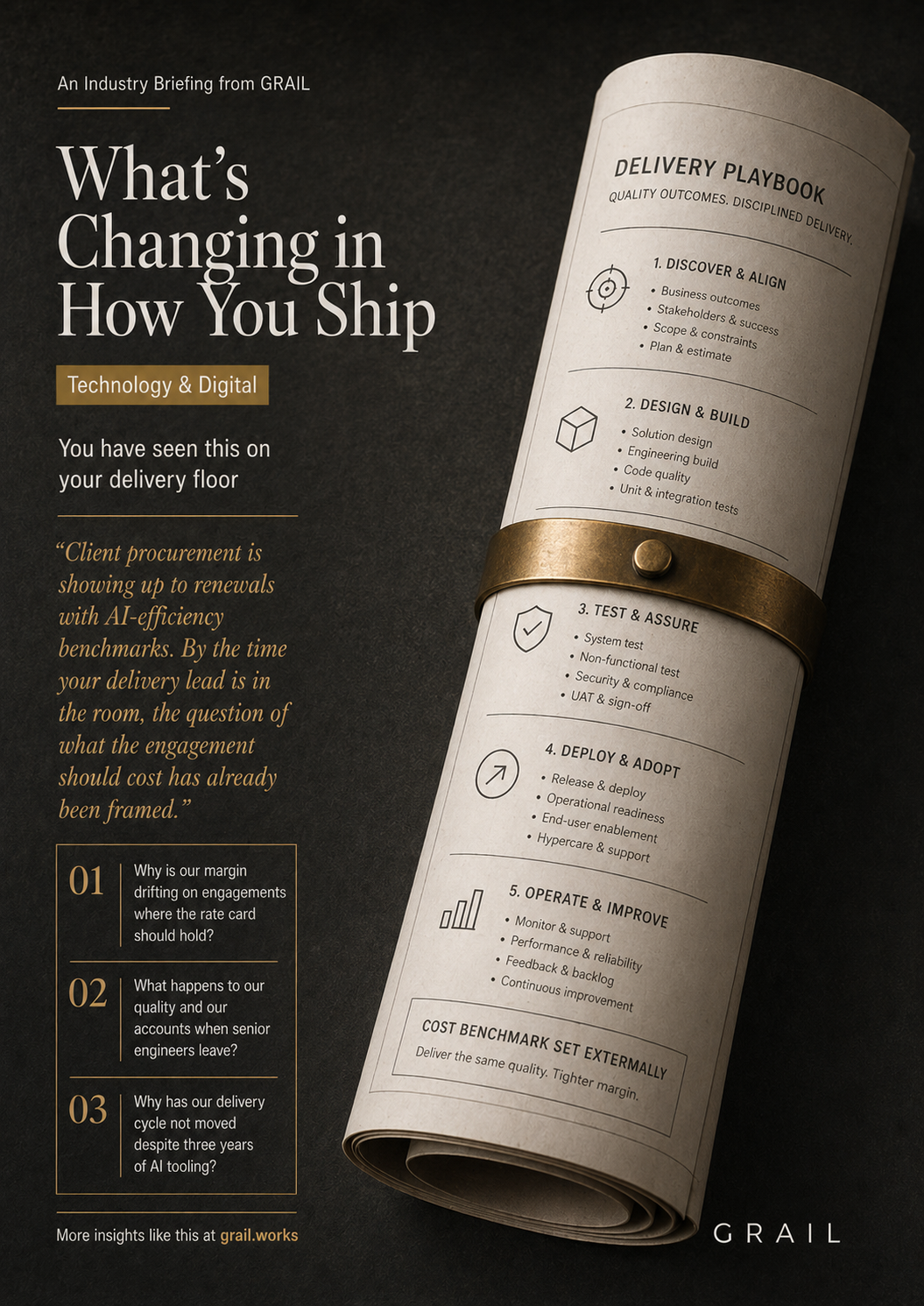
The 10-page briefing. Worth 20 minutes.
One email. One PDF. Worth twenty minutes of your week.
We send it once. Work emails only.
Every Chief Operating Officer or Head of Delivery at a mid-sized technology firm has had the same Monday morning. Sprint review for the large system integration: the technical lead who has been on the account for three years handed in notice on Friday for an AI-native startup. Pipeline review: lost pitch last week to a firm with twelve people you have never heard of. And the productivity report from the AI tools pilot launched six months ago: individual output up, delivery cycles unchanged.
The problem is not the tools. The delivery engine those tools are running on was designed for 2019 constraints and has not been redesigned. Your firm is expected to lead on AI by every client in the portfolio. Being visibly behind is not just an operational problem. It is a credibility problem the client notices before you do.
Your project margin, your delivery reliability, and your delivery speed are not three separate problems. They share one root. The senior judgment that makes your firm unchallengeable has never been separated from the engineers who carry it. Your CEO is already asking this question. The briefing below is what you want in your hand before the next operations review.
Can you point to one thing in your delivery operation that is measurably smarter this quarter than last?
The firms that can answer yes are already winning the pitches you thought were yours.
Project Margin. Delivery Reliability. Delivery Speed.
Three questions every technology delivery COO tracks. None of them used to be the same question. They are now.
Why is our margin drifting on engagements where the rate card should hold?
AI compresses the hours that justified mid-level billing. Under hourly rates, that efficiency goes to the client as faster delivery, not to the firm as higher margin. The firms capturing AI efficiency as margin have moved toward fixed-price delivery. The ones still billing hourly are watching productivity rise and margin compress in the same quarter.
What happens to our quality and our accounts when senior engineers leave?
Your senior engineers carry years of client-specific context: architecture history, integration decisions, unwritten rules of the client's technical environment. None of it has been captured. When they leave for an AI-native startup, the account is at risk within twelve months. You know which accounts this applies to right now.
Why has our delivery cycle not moved despite three years of AI tooling?
AI tools increased individual developer output. Delivery cycles did not shorten because the bottleneck was never individual output. It was senior engineer time applied to tasks that no longer require senior judgment. Free that time and the cycle shortens. The firms that rebuilt delivery around this are closing in half the time. Same team. Different architecture.
What you get when you download
An 11-page report for Chief Operating Officers and Heads of Delivery at mid-market technology and digital firms. Designed to be read in one sitting before your next operations review.
Your industry, your operations, and why they are one problem
What is happening to technology services as a sector. What is happening inside your delivery engine, your specialist bench, your senior engineers, and your client continuity right now. And the intersection most COOs have not named yet: you do not have three problems, you have one.
Four moves across delivery, quality, bench, and continuity
Separate the routine work from the judgment and price around the judgment. Capture client context as a side-effect of delivery. Redesign the junior role around judgment from day one. Treat every major client account as an active intelligence asset. One concrete move per sub-function, starting this quarter.
Five questions for your next operations review
The realisation question. The senior engineer hours question. The account exposure question. The measurably-smarter question. The mid-level developer of 2027 question. Where your operations team cannot agree on the answer is the conversation worth an hour on the agenda.
Calibrated for each seat at the table.