Moat.
Speed.
Allocation.
The platform moat that survives 2028 is being chosen this year.
This briefing tells you which platform moats survive 2028 in technology and digital services as AI rewrites build economics. Read it before your R&D allocation locks for the decade.
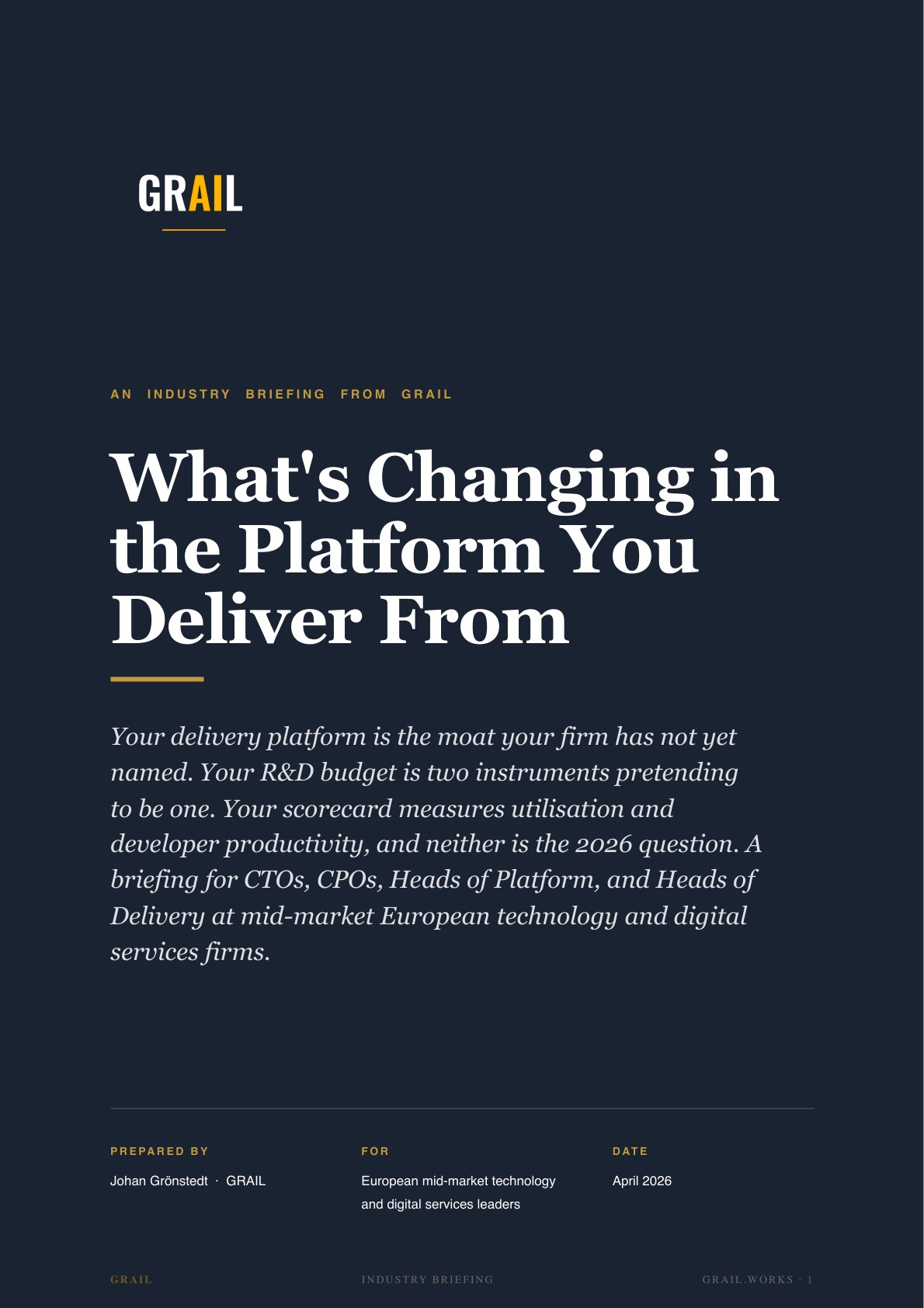
The 10-page briefing. Worth 20 minutes.
One email. One PDF. Worth twenty minutes of your week.
We send it once. Work emails only.
Tuesday 10:00, delivery review. Utilisation at sixty-five percent. Copilot adoption at seventy-two percent. Sprint velocity up sixteen percent on the dashboard. You lost a two-million-euro fixed-price pitch on Friday to an eleven-person shop that ran an AI-augmented delivery walkthrough in the pitch room. Your lead architect on the bank account mentioned a recruiter call from a twelve-person AI-native over coffee Thursday. Your biggest client's CIO asked last week whether they could see your actual internal AI-augmented delivery workflow. You said yes. You are not sure what you are going to show them.
You are not running one R&D function. You are running two, and only one is on your scorecard. One funds what you already deliver. The other funds what has to exist by 2028: the proprietary delivery platform you have not built, the productised services your client work has generated that you have never captured, the reusable-asset library that compounds across engagements, the integration depth that turns a six-month engagement into a thirty-day POC you can actually ship.
The moat that matters in 2028 is not the developers on your bench. It is the platform they deliver from.
This is the question your CEO is already asking. The briefing below is what you want in your hand before the next delivery-platform review.
Build Velocity. Product Defensibility. R&D Capital Allocation.
Three questions every technology-services CTO is tracking. The second is the crux. The first and third are how you earn the right to answer it.
Is our engineering speed shipping client-ready fixed-price output, or demos that fall over?
Copilot adoption at seventy percent. Cycle time flat. Ten-thousand-line PRs barely reviewed. Your clients see what you run internally the first time they walk your delivery floor. Spotify spent four years on the platform that lets agents ship cleanly. You cannot replicate four years in eighteen months. Buy what the tool layer can carry. Own the discipline that makes it ship.
What does our delivery produce that an eleven-person AI-native shop cannot copy in a year?
Your individual engineers are recruitable. Your proprietary delivery platform, your productised services, your reusable-asset library, and your integration depth into the top ten client systems are not. The moat sits in the platform, not on the bench. Netcompany ran this to eighty percent of revenue from own IP.
Is our R&D-and-platform budget one instrument or two?
Plateau capital runs the existing billable engine at lower unit cost. Compounding capital builds the platform and productised IP for 2028. On one hurdle rate the first wins every quarter. On one scorecard the second does not exist. The CTO who walks in with one budget runs the programme every peer is running.
What you get when you download
An 11-page report for CTOs, CPOs, Heads of Platform, and Heads of Delivery at mid-market European technology and digital services firms. Designed to be read in one sitting before your next delivery-platform review.
Your industry, your delivery platform, and why they are one problem
What is happening to mid-market technology services: eleven-person AI-native shops pitching thirty-day POCs against six-month engagements, the credibility paradox biting in every pitch room, and the SEB four-times growth delta between time-based and value-based firms. What is happening inside your delivery platform: Copilot adoption up, cycle time flat, the junior pathway quietly collapsed, and the board AI-strategy ownership list your seat is not on. And the intersection: same force, two altitudes, one problem.
Four moves across build engine, delivery platform, productised services, and senior bench
Instrument review depth per line, not just cycle time, and make ADRs and eval harnesses first-class infrastructure. Build the delivery-platform moat through a firm-owned AI-augmented tooling stack, a reusable-asset library, and an integration depth graph. Stand two productised services on protected P&L with demoable internal workflows. Rebuild the junior pathway around senior and agent pairing.
Five questions for your next delivery-platform review
Is your R&D-and-platform budget one instrument or two, and what is the kill criterion on each? Name the AI-native shop that just won the last fixed-price pitch you lost. How many months to reconstruct delivery patterns if your two senior architects leave tomorrow? Where did the freed hours from seventy-percent Copilot adoption go? Is your Q1 boundary agreement with the CEO written?
Calibrated for each seat at the table.