Cheaper.
Better.
Faster.
The triple threat that used to be a tradeoff is now table stakes.
This briefing tells you where the triple threat lands in vertical software operations as AI rewrites the cost structure. Read it before your competitors decide who is table stakes.
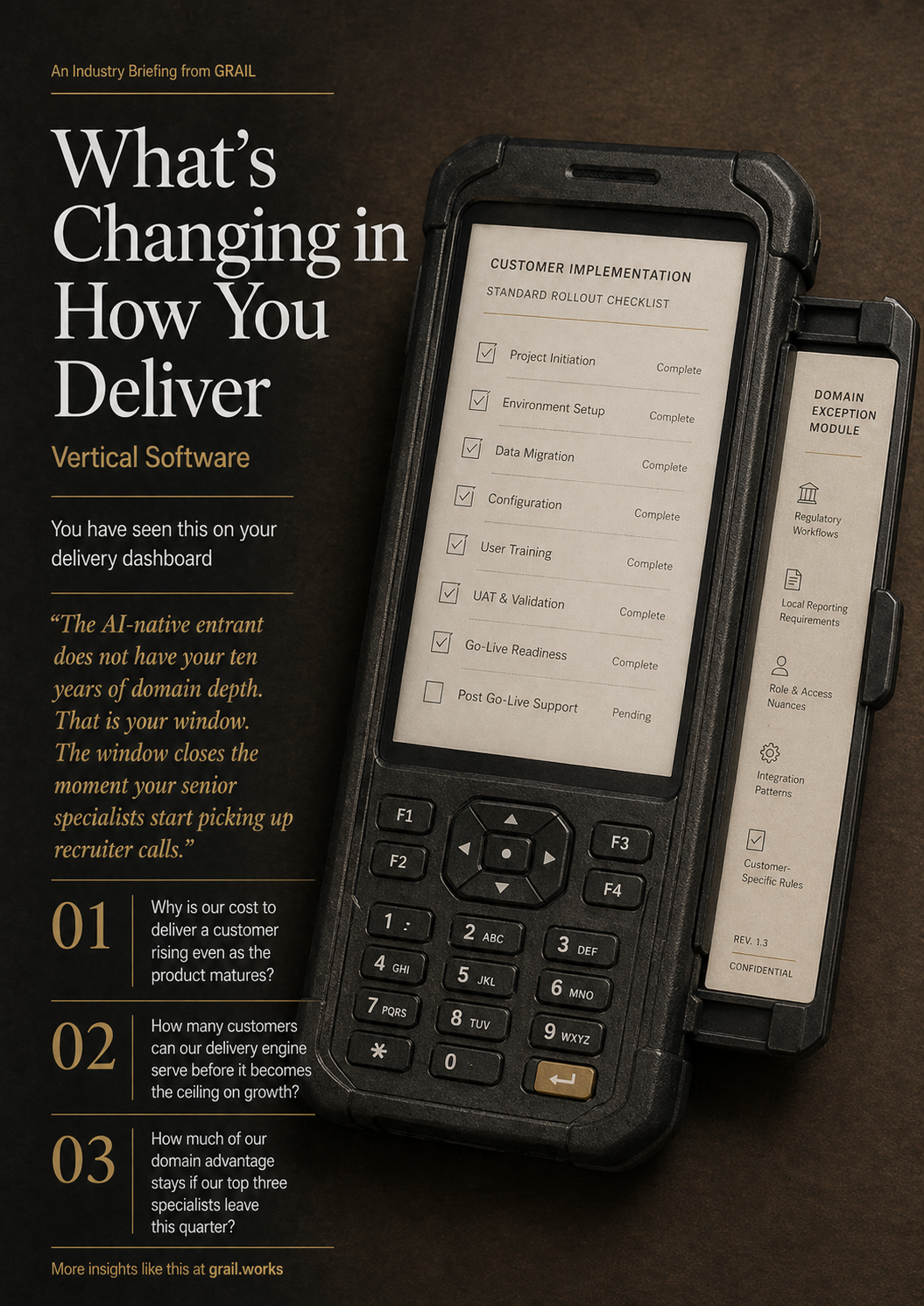
The 10-page briefing. Worth 20 minutes.
One email. One PDF. Worth twenty minutes of your week.
We send it once. Work emails only.
Every COO or Head of Delivery at a mid-sized vertical software company in Europe has had the same Monday morning. An enterprise implementation six weeks past its go-live date because the senior lead who knew the customer's legacy integration left for an AI-native startup two months ago. Nobody else has the context. A customer success report showing time-to-first-value stretched from eight weeks to fourteen over the past year, while the implementation team grew twenty percent. An email from the board chair noting that the AI-native competitor that entered your vertical eighteen months ago just presented at your flagship customer's operations review.
You have run this delivery function for a decade. Hire strong implementation consultants. Build the customer relationships. Protect the quality floor. Hold time-to-value at the number. The business was understandable.
Both problems are structural and they are happening simultaneously. Most vertical software COOs are treating them separately. The ones who see them as one are going to own the next decade of European vertical software.
If your top three senior domain specialists left this quarter, what would happen to the customers they serve?
Your CEO is already asking this. The briefing below is what you want in your hand before the next delivery review.
Delivery Unit Economics. Delivery Throughput. Knowledge Retention.
Three questions every vertical software COO is tracked against. None of them used to be the same question. They are now.
Why is our cost to deliver a customer rising even as the product matures?
Professional services cost per implementation should compress as the product matures and the team builds expertise. Instead it is holding or rising. Each complex implementation rediscovers context the previous one already resolved, because nobody built the infrastructure to carry it forward. The cost of rediscovery is invisible on the P&L but present on every implementation timeline.
How many customers can our delivery engine serve before it becomes the ceiling on growth?
If your average implementation takes fourteen weeks and your team runs eight enterprise implementations per quarter, the delivery engine is the ceiling on how many deals the sales team can close. Compressing to six weeks enables eighteen implementations with the same team. Not a productivity story. A growth capacity story. The COO who lifts that ceiling before sales hits it is the one in the board conversation about why growth accelerated.
How much of our domain advantage stays if our top three specialists leave this quarter?
The domain knowledge your firm accumulated over ten years of customer delivery is the one thing AI-native entrants cannot replicate quickly. But it is only an advantage if it is institutional. A senior implementation lead who leaves takes their customer context with them. Their accounts go to a competitor within eighteen months of their departure, not because the product got worse, but because the relationship intelligence left.
What you get when you download
An 11-page report for Chief Operating Officers and Heads of Delivery at mid-market vertical software companies. Designed to be read in one sitting before your next delivery review.
Your industry, your delivery engine, and why they are one problem
What is happening to vertical software companies as AI-native entrants compress the technical barriers. What is happening inside your implementation team, your professional services margin, your customer success operation, your senior domain specialists, and your support quality right now. And the intersection most COOs have not named: you do not have two problems, you have one.
Four moves across implementation, professional services, customer success, and support
Decompose every implementation type to the task level and rebuild the playbook around the tasks that require judgment. Extract domain knowledge as a side-effect of delivery, not a separate documentation project. Build customer intelligence infrastructure before every strategic renewal. Put senior judgment into escalation infrastructure so it stops being the bottleneck.
Five questions for your next delivery review
The specialist-departure question. The time-to-value question. The delivery-capacity-ceiling question. The cost-of-rediscovery question. The renewal-preparation question. Where your delivery team cannot agree on the answer is the conversation worth an hour on the agenda.
Calibrated for each seat at the table.