Revenue.
Margin.
Valuation.
Three numbers your board reads. AI is rewriting all three in your industry.
This briefing tells you where revenue, margin, and valuation move in B2B industrial as AI rewrites the industry. Read it before your competitors decide what your next decade looks like.
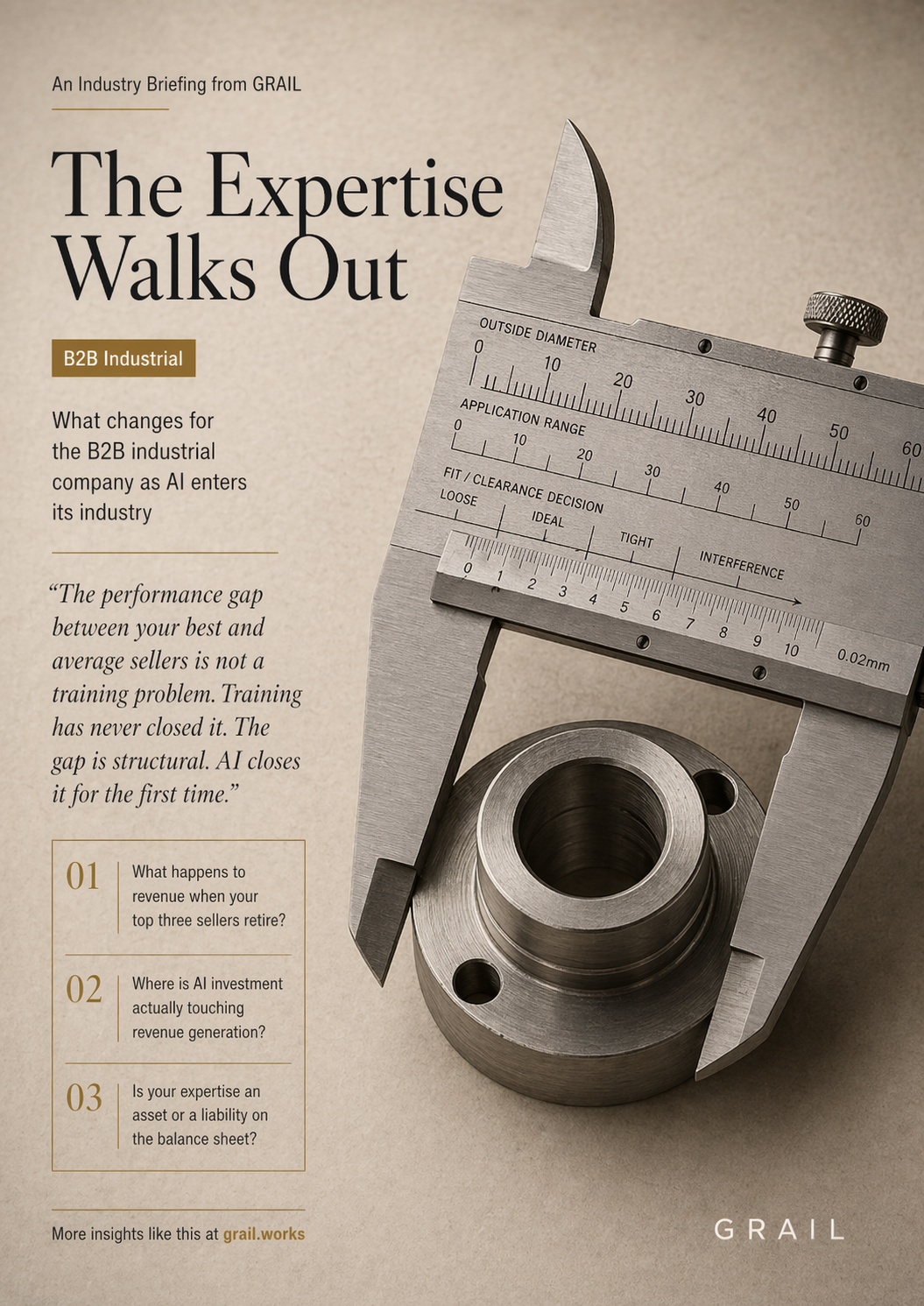
The 10-page briefing. Worth 20 minutes.
One email. One PDF. Worth twenty minutes of your week.
We send it once. Work emails only.
Industrial B2B companies built their competitive advantage on application knowledge. The ability to look at a customer's process, understand the real problem behind the stated requirement, and recommend the right solution from a catalogue of thousands. That capability lives in a handful of senior technical sellers and application engineers. It took them fifteen years to accumulate. It exists only in their heads.
The performance gap between your best and average sellers is not a training problem. Training has never closed it. The gap is structural. AI closes it for the first time.
AI can now extract the patterns from top performers' work artifacts: the questions they ask on first site visits, the product combinations they recommend, the competitive responses that win. A seller with three years of experience, augmented by AI trained on those patterns, delivers preparation quality that previously required fifteen years. The expert stays essential for the hardest problems. The organization stops being dependent on three people for forty percent of its revenue.
For the CEO of a B2B industrial company, this is not a technology question. It is a revenue question, a profit question, and a valuation question.
Revenue. Profit. Valuation.
Three lenses. Three answers the management team needs before the next board meeting.
Revenue
Three to five sellers generate forty percent of revenue. They are over fifty. Every retirement costs twelve to eighteen months of revenue impact because the replacement cannot carry the application knowledge fast enough. The revenue question is not how to grow. It is how to prevent the knowledge that drives growth from walking out the door.
Profit
Industrial companies invest in product AI, predictive maintenance, and IoT. Only four percent report strong returns. The commercial layer where margins are generated receives almost nothing. Meanwhile, buyers arm themselves with AI-powered procurement benchmarking. Sellers who cannot defend value propositions against those tools lose on price. Margin erodes from the customer side while the company invests on the wrong side.
Valuation
Expert knowledge in individual heads is a concentration risk. Institutional knowledge encoded into infrastructure is a compounding asset. The same revenue base, valued very differently depending on whether the expertise survives a wave of retirements. Acquirers and boards increasingly ask this question directly.
What you'll get when you download
A 10-page report for B2B industrial CEOs and management teams. Designed to be read in one sitting before your next leadership meeting.
The strategic choice, side by side
The default path (automate tasks, invest in product AI, accept the performance gap) and the repositioning path (distribute expertise, invest in the commercial layer, close the gap structurally), with the financial logic of each.
The four levers that compound
Extract expert knowledge from existing work artifacts. Augment the meeting and delivery cycle end to end. Build group-level AI infrastructure so innovations scale across countries. Defend margins against AI-armed procurement teams.
Five questions for your next leadership meeting
Diagnostic questions the CEO should test the management team against. The questions where the room cannot agree are the ones worth a longer conversation.
Calibrated for each seat at the table.