Moat.
Speed.
Allocation.
The platform moat that survives 2028 is being chosen this year.
This briefing tells you which platform moats survive 2028 in B2B industrial as AI rewrites build economics. Read it before your R&D allocation locks for the decade.
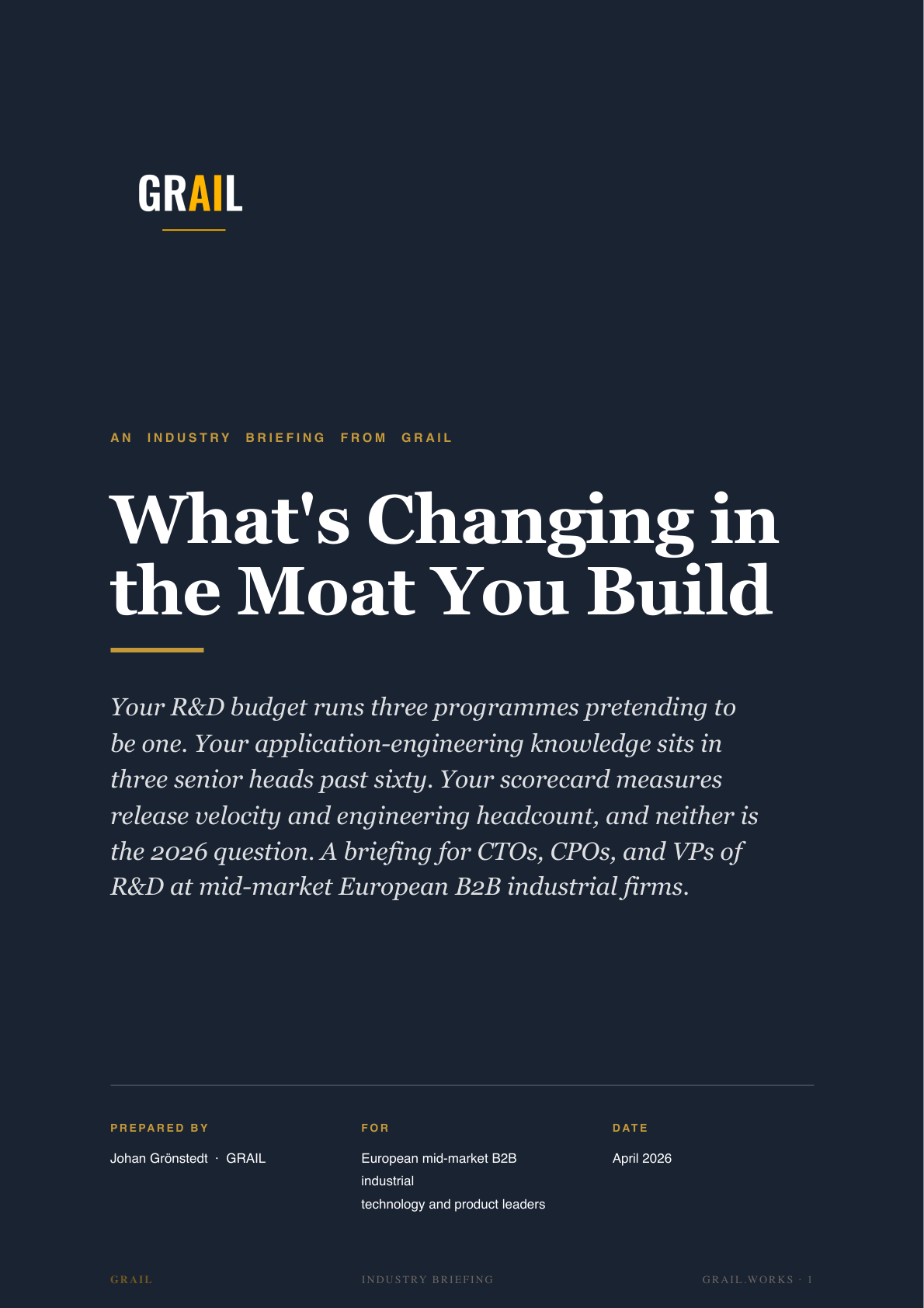
The 10-page briefing. Worth 20 minutes.
One email. One PDF. Worth twenty minutes of your week.
We send it once. Work emails only.
Monday 9:15, R&D review. Q1 hardware release shipped two sprints early. Application engineering up twenty-eight percent on billable hours. Service platform ingesting eleven million telemetry events a day. Your VP Engineering opens with the dashboard. Phone buzzes. Your largest distributor: "A customer ran your rate card through Coupa against three European competitors and a Tulip-on-open-hardware build. Losing on price and lead time. Thursday?" Your top application engineer sent a retirement-planning calendar invite. Your CEO has a Chief Digital Officer shortlist from the board on his desk.
You are not running one R&D function. You are running three, and only one is on your scorecard. Hardware R&D funds the next release. Commercial-ops R&D funds the stack your sales and application engineers live on. Service and IoT R&D funds the telemetry. Only one of the three builds the 2028 moat: the application-engineering knowledge captured, the installed-base telemetry structured, the integration depth published.
The moat that matters in 2028 is not above the model layer. It is underneath it.
This is the question your CEO is already asking. The briefing below is what you want in your hand before the next R&D review.
Build Velocity. Product Defensibility. R&D Capital Allocation.
Three questions every industrial CTO is tracking. The third is the crux. The first two are how you earn the right to answer it.
Is our engineering speed shipping production-grade output, or demos that fall over at commissioning?
Hardware cycles compressed by simulation. Firmware on agent-generated test suites. Application engineering on customer-documentation agents. Velocity is up. Field-failure root causes are up too. The industrial giants spent a decade on the platform foundation that lets application teams ship at speed. Buy what the tool layer can carry. Own the discipline that makes it ship.
What does our product do that a Tulip on open hardware or an AI-armed buyer cannot commoditise?
Your component spec commoditises when the next AI-armed procurement tool runs a benchmark. Your application-engineering knowledge, your installed-base telemetry, and your integration depth compound. Your top senior engineers carry the reasoning behind every successful install, and two of them are past sixty.
Is our R&D budget one programme or three?
Hardware R&D funds the next release. Commercial-ops R&D funds the tech stack. Service and IoT R&D funds the telemetry platform. On one hurdle rate, hardware wins every quarter. On one scorecard, the other two do not exist. The CTO who walks in with one budget runs the same programme every peer is running.
What you get when you download
An 11-page report for CTOs, CPOs, and VPs of R&D at mid-market European B2B industrial firms. Designed to be read in one sitting before your next R&D review.
Your industry, your R&D function, and why they are one problem
What is happening to mid-market B2B industrial: software-natives on open hardware at outcome-priced unit economics, AI-armed procurement commoditising the catalogue, and the industrial IoT platform decade that never captured the moat. What is happening inside your R&D function: velocity up, field-failure surprises up, senior application engineers retiring, and the board AI-strategy ownership list your seat is not on. And the intersection: same force, two altitudes, one problem.
Four moves across build engine, platform and data, product thesis, and R&D bench
Instrument review depth per module, not just cycle time, and make design-reviews and eval harnesses first-class infrastructure. Capture the moat underneath the model layer through an application-engineering knowledge graph, installed-base telemetry with renegotiated data rights, and an integration depth graph. Stand one outcome-priced line on protected P&L. Capture senior knowledge before retirement and pair juniors deliberately.
Five questions for your next R&D review
Is your R&D budget one programme or three, and what is the kill criterion on each? Name the software-native in your category on open hardware. How many months to reconstruct application-engineering reasoning if your top three seniors retire in eighteen months? What portion of your installed-base telemetry do you have structured data rights to? Is your Q1 boundary agreement with the CEO, CFO, and COO written?
Calibrated for each seat at the table.