Cheaper.
Better.
Faster.
The triple threat that used to be a tradeoff is now table stakes.
This briefing tells you where the triple threat lands in B2B industrial operations as AI rewrites the cost structure. Read it before your competitors decide who is table stakes.
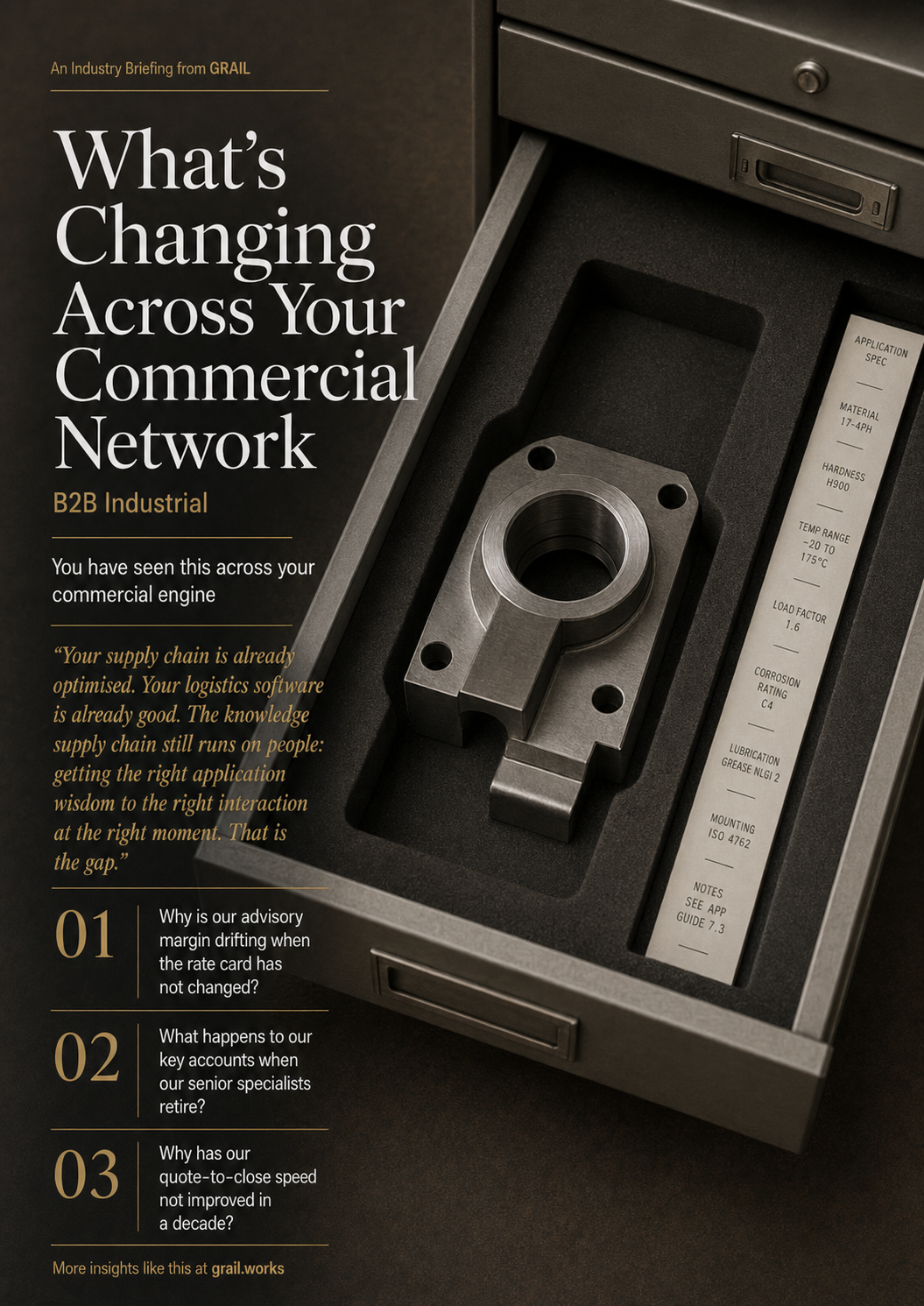
The 10-page briefing. Worth 20 minutes.
One email. One PDF. Worth twenty minutes of your week.
We send it once. Work emails only.
Every COO or Head of Operations at a mid-sized B2B industrial firm has had the same Monday morning. Three items before the operations review. Lars at the Hamburg account retires in fourteen months, and his counterpart has never worked this client. The frame contract tender came in seven days ago and three of those days were waiting for the application specialist to clear the technical compliance section. The quarterly numbers show realisation on application advisory services down four points. Same number of service calls. Same rate card. More senior hours per ticket, and the procurement teams that can run AI cost benchmarks are beginning to ask questions.
You have run this commercial engine for a long time. Hire the best application engineers. Build the accounts around them. Protect the quality floor. The pattern was legible. Then the gap between your best specialists and the rest stopped being a training problem and started being an infrastructure problem.
Most B2B industrial COOs are treating the margin drift, the retirement risk, and the slow cycle as three separate problems. The ones who see them as one are already building the advantage that will be very hard to close. Your CEO is already asking where that advantage is.
Can you point to one part of your commercial organisation that is measurably more capable this quarter than last?
The briefing below is what you want in your hand before the next operations review.
Margin Per Delivery. Account Continuity. Cycle Time.
Three questions every B2B industrial COO is tracking. None of them used to be connected. They are now.
Why is our advisory margin drifting when the rate card has not changed?
Application advisory is bundled into the product margin. When senior preparation time per interaction rises, the cost per engagement rises with it. Procurement teams with AI cost benchmarks already know what AI-efficient delivery should cost. The rate card stays. The margin conversation is coming.
What happens to our key accounts when our senior specialists retire?
Eight to fifteen of your most experienced application engineers carry the relationships that anchor your revenue base. Each holds client-specific knowledge accumulated over decades that has never been formalised. When one retires, the context does not transfer. One in three major accounts goes to tender within eighteen months of the primary specialist's departure.
Why has our quote-to-close speed not improved in a decade?
A standard application inquiry runs seven to ten days. Roughly half of that time is waiting for a senior specialist to retrieve context that could now live in infrastructure the firm has not built. Competitors who have rebuilt their inquiry workflow close in two to three days. In industries where procurement scores on response speed, the slow firms are losing tenders they are not even tracking as losses yet.
What you get when you download
An 11-page report for Chief Operating Officers and Heads of Operations at mid-market B2B industrial firms. Designed to be read in one sitting before your next operations review.
Your industry, your commercial network, and why they are one problem
What is happening in B2B industrial as a sector: knowledge encoding shifts who holds competitive advantage. What is happening inside your application advisory, your quote teams, your senior specialists, and your key accounts right now. And the intersection most COOs have not named: margin drift, retirement risk, and cycle time are not three problems. They are one.
Four moves across your commercial network, application advisory, quotes, and accounts
Map every commercial interaction to the task level, rebuild delivery costs accordingly. Extract senior application knowledge from work already being done, not from interviews. Rebuild the inquiry workflow around what agents carry from receipt to first draft. Treat every major account as a knowledge asset the firm owns, not a relationship a person holds.
Five questions for your next operations review
The advisory margin question. The specialist hours question. The retirement-exposure question. The measurably-more-capable question. The account-manager-of-2028 question. Where your operations team cannot agree on the answer is the conversation worth an hour on the agenda before the board asks it first.
Calibrated for each seat at the table.