Revenue.
Margin.
Valuation.
Three numbers your board reads. AI is rewriting all three in your industry.
This briefing tells you where revenue, margin, and valuation move in financial advisory and wealth management as AI rewrites the industry. Read it before your competitors decide what your next decade looks like.
The 10-page briefing. Worth 20 minutes.
One email. One PDF. Worth twenty minutes of your week.
We send it once. Work emails only.
A boutique wealth management firm with a billion euros under management and two founding partners approaching sixty. The practice is profitable. Client retention is strong. The succession plan is "introduce the junior partner to our top clients and hope the relationship transfers." That has never worked when the relationship was built on twenty years of trust.
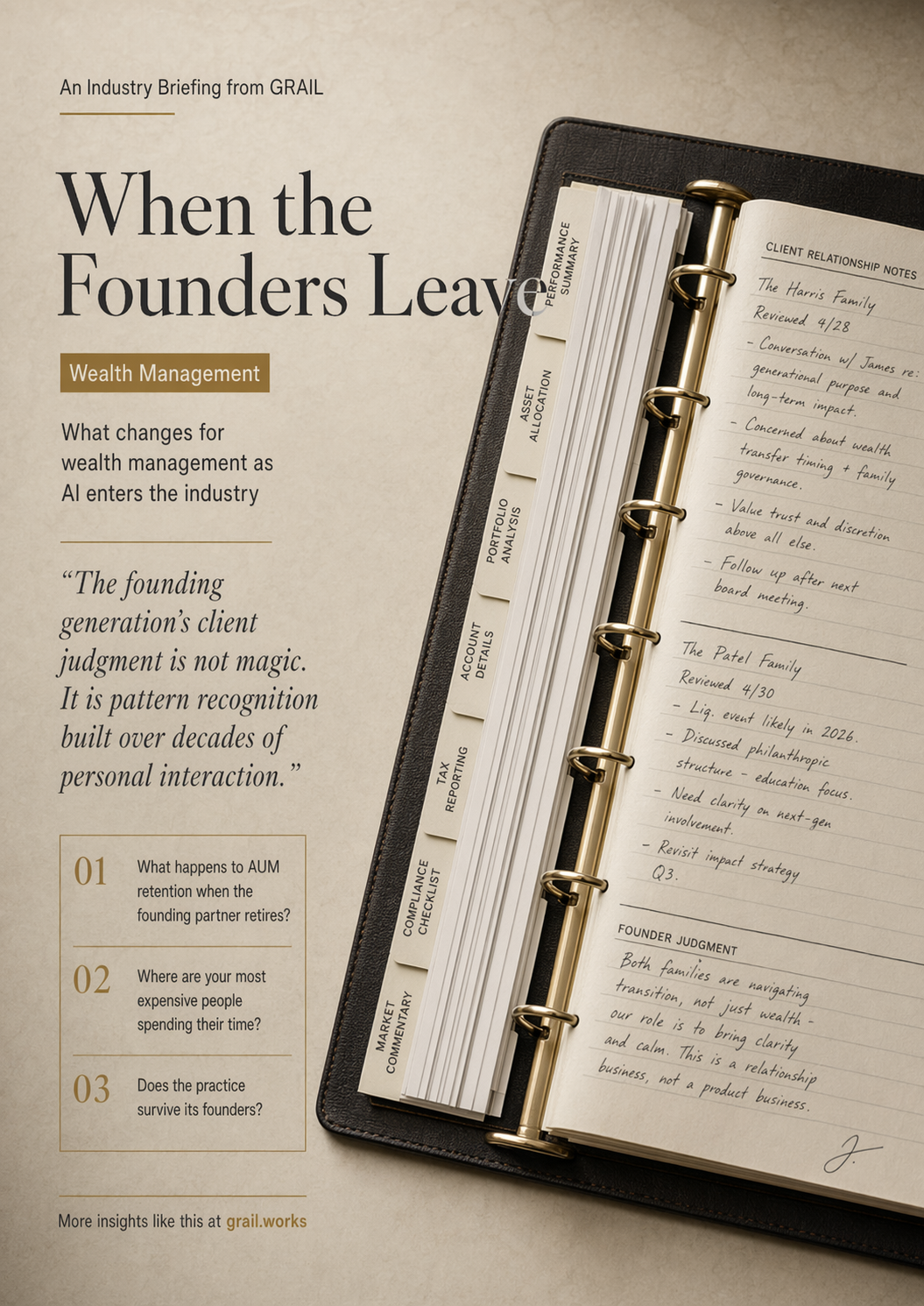
The founding generation's judgment is not magic. It is pattern recognition built over decades. And right now, it exists nowhere outside their heads.
Senior advisors currently spend forty percent or more of their time on production work: research synthesis, portfolio construction, compliance documentation, client reporting. AI compresses that entire production layer. A senior advisor augmented by AI handles the workload that currently requires analysts, paraplanners, and back-office staff. The economics invert: instead of needing AUM scale to cover overhead, a lean firm with AI infrastructure delivers institutional-quality output at a fraction of the cost.
For the CEO of a wealth management firm, this is not a technology question. It is a revenue question, a profit question, and a valuation question. And the succession clock is ticking on all three.
Revenue. Profit. Valuation.
Three lenses. Three answers the management team needs before the founding partners set a retirement date.
Revenue
Client retention correlates directly with specific advisor tenure. When a founding partner retires, the accounts that seemed stable show fragility within months. The firms solving this now are capturing founding partner knowledge into institutional systems so the next generation inherits the relationship at eighty percent, not zero. Revenue protection through succession is a knowledge infrastructure problem.
Profit
Senior advisors spending forty percent of their time on production work is the most expensive misallocation in the practice. AI compresses research, reporting, compliance, and portfolio construction. The freed capacity goes to relationship depth and new client acquisition. The margin improvement is not from cutting headcount. It is from redeploying the most valuable people to the most valuable work.
Valuation
A practice where client knowledge lives in the founding partner's head is priced at a discount. A practice where that knowledge is institutional, transferable, and augmented by AI infrastructure is priced at a premium. Same AUM. Same client base. Very different multiples at succession or sale, depending on whether the acquirer believes the practice survives the founders leaving.
What you'll get when you download
A 10-page report for wealth management CEOs and founding partners. Designed to be read in one sitting before your next partner meeting.
The strategic choice, side by side
The default path (hope succession works through personal introduction, add AI for back-office efficiency) and the repositioning path (capture founding knowledge institutionally, free advisors from production, reprice the practice for succession), with the financial logic of each.
The four levers that compound
Capture founding partner knowledge before retirement. Restructure advisor time from production to relationships. Build a practice that is simultaneously more personal and more scalable. Reprice the succession story around institutional capability, not individual tenure.
Five questions for your next partner meeting
Diagnostic questions the CEO should test the founding partners against before setting a succession timeline. The questions where the room cannot agree are the ones worth a longer conversation.
Calibrated for each seat at the table.