Cheaper.
Better.
Faster.
The triple threat that used to be a tradeoff is now table stakes.
This briefing tells you where the triple threat lands in financial advisory and wealth management operations as AI rewrites the cost structure. Read it before your competitors decide who is table stakes.
The 10-page briefing. Worth 20 minutes.
One email. One PDF. Worth twenty minutes of your week.
We send it once. Work emails only.
Every Chief Operating Officer or Head of Operations at a mid-sized wealth-management firm has had the same Monday morning. Three advisor-support files this week. Ulla, thirty-two years at the firm, one hundred and forty HNWI relationships, a retirement meeting on her calendar in fourteen months. A paraplanner spent nineteen hours last week on portfolio-review prep and MiFID II suitability checks for one UHNW family. Day thirty-seven of an onboarding for a twelve-million-euro inheritance client, and KYC is still pending because three documents went to a shared mailbox.
You have run this function for fifteen years. The pattern used to be simple. Hire disciplined paraplanners. Hold compliance to zero findings. Protect AUM retention. Something changed.
This is not a you problem. It is an industry problem and an advisor-support problem, happening at the same time. Most wealth-management COOs are treating them as two. The ones who see them as one are going to own the next decade of European boutique wealth.
If your two most experienced senior advisors retired tomorrow, what percentage of their client understanding would exist anywhere outside their heads?
Your CEO is already asking this. The briefing below is what you want in your hand before the next operations review.
Unit Economics. Service Reliability. Cycle Time.
Three questions every wealth-management COO is tracking. None of them used to be the same question. They are now.
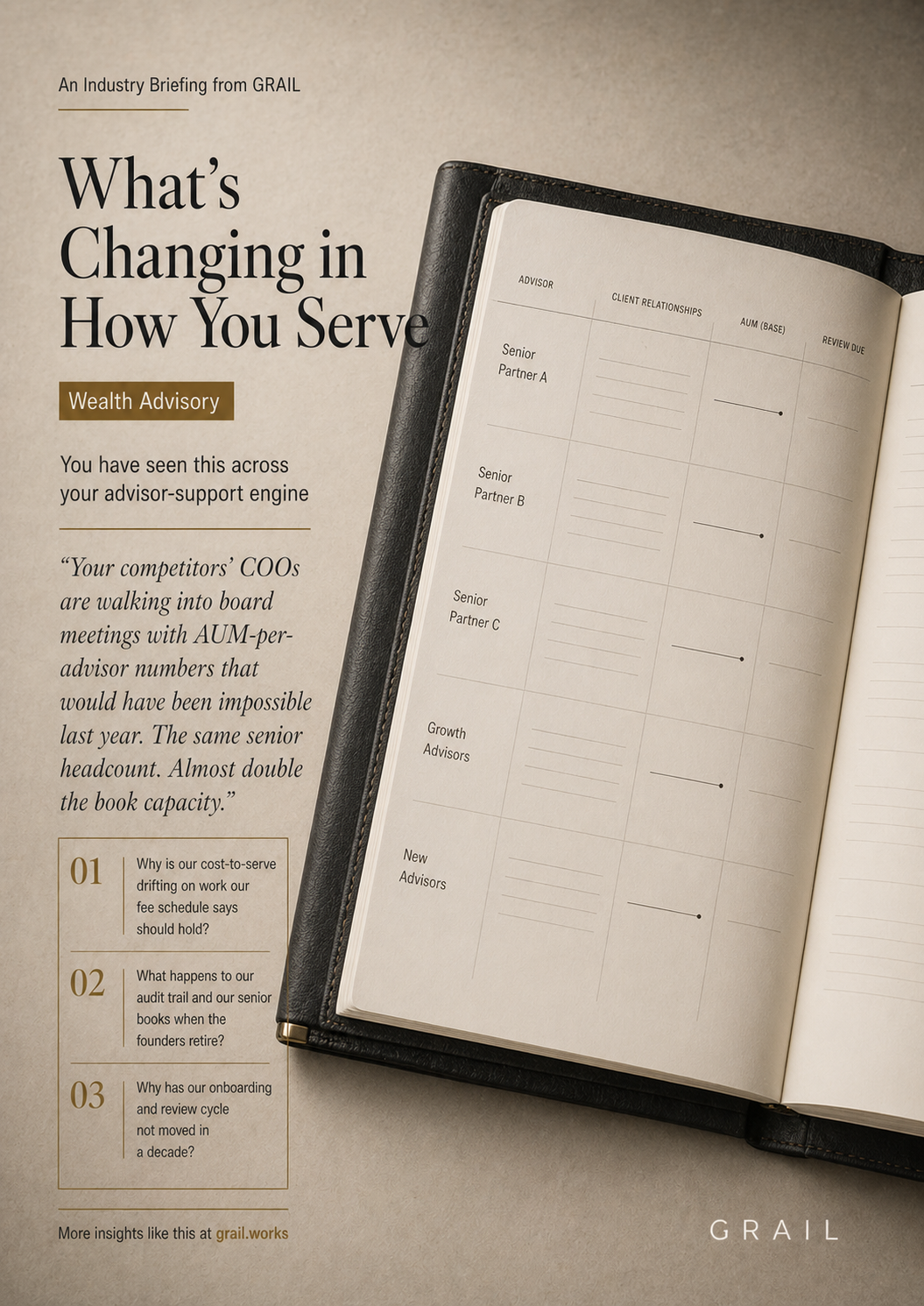
Why is our cost-to-serve drifting on work our fee schedule says should hold?
The fee schedule has not moved. Paraplanner utilisation is within target. But cost-to-serve on your HNWI book is up two to four points against two years ago, and your senior advisors are spending more hours on meeting prep than on meeting time. The platforms your advisors already subscribe to are producing the analysis work that justified the bench.
What happens to our audit trail and our senior books when the founders retire?
Six to fourteen of your senior advisors are within five years of retirement. Each one carries HNWI client judgment that took twenty-five years to build and has never been written down. Twenty to thirty percent of the book moves the year after the retirement announcement, and the suitability cases they used to catch start landing in the regulator's sample.
Why has our onboarding and review cycle not moved in a decade?
A standard HNWI onboarding takes six to eight weeks. A quarterly portfolio review turns around in ten working days. Half of that elapsed time is preparation, compliance cross-check, and drafting that now compresses to hours. The firms that rebuild advisor support around this close onboarding in ten days, turn reviews around in forty-eight hours, and answer client questions the same morning.
What you get when you download
An 11-page report for Chief Operating Officers and Heads of Operations at boutique and mid-market wealth-management firms. Designed to be read in one sitting before your next operations review.
Your industry, your operations, and why they are one problem
What is happening in boutique wealth as a sector. What is happening inside your advisor-support engine, your compliance and risk operations, your client-service operations, your senior advisors and their books, and your client continuity right now. And the intersection most COOs have not named yet: you do not have three problems, you have one.
Four moves across advisor support, compliance, senior books, and continuity
Decompose every client-service engagement to the task level and rebuild paraplanner roles around the work that still makes money. Build the audit trail as agent infrastructure. Extract senior-advisor judgment as a side-effect of daily work. Institutionalise each HNWI relationship so the book transfers on architecture, not biography.
Five questions for your next operations review
The onboarding-lost-time question. The senior-advisor prep-hours question. The retirement-AUM-exposure question. The measurably-smarter question. The paraplanner-of-2027 question. Where your operations team cannot agree on the answer is the conversation worth an hour on the agenda.
Calibrated for each seat at the table.