Capital.
Forecast.
Story.
What you allocate this year is the story your board reads next year.
This briefing tells you which capital-allocation decisions become 10x bets in financial advisory and wealth management as AI compresses the cost stack. Read it before your peers send their version to the board.
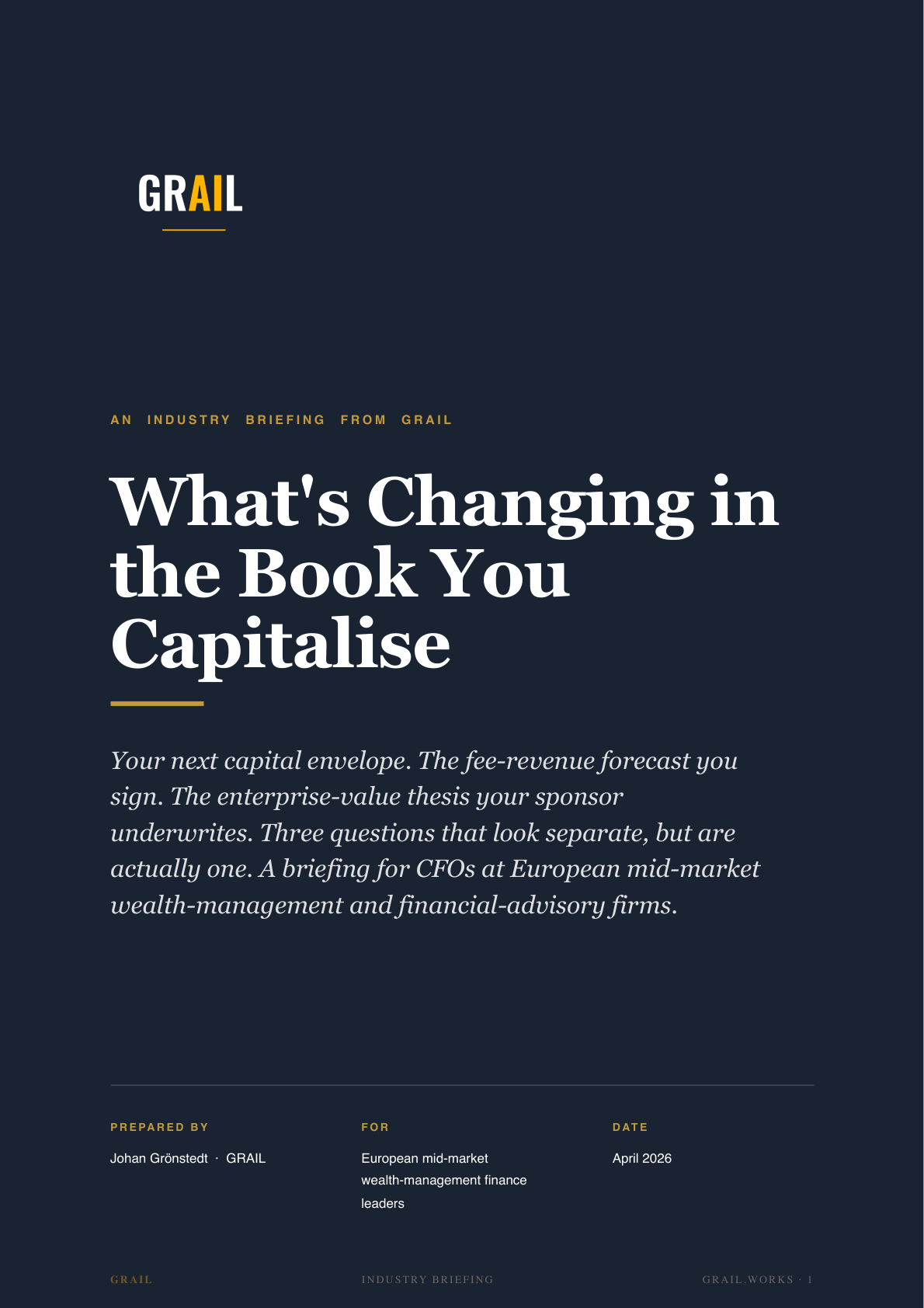
The 10-page briefing. Worth 20 minutes.
One email. One PDF. Worth twenty minutes of your week.
We send it once. Work emails only.
Every CFO at a mid-sized European wealth-management firm has had the same Thursday morning. Four things on the screen at 8:45. The head of the Stockholm desk has announced a 2027 retirement; eleven of his top twenty clients have no secondary relationship anywhere else in the firm. Your Head of Technology forwarded you a planning-platform demo yesterday with a €900k licence attached. Your Head of Advisory has put a €2M senior-advisor retention package on your desk. Your sponsor's partner pinged you on Slack: curious about the succession plan and the valuation implications before Monday.
You have signed fifteen fee-revenue forecasts for this partner group. The pattern used to be simple. Hold the fee schedule, protect the book, grow with the market. The job has not changed in fifty years. The bar has risen on every measure of doing it, simultaneously, and the contradictions you have been navigating since you took the seat are suddenly re-openable.
The senior-advisor retention package the CEO wants you to sign is not a comp line. It is the largest single capital-allocation decision you will make this year.
This is the question your chair is already asking. The briefing below is what you want in your hand before the next partner group meeting.
Capital Allocation. Forecast Credibility. Value-Creation Narrative.
Three questions every wealth-management CFO is tracking. The first is the crux. The other two are how you earn the right to answer it.
Where does the next capital envelope actually compound?
AI-augmented advisor infrastructure, senior-advisor retention packages, tuck-in of a retiring-founder boutique, founding-partner succession buyout, platform licence for the next tier. Today's default: each requisition arrives on a different week, gets signed, and the capital-allocation authority fragments across the partner group.
Why did fee revenue print below plan, and what is the client-level story?
Your partner group voted on fee-revenue growth. Your firm is printing below. Your Head of FP&A cannot walk the audit committee through the retention story. The relationship signal sits in advisor calendars. The flow signal sits in planning software. The fee-margin signal sits in benchmarks the finance team has never seen.
What does this firm do that compounds faster than peers?
Your board wants the strategy-day preview. Your sponsor wants the AI-and-succession note. Your chair wants the how-we-stay-ahead answer. Three audiences, three documents, three teams, and the numbers underneath them do not match.
What you get when you download
An 11-page report for Chief Financial Officers at mid-market European wealth-management firms. Designed to be read in one sitting before your next partner group meeting.
Your industry, your finance function, and why they are one problem
What is happening in mid-market wealth management as a sector. What is happening inside your capital, your forecast, your fee architecture, your Controller bench, and your enterprise-value thesis right now. And the intersection most CFOs have not named yet: you do not have three scorecard problems, you have one.
Four moves across capital, forecast, fee architecture, and narrative
Route every capital decision through one portfolio page, not five requisitions. Rebuild the forecast as a retention driver graph, not an AUM spreadsheet. Migrate fee architecture from AUM-basis-points to three mechanics. Write the enterprise-value thesis once, refresh continuously off the same data.
Five questions for your next partner group meeting
The platform-licence question. The fee-revenue-plan-versus-print question. The three-fee-mechanics question. The three-audiences-one-thesis question. The 2031-succession-bench question. Where your finance leadership cannot agree on the answer is the conversation worth an hour on the agenda.
Calibrated for each seat at the table.