Margin.
Pace.
Position.
The whole GTM playbook is being rewritten in real time, across every commercial team at once.
This briefing tells you how the GTM playbook gets rewritten in life sciences as AI compresses every commercial team. Read it before your competitors hit their first AI-native quarter.
The 10-page briefing. Worth 20 minutes.
One email. One PDF. Worth twenty minutes of your week.
We send it once. Work emails only.
It is Monday at a European pharma affiliate. Three things happened over the weekend. Your lead MSL left a voicemail about a KOL who raised a safety concern on a sub-group your field force has never been briefed on. Your Head of Market Access emailed at eleven Friday night: the reimbursement decision may come two months earlier than planned. Your competitor announced EMA approval six weeks ahead of your expected date.
You have run four launches in this affiliate. The pattern used to be clear. Hire the right specialists. Build a tight launch team. Run disciplined quarterly coordination. Something changed.
This is not a you problem. It is an industry problem and a function problem, happening at the same time. Most commercial leaders are treating them as two. The ones who see them as one are going to own the next decade of launches.
Same technology. Same twelve months. Opposite outcomes. The difference is the operator, not the AI.
Your GM is already asking you about this. The briefing below is what you want in your hand before that conversation.
Uptake. Coordination. Continuity.
Three questions every commercial leader is tracking. None of them used to be the same question. They are now.
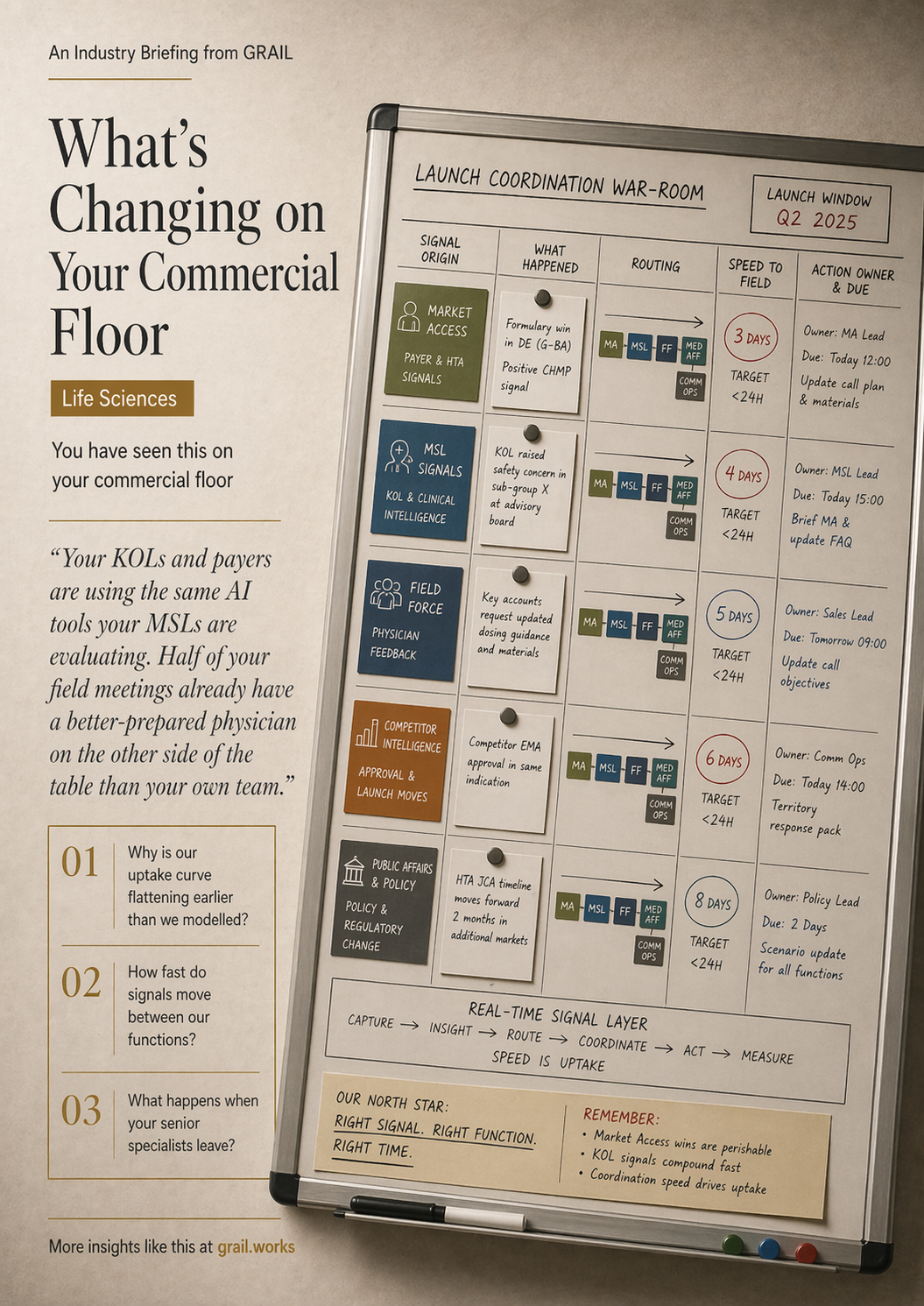
Why is our uptake curve flattening earlier than we modelled?
The launch you ran two years ago hit plateau faster than the one before. The one in market now looks like it will plateau sooner still. Your patent clock has not changed. What changed is that competitors landed formulary positions faster and KOLs arrived at advisory boards already briefed.
How fast do signals move between our functions?
Your market access team lands a formulary win on Tuesday. Your field force does not hear about it until the next planning meeting. An MSL captures a KOL's concern at a congress; the JCA dossier team finds out three weeks later. This is invisible in any function's KPIs.
What happens when our senior specialists leave?
Three to five people on your floor carry the KOL relationships, the HTA knowledge, and the payer read your operation runs on. Two are being approached by larger affiliates this quarter. When they leave, the launch momentum stalls twelve to eighteen months later.
What you get when you download
An 11-page report for commercial leaders at mid-market life sciences affiliates. Designed to be read in one sitting before your next launch readiness review.
Your industry, your function, and why they are one problem
What is happening in life sciences commercialisation as a sector. What is happening on your affiliate's floor right now. And the intersection most commercial leaders have not named yet. Plain language you can use in the GM staff meeting.
Four moves across MSLs, market access, field force, and continuity
How to build the research cell around each MSL. How to stand up an HTA and formulary intelligence layer. How to translate KOL-level intelligence into physician calls fast. How to capture what your senior specialists know before they leave.
Five questions for your next launch readiness review
Time from approval to peak uptake on your last two launches. What changes when market access wins a formulary. Top-three specialist handover plan. Where your average MSL spends Monday morning. The specialists already doing what the rest will need to do by 2027.
Calibrated for each seat at the table.