Cheaper.
Better.
Faster.
The triple threat that used to be a tradeoff is now table stakes.
This briefing tells you where the triple threat lands in life sciences operations as AI rewrites the cost structure. Read it before your competitors decide who is table stakes.
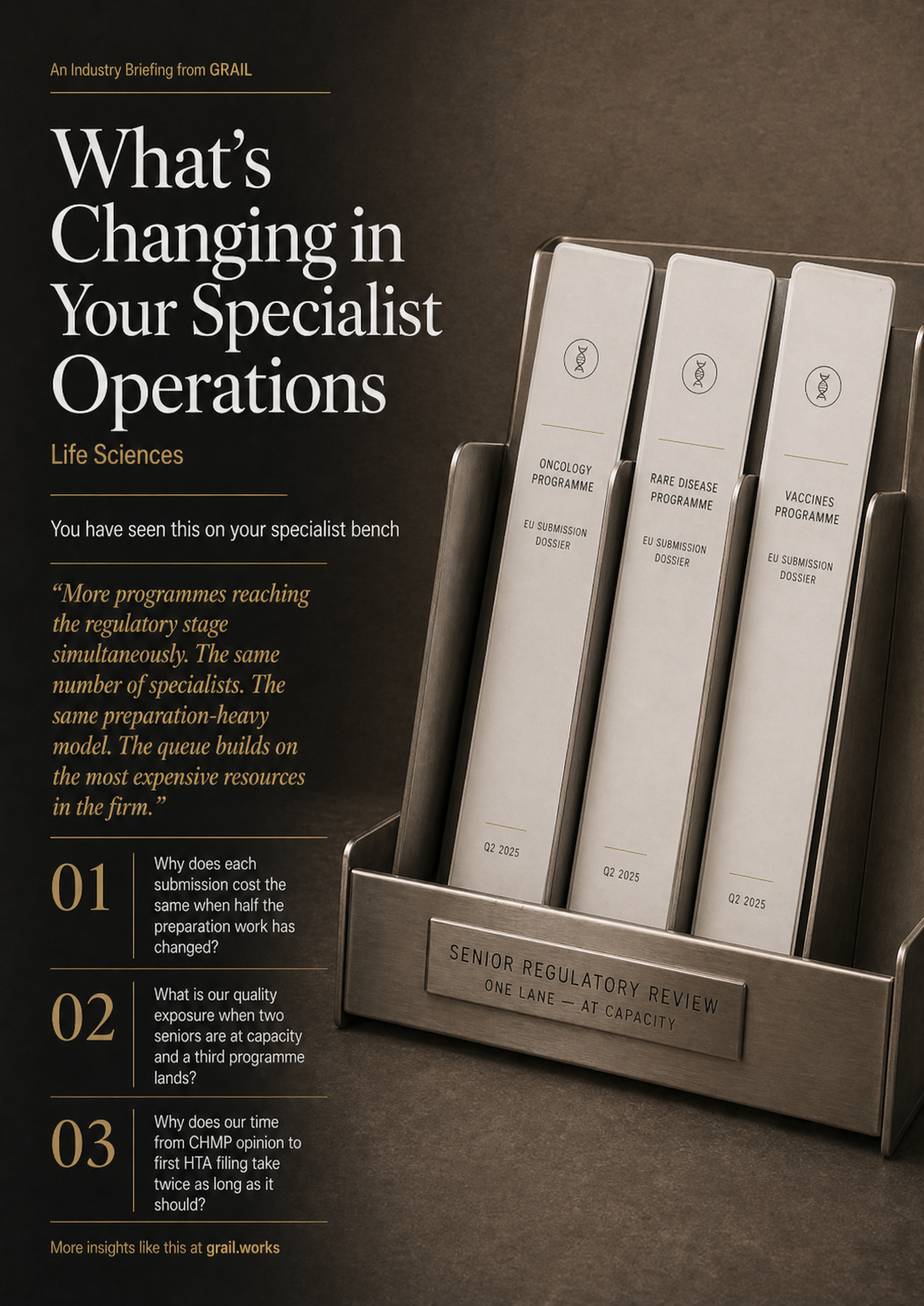
The 10-page briefing. Worth 20 minutes.
One email. One PDF. Worth twenty minutes of your week.
We send it once. Work emails only.
Every COO at a mid-sized pharma affiliate or specialty pharma firm has had this Tuesday. Day 120 EMA response due before end of day. PSUR review for the cardiometabolic programme on Thursday. Germany HTA package shipping next week. The market access manager who joined in January is covering the fourth programme on her own. The regulatory affairs director is the bottleneck. The CEO asked about programme timelines in the last leadership meeting.
You have run this function for fifteen years. The specialist bench used to carry the load. Something has shifted. The EU HTA Regulation changed in January 2025. Multi-market submission requirements that used to run sequentially are running simultaneously. Your bench has not grown. The queue has.
Most life sciences COOs are treating this as a resourcing problem. The ones pulling ahead have realised it is a preparation problem. The preparation that consumes half your specialists' time is not regulated. The judgment that takes the other half is.
Same bench. Same quality. Three programmes instead of two. The difference is whether the preparation layer is still running on your specialists or on the infrastructure built around them.
Your CEO is already asking about programme timelines. The briefing below is what you want in your hand before the next operations review.
Knowledge Delivery Cost. Specialist Output Quality. Programme Cycle Time.
Three questions every life sciences COO is tracking. None of them used to be the same question. They are now.
Why does each submission cost the same when half the preparation work has changed?
Your specialists are fully loaded. Your rate card has not moved. But the cost per qualified regulatory or market access output is drifting upward. Regulatory affairs managers spend forty to fifty percent of their time on compilation, cross-referencing, and formatting that AI now handles at comparable quality. The specialist who costs you €220,000 fully loaded per year is spending half their time on work your firm is overqualifying.
What is your quality exposure when two seniors are at capacity and a third programme lands?
Your quality floor cannot slip. FDA warning letters, EMA referral procedures, HTA rejection. All downstream of quality failure, and all existential for a mid-market firm. The paradox: quality often rises when specialists shift from compilation to review. The specialist who reviews an agent-drafted PSUR narrative finds the error that the compilation specialist missed because she was tired on hour six of formatting. Capacity pressure is where the quality floor breaks.
Why does your CHMP opinion filing take twice as long as it should?
A six-country HTA submission package takes the same four people the same eight weeks it always has. But the EU HTA Regulation now means those six packages run simultaneously, not sequentially. More submissions, same bench, same preparation architecture. The queue builds. The firms that rebuild the preparation layer compress cycle times by thirty to fifty percent on the same bench. That cycle-time advantage in market access is not incremental. It is first-mover pricing versus second-mover discount.
What you get when you download
An 11-page report for COOs and Heads of Operations at mid-market European life sciences firms. Designed to be read in one sitting before your next operations review.
Your industry, your specialist bench, and why they are one problem
What is happening in European life sciences operations as the EU HTA Regulation reshapes multi-market submission requirements. What is happening inside your regulatory affairs function, your market access team, your medical affairs and pharmacovigilance bench, and your programme pipeline. And the intersection most COOs have not named yet: the preparation layer that consumes half your specialists' time is the constraint, and it is not a regulated constraint.
Four moves across regulatory, market access, pharmacovigilance, and your bench
Extract the submission preparation layer from regulatory affairs. Rebuild the dossier assembly process in market access. Free your senior medical affairs and safety professionals from literature monitoring and PSUR narrative drafting. Solve the succession problem before the retirement conversations start. Four concrete moves, one per sub-function, built for a COO who runs the specialist bench, not the science.
Five questions for your next operations review
The preparation-versus-judgment question for your regulatory and market access specialists. The three-simultaneous-programmes question. The retirement-exposure question for your senior regulatory director's EMA negotiation history. The parallel-versus-sequential programme question. The market access timing question your CFO will ask when the next submission delays by six weeks. Where your operations team cannot agree is the conversation worth an hour on the agenda.
Calibrated for each seat at the table.