Revenue.
Margin.
Valuation.
Three numbers your board reads. AI is rewriting all three in your industry.
This briefing tells you where revenue, margin, and valuation move in life sciences as AI rewrites the industry. Read it before your competitors decide what your next decade looks like.
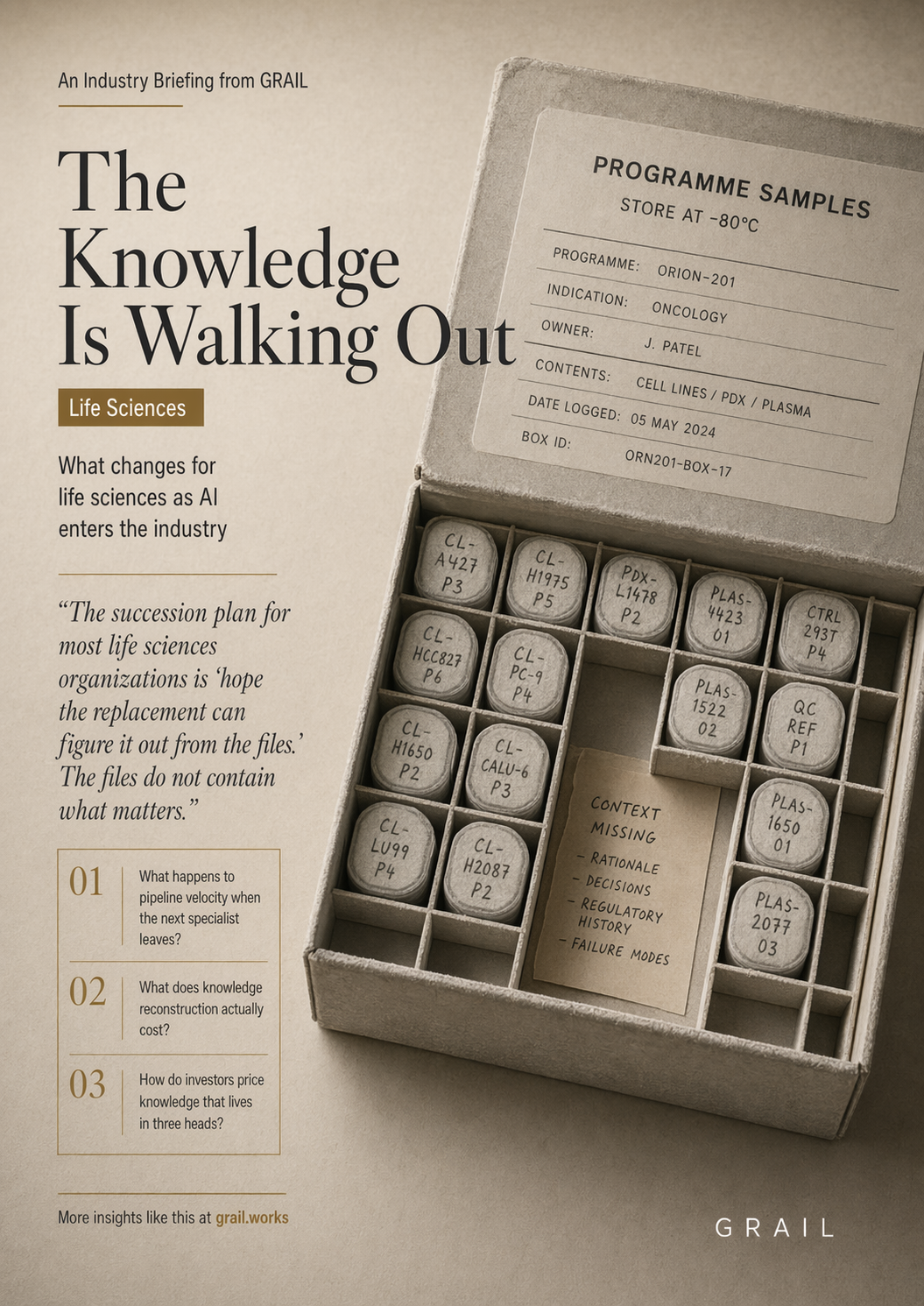
The 10-page briefing. Worth 20 minutes.
One email. One PDF. Worth twenty minutes of your week.
We send it once. Work emails only.
AI is compressing early discovery timelines by 30 to 40 percent. Target identification, molecular simulation, and literature review all move faster. But no AI-discovered drug has received FDA approval. Clinical trials remain biology-bound. The result: more programs reach the translational and regulatory phases simultaneously, creating capacity pressure on the exact specialists who are hardest to retain.
The knowledge that drives your pipeline is personal, accumulated over years, and irreplaceable when it leaves. That is not a talent problem. It is a structural vulnerability.
Regulatory affairs directors, principal scientists, MSLs, and market access specialists carry knowledge that lives in their heads, not in any system. Biotech layoffs rose 16 percent year over year in 2025, with 42,700 people affected, yet shortages persist in the exact roles where knowledge fragility is highest. The people who carry the most critical knowledge are the most in demand and the most at risk of departure.
For the CEO of a life sciences company, this is not a talent retention question. It is a revenue question, a profit question, and a valuation question.
Revenue. Profit. Valuation.
Three lenses. Three answers the management team needs before the next board meeting.
Revenue
Pipeline velocity depends on specialists who handle regulatory interactions, manage cross-functional coordination, and maintain the commercial relationships that drive market access. When one of those specialists leaves, the program does not stop. It slows. Submissions take longer. Regulatory responses lose precision. Launch timelines drift by quarters, not weeks. The revenue impact is invisible until the pipeline review reveals the delay.
Profit
Reconstructing specialist knowledge after a departure costs far more than encoding it while the expert is still available. External consultants, delayed submissions, rework on regulatory narratives. The cost is not the replacement hire. It is the 12 to 18 months of degraded decision quality while the organization reconstructs what one person carried.
Valuation
Acquirers and investors discount companies where pipeline-critical knowledge is held by a handful of individuals. Due diligence that reveals three people carry the regulatory narrative, the clinical strategy, and the commercial relationships creates a risk premium. Institutional knowledge infrastructure is a valuation premium. Personal knowledge concentration is a valuation discount.
What you'll get when you download
A 10-page report for life sciences CEOs and management teams. Designed to be read in one sitting before your next board meeting.
The strategic choice, side by side
The default path (invest in discovery AI, hope the talent market stabilizes, manage knowledge risk through succession planning) and the repositioning path (build institutional knowledge infrastructure, encode specialist expertise before departures force reconstruction, use AI to extend scarce specialist capacity), with the financial logic of each.
The four levers that compound
Encode specialist knowledge into institutional infrastructure while the experts are still available. Use AI to handle the preparation, monitoring, and documentation that consume 40 to 50 percent of specialist time. Build cross-functional knowledge systems that survive personnel transitions. Reframe the talent strategy around knowledge architecture, not headcount.
Five questions for your next board meeting
Diagnostic questions the CEO should test the leadership team against before the board sees the pipeline review. The questions where the room cannot agree are the ones worth a longer conversation.
Calibrated for each seat at the table.