Revenue.
Margin.
Valuation.
Three numbers your board reads. AI is rewriting all three in your industry.
This briefing tells you where revenue, margin, and valuation move in sales-heavy manufacturing as AI rewrites the industry. Read it before your competitors decide what your next decade looks like.
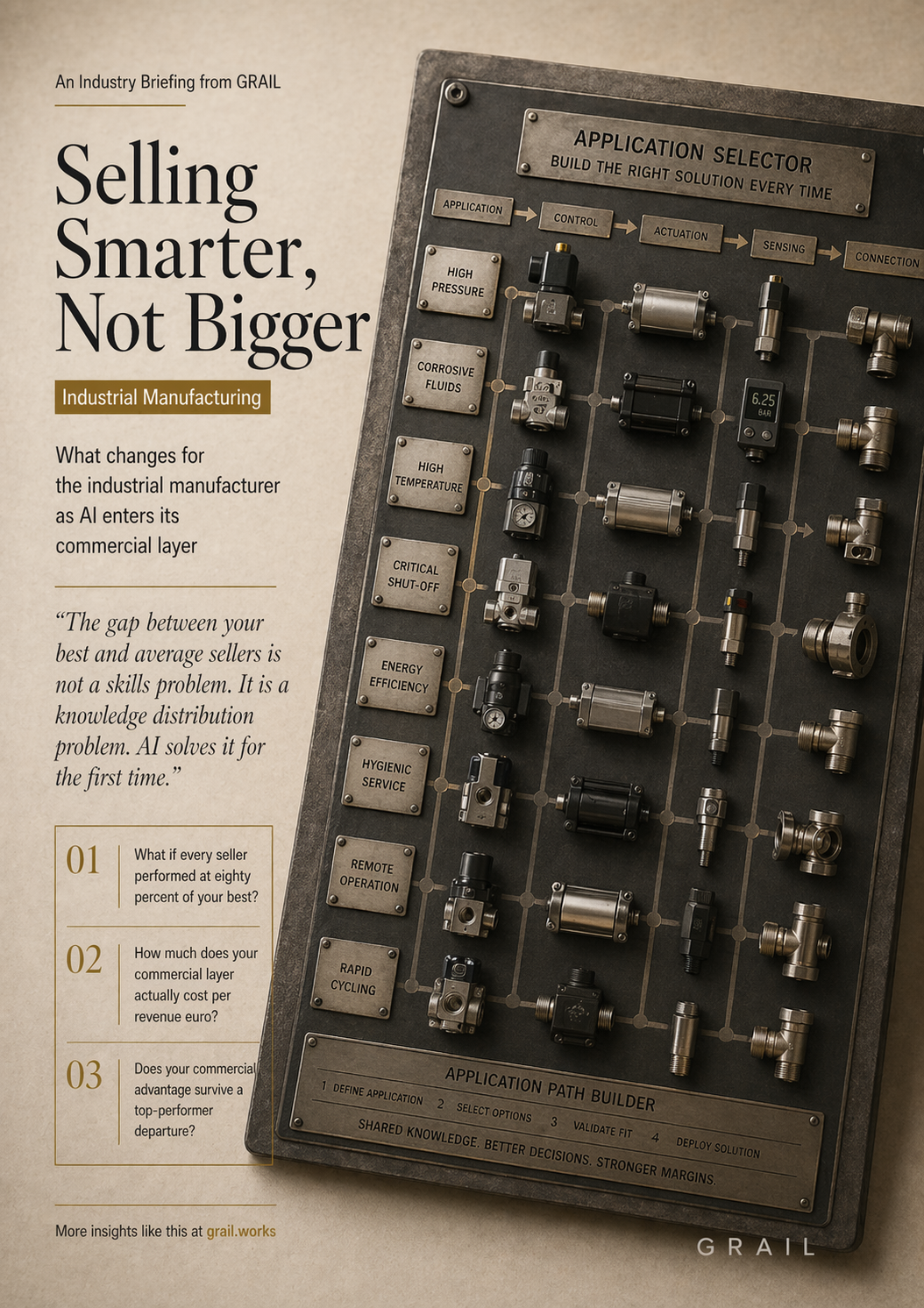
The 10-page briefing. Worth 20 minutes.
One email. One PDF. Worth twenty minutes of your week.
We send it once. Work emails only.
In most industrial sales teams, three to five people generate forty percent of revenue. They carry fifteen to twenty years of application knowledge that exists only in their heads: which products fail in specific environments, which competitive alternatives are vulnerable, which customer contacts actually make the buying decision. No training program has ever transferred this. No CRM has ever captured it. No process redesign has ever closed the gap.
The gap between your best and average sellers is not a skills problem. It is a knowledge distribution problem. AI solves it for the first time.
AI changes the economics of knowledge distribution completely. Application knowledge can now be extracted from work artifacts that already exist: call transcripts, tender responses, technical reports, installation records. The expert does not need to document anything new. The system learns from what they already produce. The five-year learning curve compresses to months. The performance gap becomes structurally closeable.
For the CEO of an industrial manufacturer with a large sales organization, this is not a technology question. It is a revenue question, a profit question, and a valuation question.
Revenue. Profit. Valuation.
Three lenses. Three answers the management team needs before the next board meeting.
Revenue
A fifteen-person sales team carrying 150,000 euros each in annual revenue. A five percent improvement produces 112,000 euros in additional revenue against a program investment of 35,000 euros. At ten percent the return doubles. Scale across a hundred sellers in multiple countries and the compound effect is transformational. The math is not theoretical. Industrial sales leaders do the calculation themselves when they see what AI-augmented preparation looks like.
Profit
Sellers spend forty to sixty percent of their time preparing to sell, documenting what was sold, and reporting what happened. That is not selling. That is overhead. AI compresses preparation from hours to minutes and follow-up from days to minutes. The same team produces more revenue without adding headcount. Operating margins in industrial manufacturing run five to twelve percent. Even small shifts in commercial efficiency move profit materially.
Valuation
Each senior seller departure costs eighteen to thirty-six months of knowledge rebuilding at 1.5 to 2 times base salary in replacement cost. The revenue impact surfaces as customer relationships migrate. A company whose commercial intelligence is institutional, not personal, eliminates this risk entirely. The same revenue base, at a very different risk profile, commands a different valuation from any buyer or investor who looks at the business.
What you'll get when you download
A 10-page report for industrial manufacturing CEOs and VP Sales. Designed to be read in one sitting before your next leadership meeting.
The strategic choice, side by side
The default path (automate the CRM, buy generic sales tools, accept the bell curve) and the repositioning path (augment the seller, build application-specific intelligence, close the bell curve), with the commercial logic of each. What happens to revenue, profit, and valuation under both scenarios.
The four levers that compound
Encode top-seller knowledge into organizational infrastructure. AI-augment the full sales meeting cycle. Scale proven systems across geographies from group level. Invest in the commercial layer, not just the product layer. Four moves, each modest alone, transformational together.
Five questions for your next leadership meeting
Diagnostic questions the CEO should test the management team against before the next board review. The questions where the room cannot agree are the ones worth a longer conversation.
Calibrated for each seat at the table.