Cheaper.
Better.
Faster.
The triple threat that used to be a tradeoff is now table stakes.
This briefing tells you where the triple threat lands in sales-heavy manufacturing operations as AI rewrites the cost structure. Read it before your competitors decide who is table stakes.
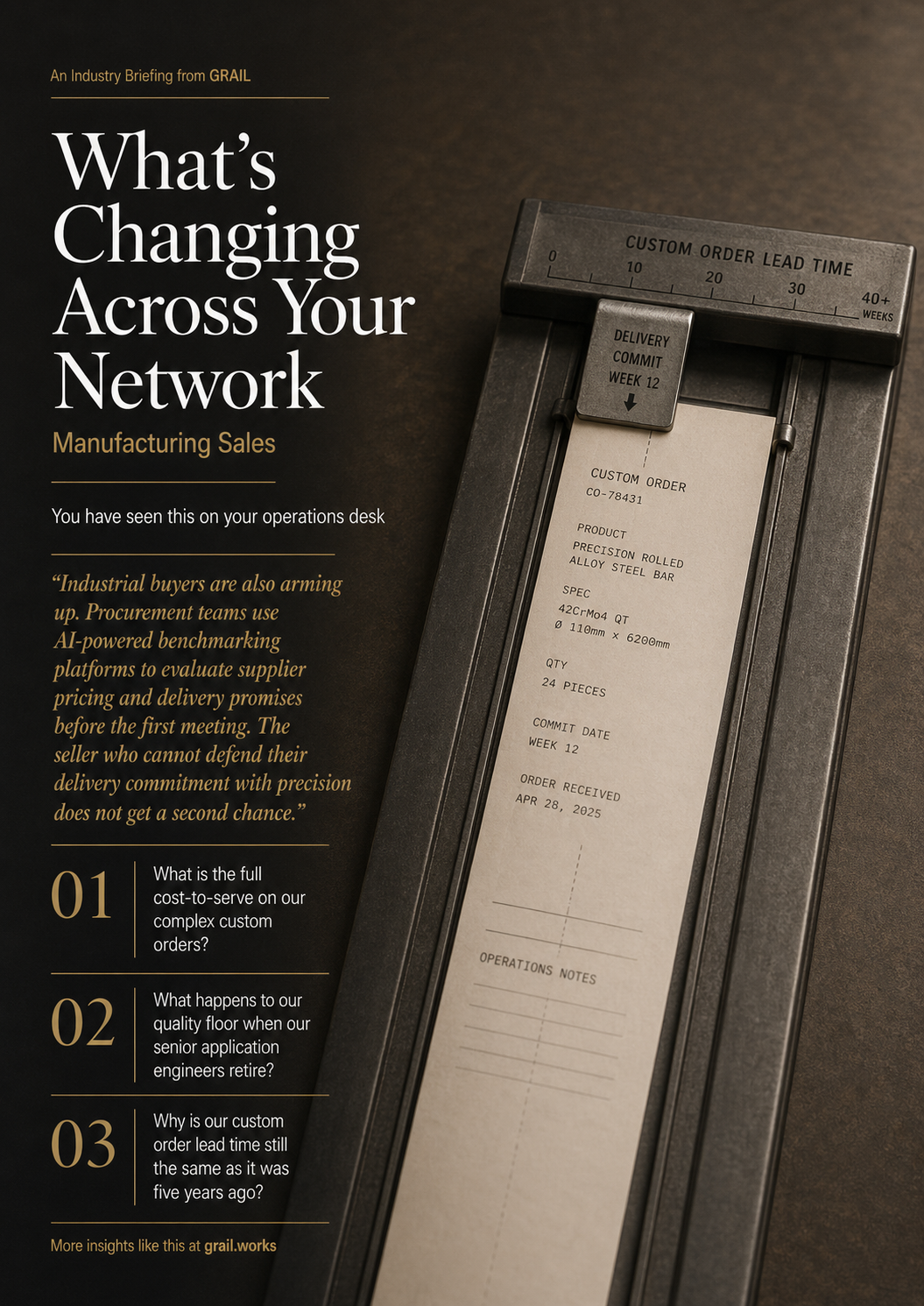
The 10-page briefing. Worth 20 minutes.
One email. One PDF. Worth twenty minutes of your week.
We send it once. Work emails only.
Every Chief Operating Officer at a mid-market technical manufacturer has had the same Monday morning. The UK VP Sales closed a deal last week: fourteen custom sensor variants, three-week delivery commitment. Your MRP says seven weeks. Your planning team is rebuilding the schedule this morning. The customer is automotive. You have seven months before the annual review.
Then there is the post-mortem from last quarter's lost tender. Won on technical specification. Lost on delivery commitment. The customer gave the contract to a competitor who promised four weeks.
And on Friday, your most senior application engineer in the SEMICON division handed in his notice. He retires in three months. Everything he knows about how your products perform in cleanroom environments above 80°C is in his head, not in your quality systems.
The delivery commitment your commercial team can make is set by the operations capability you have built today.
Your CEO is about to ask which side of this you are building toward. The briefing below is what you want in your hand before that conversation.
Order Margin. On-Time-In-Full. Order-to-Delivery Cycle.
Three questions every manufacturing COO is tracking. They used to be separate numbers. In 2026 they are the same question.
What is the full cost-to-serve on our complex custom orders?
The production cost per unit is fine. But the full cost to serve a technically complex custom order: configuration work, planning overhead, rework from specification errors, after-sales on mis-specified installations. That number is drifting. On the deals you most want to win.
What happens to our quality floor when our senior application engineers retire?
Three to eight of your most senior application engineers carry field-performance knowledge accumulated over twenty-plus years. Which variants fail in flour dust at 40°C. Which sealing grades hold in pharmaceutical washdown. That knowledge has never been extracted. When they retire, the quality floor drops before the metrics show it.
Why is our custom order lead time still the same as it was five years ago?
Complex custom orders take six to ten weeks from signature to delivery. Competitors with tighter operations-to-sales coordination promise three to four. Industrial customers choosing between two technically equivalent offerings choose on lead time certainty. The COO who compresses this cycle gives sales a commercial weapon they cannot buy.
What you get when you download
An 11-page report for Chief Operating Officers and operations directors at mid-market European industrial B2B manufacturers. Designed to be read in one sitting before your next operations review.
Your industry, your delivery network, and why they are one problem
What is happening in manufacturing-sales as a sector as AI enters the commercial layer. What is happening inside your supply chain, your production and quality systems, your planning team, and your order fulfilment right now. And the intersection most manufacturing COOs have not yet named: your commercial velocity and your operations velocity are not running at the same speed.
Four moves across supply chain, quality, workforce, and order fulfilment
Decompose the custom order flow to compress lead time without adding capacity. Extract senior application engineers' field knowledge as a side-effect of daily work. Redesign planning roles around exception handling from day one. Build the real-time loop between sales commitments and what your production network can actually deliver.
Five questions for your next operations review
The custom order rework question. The application engineer retirement question. The on-time-in-full question on complex orders separated from standard lines. The planning coordination rework question. The new-entrant judgment question. Where your operations team cannot agree is the conversation worth an hour on the agenda.
Calibrated for each seat at the table.