Capital.
Forecast.
Story.
What you allocate this year is the story your board reads next year.
This briefing tells you which capital-allocation decisions become 10x bets in sales-heavy manufacturing as AI compresses the cost stack. Read it before your peers send their version to the board.
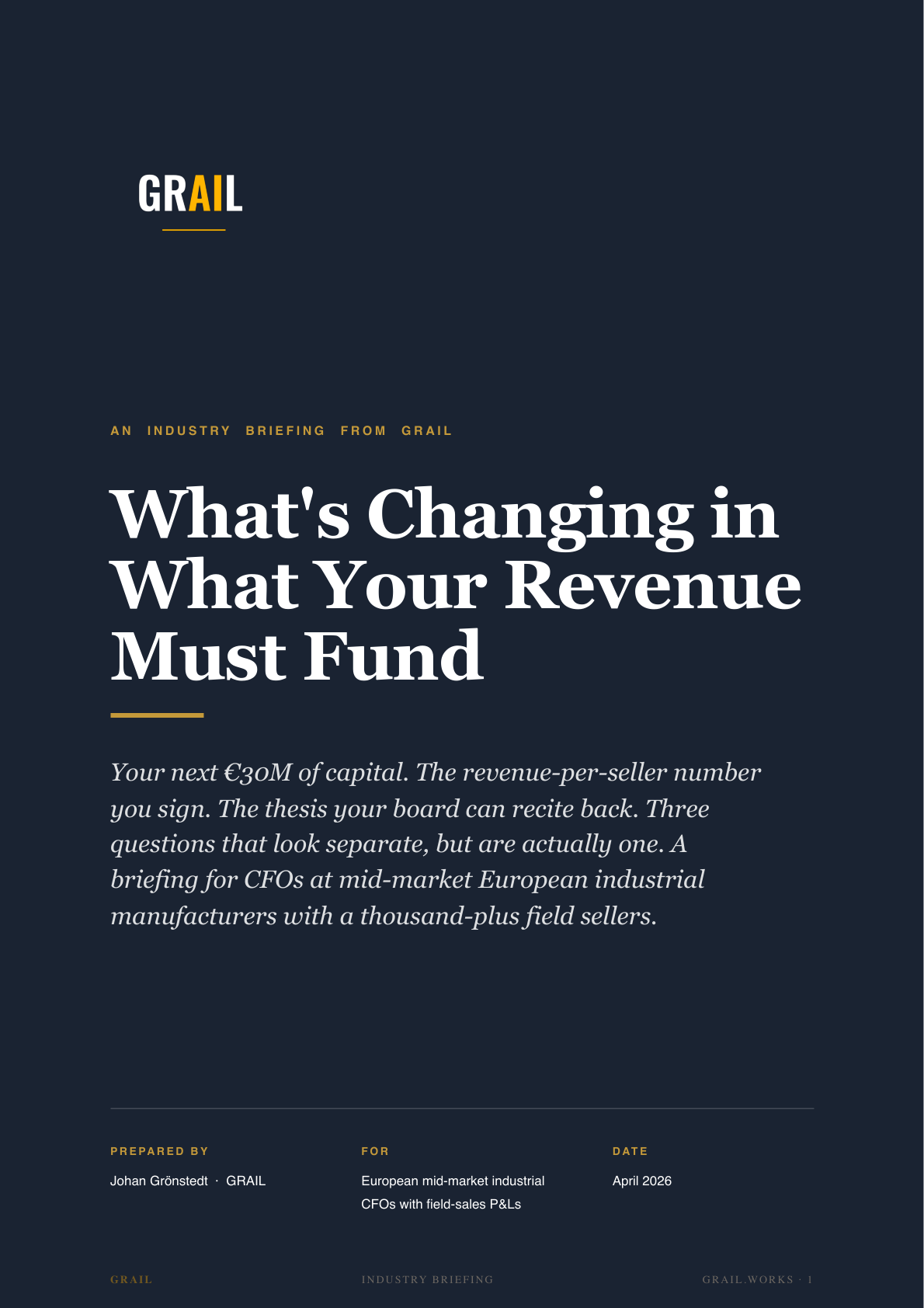
The 10-page briefing. Worth 20 minutes.
One email. One PDF. Worth twenty minutes of your week.
We send it once. Work emails only.
Every CFO at a mid-sized European industrial manufacturer with a thousand-plus field sellers has had the same Thursday morning. Four things on the screen at 8:30. Q3 revenue per seller printed at 164K against a 180K plan, the second consecutive quarter below. Your top application seller in the DACH region retired last month and three key accounts have gone quiet. Your CTO wants 3M next quarter for an IoT platform. Your banking syndicate is on the Friday call and covenant headroom has tightened 40 bps.
You have signed fifteen revenue-per-seller forecasts for this board. The pattern used to be simple. Hold the channel margin, hold the forecast, grow into the plan. The job has not changed in fifty years. The bar has risen on every measure of doing it, simultaneously, and the contradictions you have been navigating since you took the seat are suddenly re-openable.
The 800K your Group Head of Sales wants for a commercial-layer AI programme is a capital-allocation decision, not an OpEx line. It sits at a higher ROIC than anything else on the page you sign.
This is the question your chair is already asking before the retirement wave lands. The briefing below is what you want in your hand before the next revenue-per-seller review.
Capital Allocation. Forecast Credibility. Value-Creation Narrative.
Three questions every industrial CFO with a thousand-plus field sellers is tracking. The first is the crux. The other two are how you earn the right to answer it.
Where does the next €30M actually compound?
Plant capex, IoT platform, tuck-in of a specialty distributor, working-capital financing, share buyback, commercial-layer AI programme. Today's default: the COO asks for capex, the CTO asks for IoT, and the 1,200-person sales organisation where the margin is made gets nothing.
Why did revenue per seller print below plan, and what is the territory story?
Your board voted on 180K revenue per seller. Your firm is printing 164K. Your Head of FP&A cannot walk the audit committee through the territory-and-application story. The ramp signal sits in sales-manager one-to-ones. The price-leak signal sits in CPQ overrides. The retention signal sits in HR.
What does this firm do that compounds faster than peers?
Your board wants the strategy-day preview. Your owners want the AI-and-headcount note. Your chair wants the how-we-stay-ahead answer before the retirement wave lands. Three audiences, three documents, three teams, and the numbers underneath them do not match.
What you get when you download
An 11-page report for Chief Financial Officers at mid-market European industrial manufacturers with a thousand-plus field-sales organisations. Designed to be read in one sitting before your next revenue-per-seller review.
Your industry, your finance function, and why they are one problem
What is happening in mid-market industrial manufacturing as a sector. What is happening inside your capital allocation, your revenue-per-seller forecast, your quote-to-cash cycle, your Controller bench, and your economic thesis right now. And the intersection most CFOs have not named yet: you do not have three scorecard problems, you have one.
Four moves across capital, forecast, treasury, and narrative
Route commercial-layer AI through the M&A hurdle, not the OpEx budget. Rebuild the revenue-per-seller forecast as a live driver graph, not a rolling spreadsheet. Compress quote-to-cash from thirty-four days to twelve. Write the economic thesis once, refresh continuously off the same data.
Five questions for your next margin and revenue-per-seller review
The IoT-versus-commercial-AI capital question. The 180K-plan-164K-print question. The retirement-wave application-knowledge question. The three-audiences-one-thesis question. The 2031-succession-bench question. Where your finance leadership cannot agree on the answer is the conversation worth an hour on the agenda.
Calibrated for each seat at the table.