Revenue.
Margin.
Valuation.
Three numbers your board reads. AI is rewriting all three in your industry.
This briefing tells you where revenue, margin, and valuation move in strategy and management consulting boutiques as AI rewrites the industry. Read it before your competitors decide what your next decade looks like.
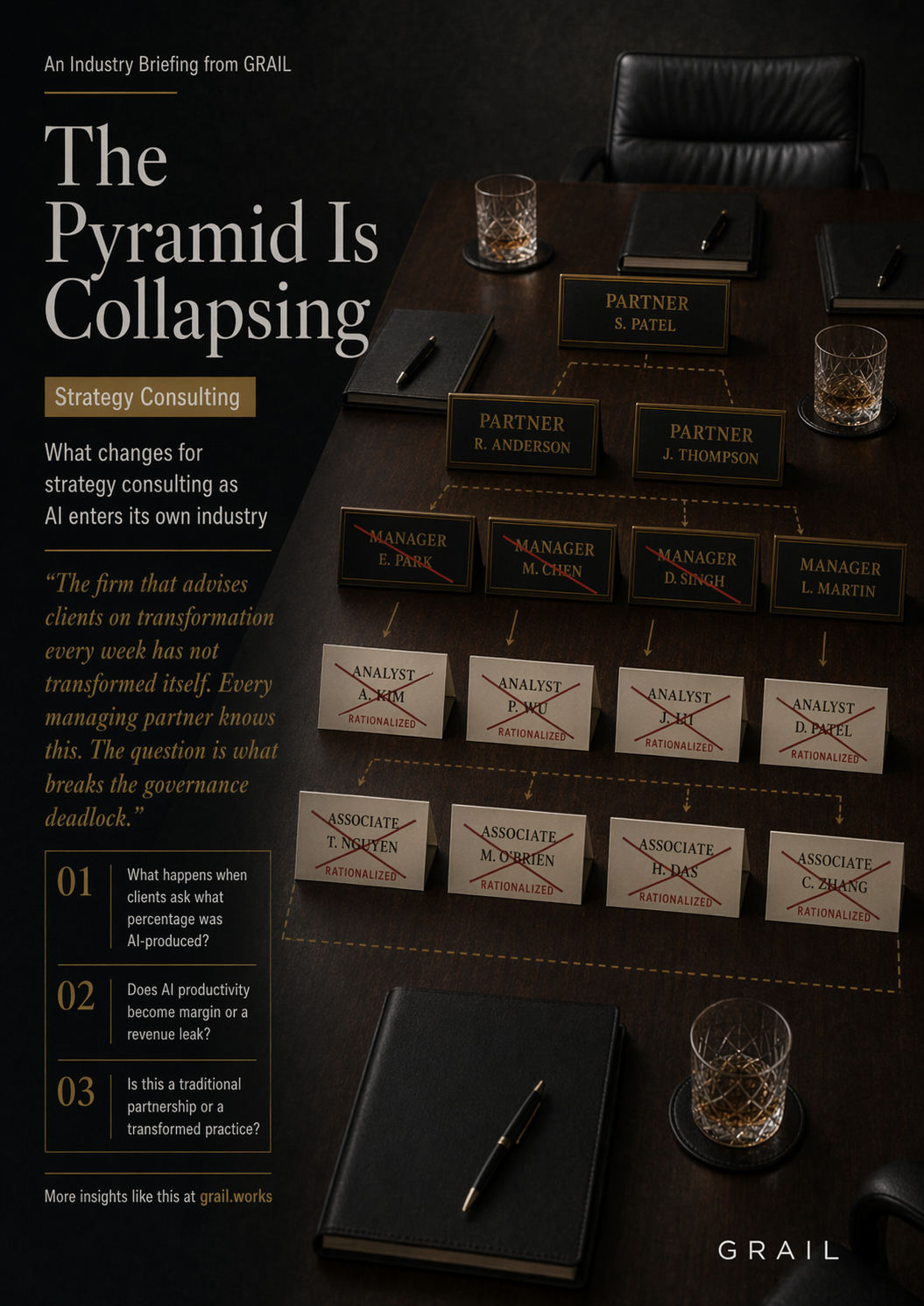
The 10-page briefing. Worth 20 minutes.
One email. One PDF. Worth twenty minutes of your week.
We send it once. Work emails only.
Strategy consulting built its economics on the pyramid: junior analysts execute intelligence-heavy production work at high billing multiples, supervised by senior partners who hold the client relationships and the judgment. AI has made sixty to seventy percent of that junior layer executable in seconds. Benchmarking, financial modeling, market sizing, slide production, secondary research. The work that funds the partnership is compressing.
You advise your clients on transformation every week. Has the partnership had the same conversation about your own firm's model?
The harder problem is not the technology. It is the governance. Partnership structures give every partner with a client book an implicit veto over changes that threaten their personal economics. Everyone agrees the firm needs to change. Nobody agrees to change their own practice first. This is a collective action problem, not a strategy problem.
For the managing partner, this is not an innovation question. It is a revenue question, a profit question, and a valuation question.
Revenue. Profit. Valuation.
Three lenses. Three answers the partnership needs before the next partner meeting.
Revenue
Clients are twelve to eighteen months from systematically asking what percentage of your deliverables were produced by AI. The first boutique in your market segment that prices transparently on a human-plus-AI model captures the positioning advantage. The second one is defending. Firms on time-based pricing grew 2.1% annually. Firms on value-based pricing grew 8.7%.
Profit
Industry EBITDA hit a five-year low. Billable utilization fell below the 75% healthy threshold. More productive juniors under the current model mean fewer billable hours, not more profit. The billing engine that built 25 to 40 percent EBITDA is running in reverse. The profit question is whether your pricing model turns AI productivity into margin or into a revenue leak.
Valuation
PE-backed AI-native entrants are being funded at scale to build consulting from the ground up without the pyramid. No junior layer, no legacy governance, structurally lower cost. The valuation question for incumbent boutiques: does the market price your firm as a traditional partnership with compressed margins, or as a transformed practice with a new delivery model and growing value-based revenue?
What you'll get when you download
A 10-page report for managing partners of strategy and management consulting boutiques. Designed to be read in one sitting before your next partner meeting.
The strategic choice, side by side
The default path (adopt AI quietly, expand margins, keep billing model) and the repositioning path (separate intelligence from judgment, reprice explicitly, redesign the apprenticeship model), with the financial logic of each.
The four levers that compound
Separate intelligence delivery from judgment pricing. Redesign the apprenticeship model for AI-augmented pattern recognition. Move first on transparent human-plus-AI pricing. Turn partnership governance from a veto structure into a change architecture.
Five questions for your next partner meeting
Diagnostic questions the managing partner should test the senior partnership against. The questions where the room cannot agree are the ones worth a longer conversation.
Calibrated for each seat at the table.