Cheaper.
Better.
Faster.
The triple threat that used to be a tradeoff is now table stakes.
This briefing tells you where the triple threat lands in strategy and management consulting boutiques operations as AI rewrites the cost structure. Read it before your competitors decide who is table stakes.
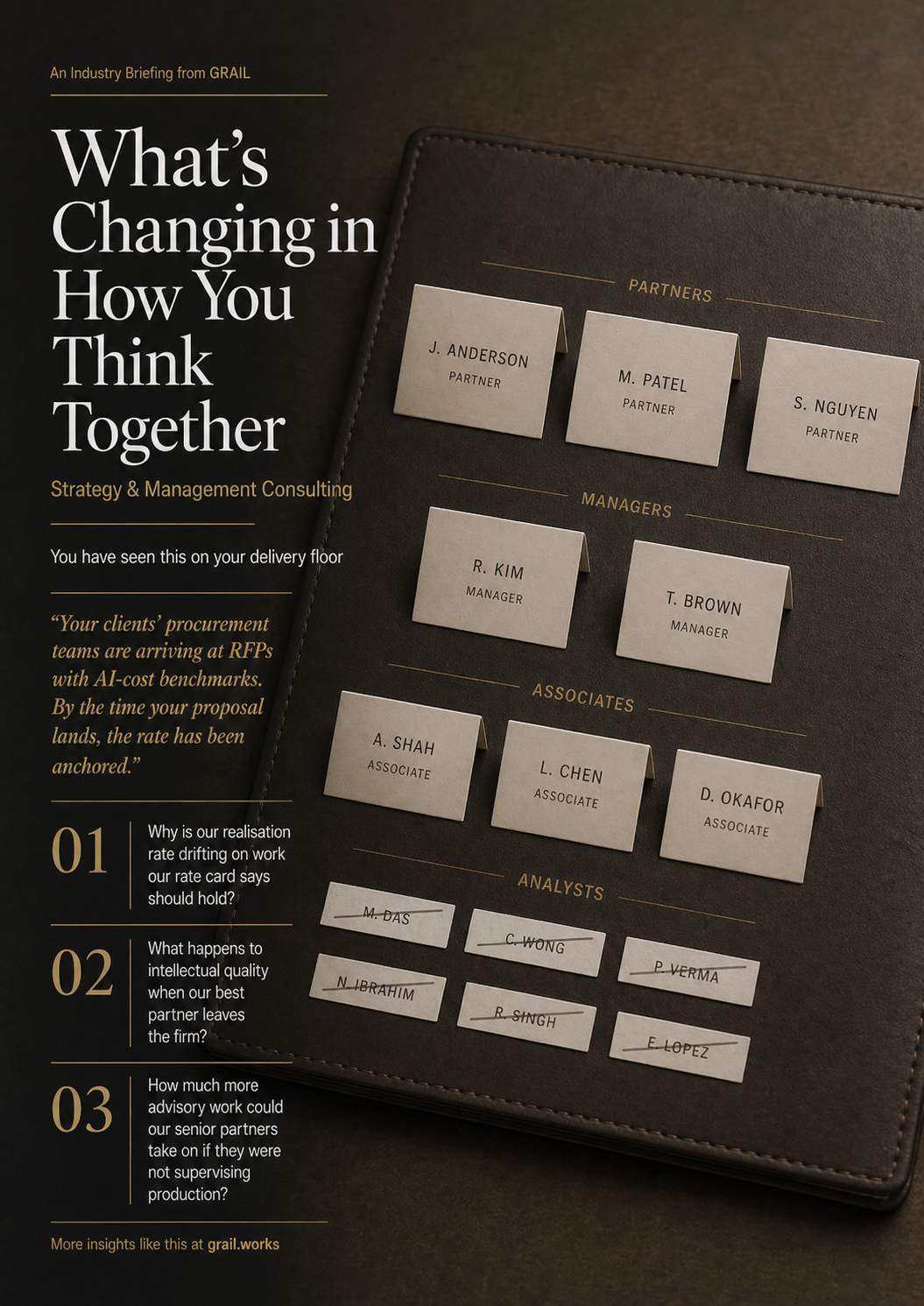
The 10-page briefing. Worth 20 minutes.
One email. One PDF. Worth twenty minutes of your week.
We send it once. Work emails only.
Every Chief Operating Officer or Head of Delivery at a mid-sized European strategy or management consulting firm has had the same Tuesday morning. Three engagements on review. The first: two weeks late because the senior partner cannot clear eight hours for the synthesis session. The second: the junior team's model took four days and the client's own tool parsed the same data in an afternoon. The third: your most experienced partner had coffee yesterday with someone from a competitor. Nobody on your bench has led a CEO-facing engagement alone.
You have run this function for fifteen years. The model used to be reliable. Something changed. Most operations leaders are treating this as three separate problems. The ones who see them as one are redesigning for the next decade.
This is an industry problem and a delivery-engine problem, arriving together. The firms that see the connection first are closing more work with the same partner headcount, at margins the old model could not reach.
Can you name one senior partner whose advisory hours with clients went up this quarter while their supervision hours went down?
Your CEO is already asking this. The briefing below is what you want in your hand before the next partner meeting.
Engagement Margin. Delivery Quality. Partner Throughput.
Three questions every consulting operations leader tracks. None of them used to be the same question. They are now.
Why is our realisation rate drifting on work the rate card says should hold?
The rate card has not changed. Utilisation is within plan. But realisation on mid-tier engagements is down two to four points a year, and clients are arriving at proposals with AI-derived cost estimates the firm has never seen before. The rate card is fine. The pricing model is the question.
What happens to our intellectual quality when our best partner leaves the firm?
Your three most experienced partners carry client-specific knowledge that took twenty years to build and has never been written down. When one leaves, the replacement steps into a relationship built on context they do not have. The floor drops before anyone says it, and the retainer goes to tender within eighteen months.
How much more advisory work could our seniors take on if they were not supervising production?
A senior partner spending thirty-five percent of their billable week reviewing production is spending that time on work that does not need them. The firms that have redesigned around this find their seniors delivering forty to fifty percent more client-facing advisory in the same quarter. Not a productivity story. A capacity story.
What you get when you download
An 11-page report for Chief Operating Officers and Heads of Delivery at mid-market strategy and management consulting firms. Designed to be read in one sitting before your next partner meeting.
Your industry, your delivery engine, and why they are one problem
What is happening to strategy consulting as a sector. What is happening inside your delivery engine, your partner bench, your analyst pipeline, and your client continuity right now. And the intersection most operations leaders have not named: you do not have three problems, you have one.
Four moves across delivery, quality, bench, and continuity
Map every engagement at the task level and price around what still requires a senior. Build engagement memory as a firm asset from artefacts partners already produce. Redesign the analyst pathway around composite advisory from day one. Treat every major retainer as an active knowledge asset the firm owns.
Five questions for your next partner meeting
The realisation question. The senior supervision hours question. The partner departure question. The measurably-faster-better-cheaper question. The analyst-of-2028 question. Where your operations leadership cannot align quickly is the conversation worth an hour on the agenda.
Calibrated for each seat at the table.