Margin.
Pace.
Position.
The whole GTM playbook is being rewritten in real time, across every commercial team at once.
This briefing tells you how the GTM playbook gets rewritten in biotech and research as AI compresses every commercial team. Read it before your competitors hit their first AI-native quarter.
The 10-page briefing. Worth 20 minutes.
One email. One PDF. Worth twenty minutes of your week.
We send it once. Work emails only.
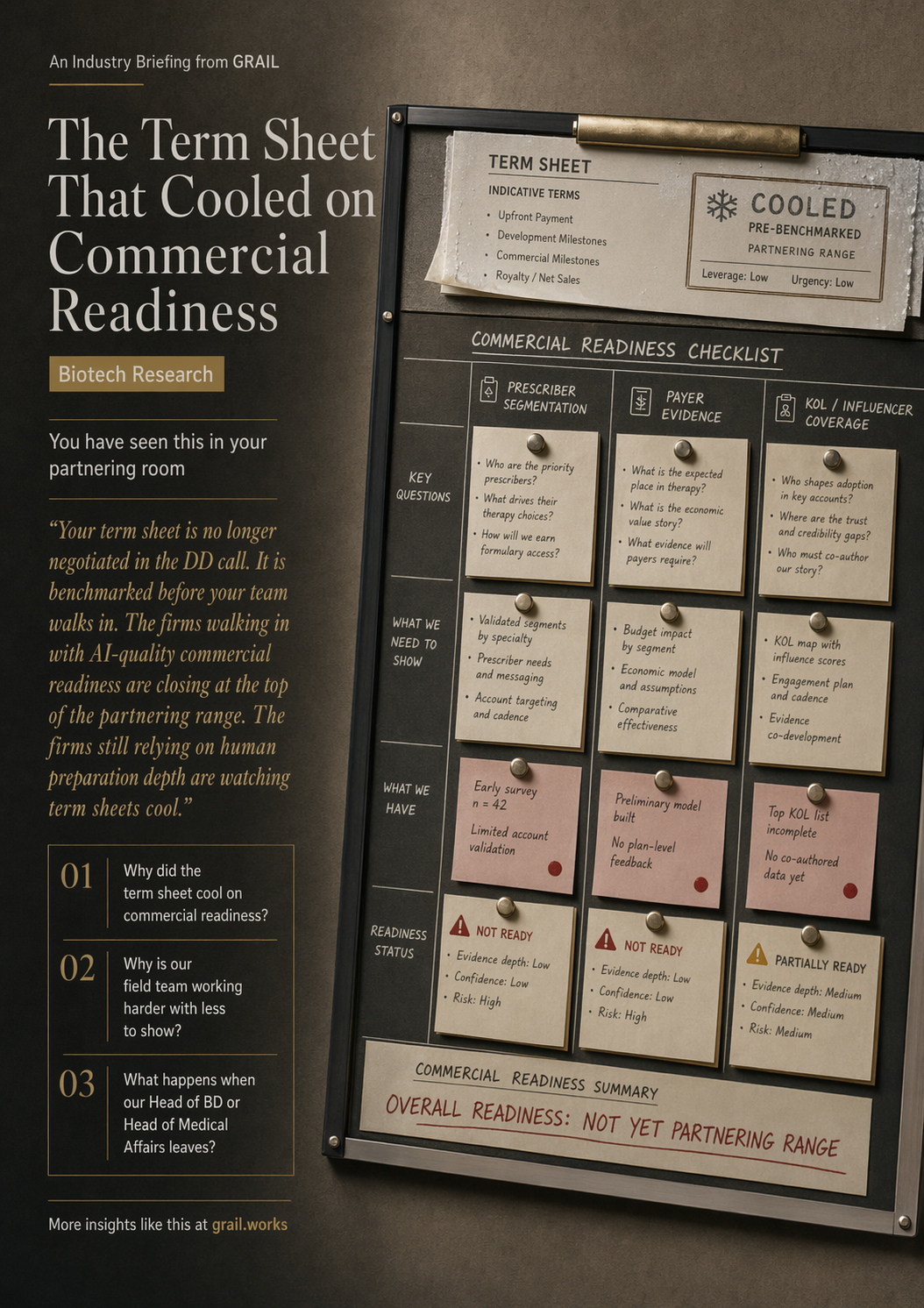
Every commercial leader at a mid-sized European biotech has had the same Monday morning. Friday afternoon, a late-stage licensing conversation cooled after the partner's DD team asked three commercial questions your team could not answer on the call. How are you segmenting prescribers in France and Germany? What payer evidence are you carrying into HTA submissions? Who carries the relationships on the thirty KOLs driving guideline inclusion?
You have run BD and commercial at biotechs for fifteen years. The pattern used to be simple. The science sold the deal. The field team launched the product. The MSLs covered the KOLs. Headcount was small but the work fit the headcount. Something changed.
This is not a you problem. It is an industry problem and a function problem, happening at the same time. Most commercial leaders are treating them as two. The ones who see them as one own the next decade of mid-market biotech commercial growth.
Same asset. Same twelve months. Opposite term sheets. The difference is the operator, not the AI.
Your CEO is already asking you about this. The briefing below is what you want in your hand before that conversation.
Partner deal. Field team. Relationships.
Three questions every commercial leader at a mid-market biotech is tracking. None of them used to be the same question. They are now.
Why did the term sheet cool on commercial readiness?
The partner's DD team asked three commercial questions on the call. Your team had the science. The partner was asking about launch segmentation, payer evidence, and KOL relationship coverage. The term sheet cooled by 15-30 percent or cooled entirely. A commercial-readiness problem, not a science problem.
Why is our field team working harder with less to show?
Your MSLs and specialty reps carry two to three times the call target of their big-pharma counterparts. They spend four to six hours a week on prep that compresses to thirty minutes once they have the tool. Your best MSLs already do this mentally. The rest cannot, and it shows up as weaker KOL engagement.
What happens when our Head of BD or Head of Medical Affairs leaves?
Four people carry your top thirty KOL relationships and your five critical big-pharma BD connections. Each is fielding recruiting calls from larger pharma. When one leaves, the relationship does not transfer. The context was never in any system. In 2026 it can be.
What you get when you download
An 11-page report for commercial leaders at mid-market European biotechs. Designed to be read in one sitting before your next leadership team meeting.
Your industry, your function, and why they are one problem
What is happening to biotech commercial economics as a sector. What is happening in your partnering room, your field team, and your market-access team right now. And the intersection most commercial leaders have not named yet. Plain language you can use in the boardroom.
Four moves across BD, field, market access, and knowledge
How to walk into late-stage DD with AI-quality commercial readiness. How to get your MSL preparation to big-pharma depth. How to produce payer dossiers in days, not quarters. How to capture KOL and BD-lead context before the recruiting call.
Five questions for your next leadership team meeting
Last five cooled partnering conversations. DD-question coverage in the call. What happens if your CMO and Head of BD leave next quarter. Depth of your asset in AI-augmented clinician research. Which MSLs are already preparing at 2027 depth.
Calibrated for each seat at the table.