Capital.
Forecast.
Story.
What you allocate this year is the story your board reads next year.
This briefing tells you which capital-allocation decisions become 10x bets in biotech and research as AI compresses the cost stack. Read it before your peers send their version to the board.
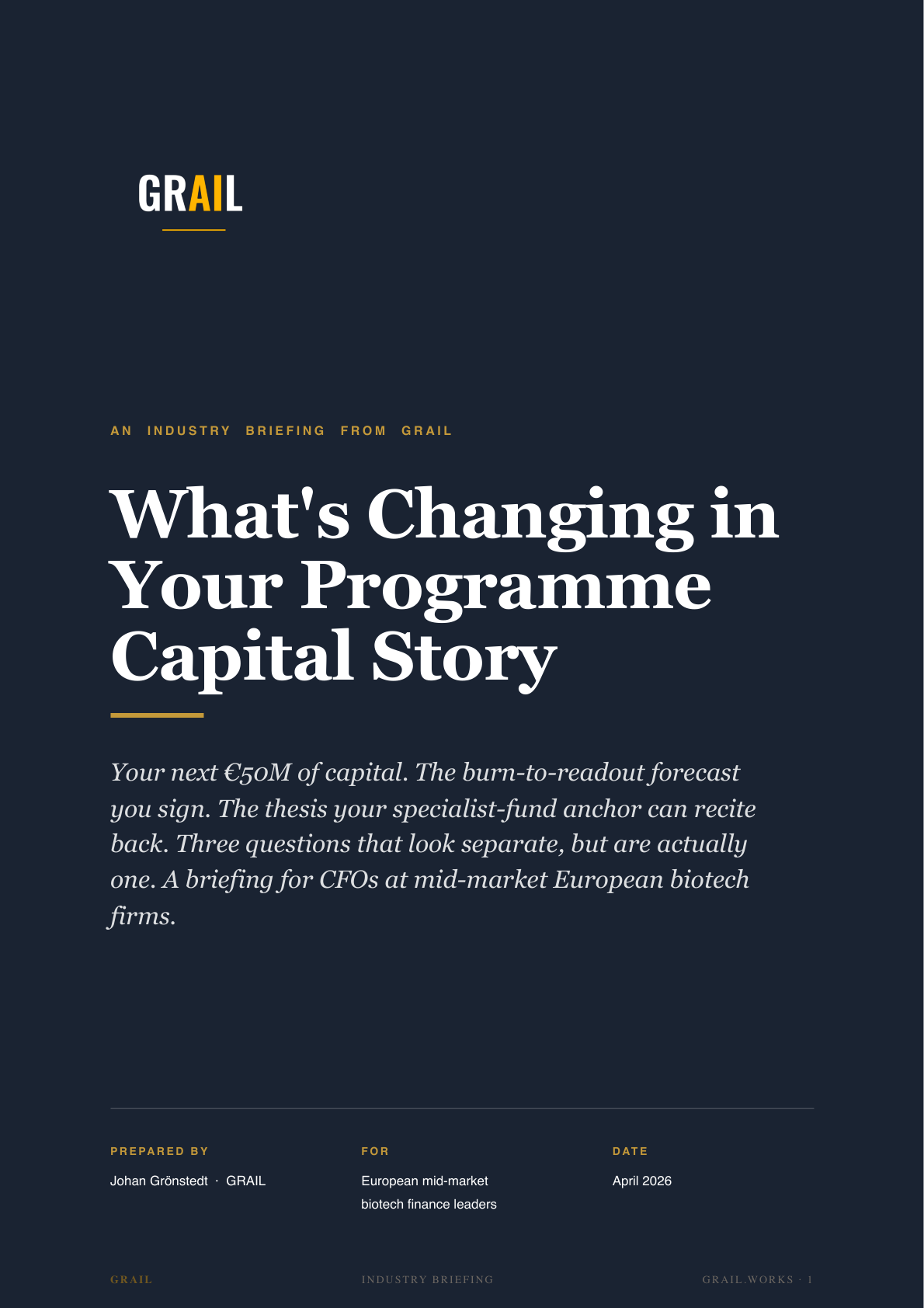
The 10-page briefing. Worth 20 minutes.
One email. One PDF. Worth twenty minutes of your week.
We send it once. Work emails only.
Every CFO at a mid-sized European biotech has had the same Thursday morning. Four things on the screen at 8:30. Your lead programme is eighteen months from pivotal Phase 3 readout and the CMC tech-transfer timeline landed three weeks late. Your CSO wants €50M next quarter to accelerate a parallel Phase 2 asset because an AI-accelerated competitor is entering the same indication nine months ahead of plan. Your Head of BD forwarded a mid-stage in-licensing opportunity yesterday at 40% below 2021 comparables. And your specialist-fund anchor's analyst closed last week's call with a single line: curious to hear your thinking on portfolio priorities and capital discipline before JPM.
You have signed fifteen forecasts for this board. The pattern used to be simple. Advance the lead. Hold cash to the next readout. Refresh the risk-adjusted NPV once a year. The job has not changed in thirty years. The bar has risen on every measure of doing it, simultaneously, and the portfolio contradictions you have been navigating since you took the seat are suddenly re-openable.
The €50M your CSO wants to accelerate the parallel Phase 2 asset is not a programme-timeline request. It is the largest single capital-allocation decision you will make this decade.
This is the question your chair is already asking. The briefing below is what you want in your hand before the next forecast review.
Capital Allocation. Forecast Credibility. Value-Creation Narrative.
Three questions every biotech CFO is tracking. The first is the crux. The other two are how you earn the right to answer it.
Where does the next €50M actually compound?
Lead-programme acceleration, in-licensing a de-risked Phase 2 asset at specialist-fund-distribution-low valuations, CDMO capacity build, commercial launch prep, hold runway to next readout. Today's default: the CSO proposes, the programme committee governs, the revised budget gets signed, and the capital-allocation authority slides away from the seat.
Why is the portfolio rNPV compressing, and what is the programme-level story?
Your board voted on a 2028 launch and a risk-adjusted NPV anchored in 2024 competitive intelligence. Your Head of FP&A cannot walk the audit committee through the portfolio-level story because programme costs sit in clinical-ops spreadsheets, development-stage probabilities sit in the CSO's head, and regulatory timeline risk sits in the Head of Regulatory's email.
What does this firm do that compounds faster than peers?
Your board wants the strategy-day preview. Your specialist-fund anchor wants the portfolio-prioritisation note. Your chair wants the how-we-stay-ahead-of-AI-accelerated-competitors answer. Three audiences, three documents, three teams, and the probability assumptions underneath them do not match.
What you get when you download
An 11-page report for Chief Financial Officers at mid-market European biotech firms. Designed to be read in one sitting before your next forecast review.
Your industry, your finance function, and why they are one problem
What is happening in mid-market European biotech as a sector. What is happening inside your capital, your forecast, your royalty and milestone architecture, your Controller bench, and your economic thesis right now. And the intersection most CFOs have not named yet: you do not have three scorecard problems, you have one.
Four moves across capital, forecast, milestones, and narrative
Route programme acceleration through the BD hurdle, not the programme committee. Rebuild the portfolio as a live probability-adjusted graph, not an annual refresh. Renegotiate royalty and milestone architecture against AI-compressed competitor timelines. Write the economic thesis once, refresh continuously off the same data.
Five questions for your next forecast review
The €50M CSO-request question. The 2024-competitive-intelligence question. The 2019-milestone-architecture question. The three-audiences-one-thesis question. The 2031-succession-bench question. Where your finance leadership cannot agree on the answer is the conversation worth an hour on the agenda.
Calibrated for each seat at the table.