Revenue.
Margin.
Valuation.
Three numbers your board reads. AI is rewriting all three in your industry.
This briefing tells you where revenue, margin, and valuation move in biotech and research as AI rewrites the industry. Read it before your competitors decide what your next decade looks like.
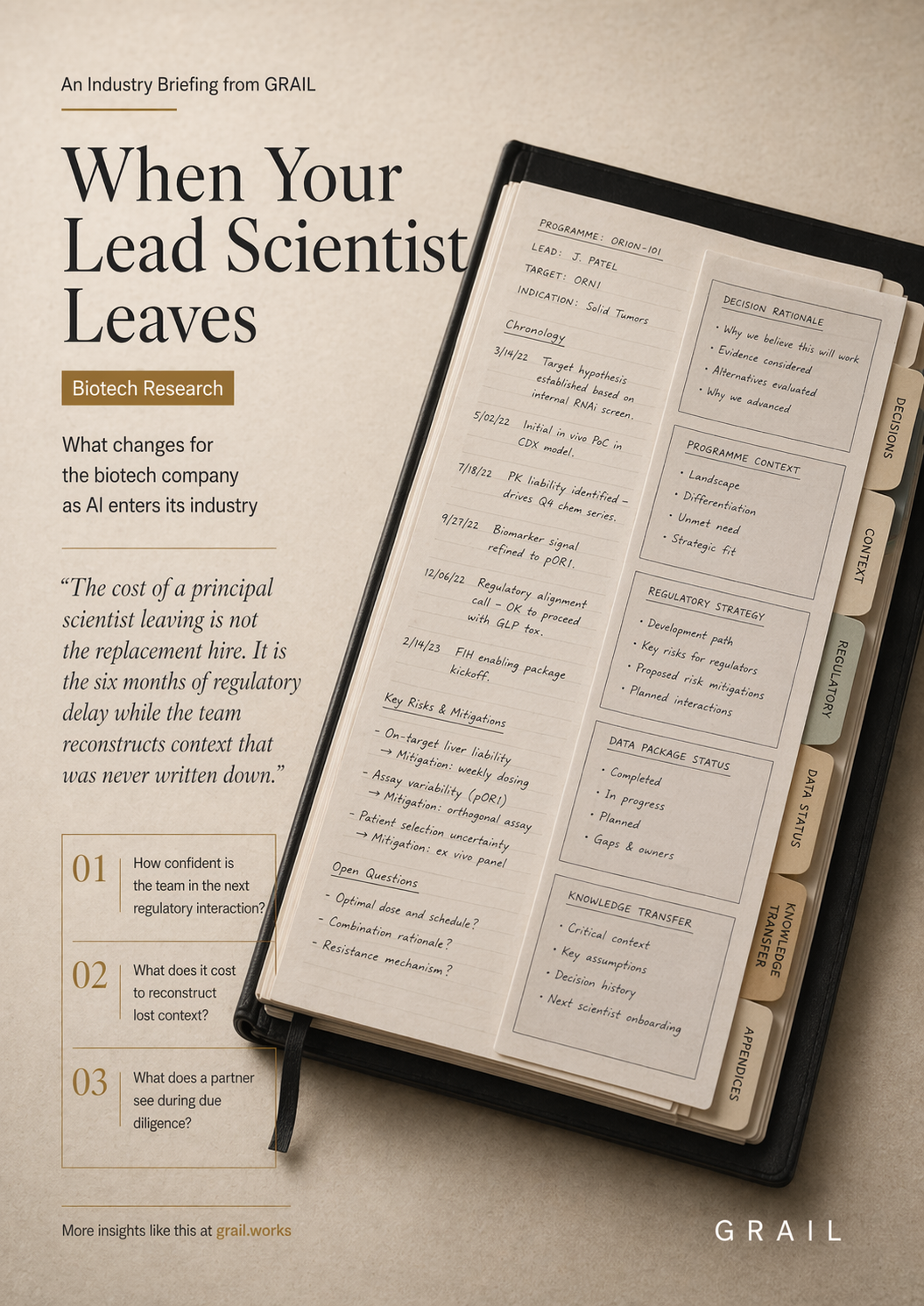
The 10-page briefing. Worth 20 minutes.
One email. One PDF. Worth twenty minutes of your week.
We send it once. Work emails only.
Mid-market biotech companies carry a fragility that rarely appears on the balance sheet. The experimental rationale, regulatory narrative, and scientific decision history behind every development programme live primarily in the heads of a small number of principal scientists. When one of those scientists leaves, the programme does not stop. It slows. Regulatory timelines stretch. Partnership due diligence exposes gaps nobody anticipated.
The cost of a principal scientist leaving is not the replacement hire. It is the six months of regulatory delay while the team reconstructs context that was never written down.
AI has not created this fragility. It has made it fixable. For the first time, it is feasible to extract, structure, and encode the reasoning behind a decade of experimental decisions into institutional knowledge systems. Not the data itself. The rationale. Why a target was prioritized. Why an assay approach was abandoned. Why the regulatory strategy changed after a specific agency interaction.
For the CEO of a biotech company, this is not a science question. It is a revenue question, a profit question, and a valuation question.
Revenue. Profit. Valuation.
Three lenses. Three answers the management team needs before the next partnership conversation.
Revenue
Licensing revenue depends on programme credibility. When the regulatory team prepares for an IND meeting by reconstructing experimental rationale from scattered documents, the preparation takes longer, the narrative is weaker, and the agency interaction is less productive. Every month of regulatory delay is a month of lost licensing timeline.
Profit
When a principal scientist departs, senior researchers spend months piecing together the reasoning behind decisions made years ago. That reconstruction absorbs the most expensive talent in the organization on work that produces no new science. The real cost is not the departed scientist's salary. It is the opportunity cost of the scientists who stay.
Valuation
Acquirers and licensing partners probe programme continuity directly. When due diligence reveals that the programme narrative depends on three people being in the room, the valuation reflects the risk. Institutional programme knowledge that is accessible and structured earns a different price than personal knowledge in a few heads.
What you'll get when you download
A 10-page report for biotech and research company CEOs. Designed to be read in one sitting before your next partnership discussion.
The strategic choice, side by side
The default path (accelerate discovery, trust small teams to share, prepare for regulators reactively) and the repositioning path (build programme knowledge infrastructure, maintain regulatory readiness, make continuity a selling point), with the financial logic of each.
The four levers that compound
Extract programme rationale while scientists are available. Build the regulatory narrative as a living system. Use AI to compress preparation work. Make programme continuity visible to partners. Modest in isolation. Together, they transform fragility into a competitive asset.
Five questions for your next board meeting
Diagnostic questions the CEO should test the leadership team against before the next partnership conversation. The questions where the room cannot agree are the ones worth a longer conversation.
Calibrated for each seat at the table.