Cheaper.
Better.
Faster.
The triple threat that used to be a tradeoff is now table stakes.
This briefing tells you where the triple threat lands in biotech and research operations as AI rewrites the cost structure. Read it before your competitors decide who is table stakes.
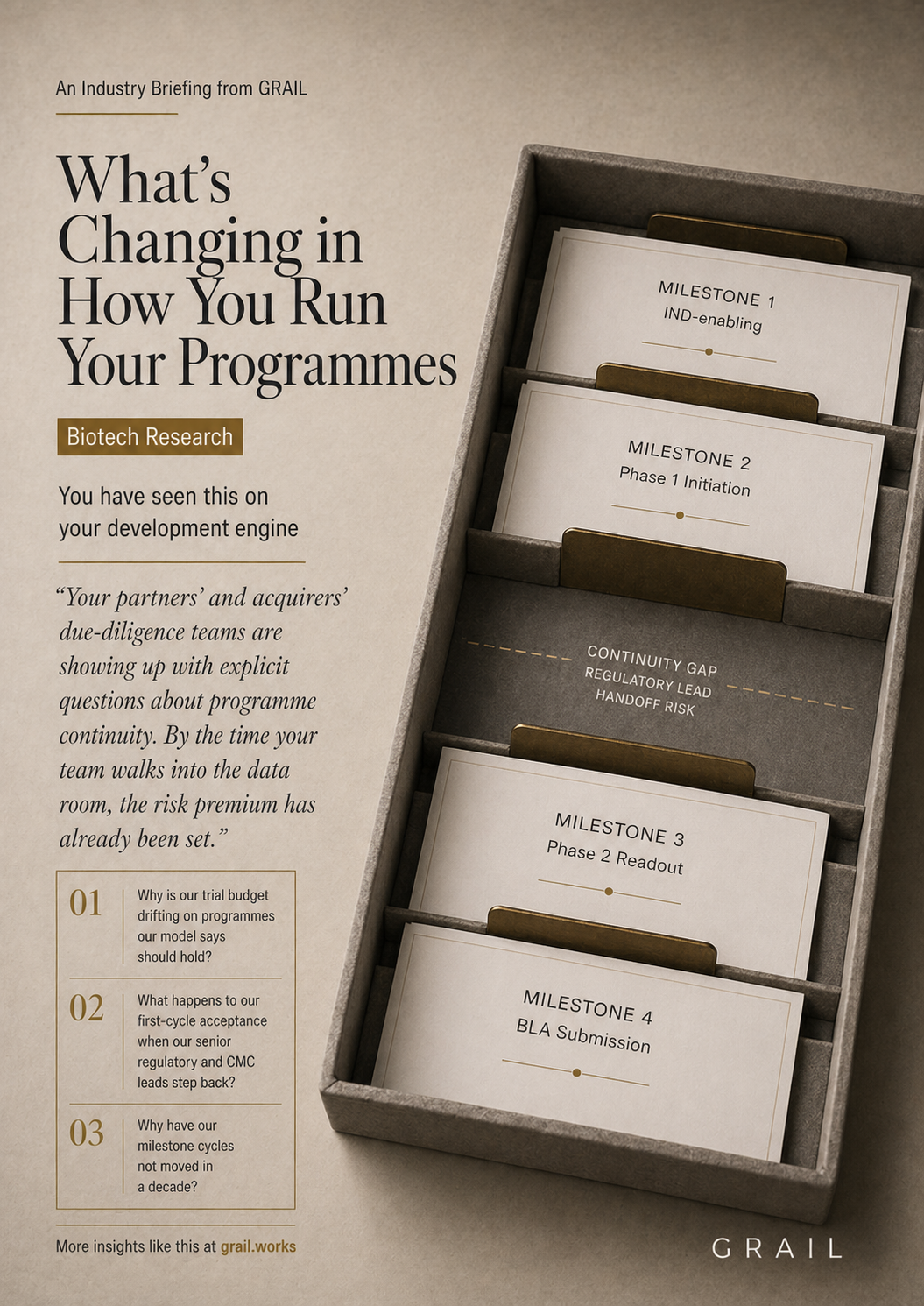
The 10-page briefing. Worth 20 minutes.
One email. One PDF. Worth twenty minutes of your week.
We send it once. Work emails only.
Every Chief Operating Officer or Head of Development Operations at a mid-sized European biotech has had the same Monday morning. Three meetings on the calendar. A CRO steering committee on your Phase IIb programme, site activation drifting to week twelve against a plan of week eight. A CDMO quality review on the comparator batch with an out-of-spec only your senior CMC lead can fully interpret. A thirty-minute slot Thursday with your senior regulatory affairs director. The subject line says transition.
You have run this function for fifteen years. The pattern used to be simple. Hire the best clinical operations, regulatory, and CMC people you could find. Write the SOPs. Keep the cash burn honest for the CFO. The business was understandable. Something changed.
This is not a you problem. It is an industry problem and a development-engine problem, happening at the same time. Most biotech COOs are treating them as two. The ones who see them as one are going to own the next decade of European mid-market biotech operations.
Can you point to one thing in your development engine that is measurably smarter this quarter than last quarter?
Your CEO is already asking this. The briefing below is what you want in your hand before the next pipeline review.
Trial Economics. Submission Reliability. Programme Velocity.
Three questions every biotech COO is tracking. None of them used to be the same question. They are now.
Why is our trial budget drifting on programmes our model says should hold?
The protocol has not changed. The CRO has not changed. But cash burn is running three to five per cent above plan each quarter, and your CFO is asking why. The work that justified the senior coordination layer has compressed.
What happens to our first-cycle acceptance when our senior leads step back?
Three to six of your most senior development-operations people are within five years of retirement or transition. Each carries agency-specific and CDMO-specific judgment that took twenty-five years to build and has never been written down. The floor holds because they are in the room.
Why have our milestone cycles not moved in a decade?
A standard pre-IND to IND cycle takes sixteen to eighteen months. Roughly half of that elapsed time is literature review, precedent cross-reference, briefing-book assembly, and internal coordination that now compresses to hours, not weeks. The firms that rebuild development operations close the same cycle in eleven to fourteen.
What you get when you download
An 11-page report for Chief Operating Officers and Heads of Development Operations at mid-market biotechs. Designed to be read in one sitting before your next pipeline review.
Your industry, your operations, and why they are one problem
What is happening in biotech development as a sector. What is happening inside your clinical operations, your regulatory and quality function, your CMC and supply, your programme team, and your senior experts right now. And the intersection most COOs have not named yet: you do not have three problems, you have one.
Four moves across clinical operations, regulatory, CMC, and programme history
Decompose every trial phase to the task level and rebuild CRO scope around the tasks that still deliver value. Extract senior regulatory and CMC judgment as a side-effect of daily work. Institutionalise the CDMO relationship so batch knowledge transfers on architecture. Rebuild programme history as a continuous artefact the partner reads.
Five questions for your next pipeline review
The milestone-drift question. The senior-coordination hours question. The retirement-exposure question. The measurably-smarter question. The mid-level programme manager of 2027 question. Where your operations team cannot agree on the answer is the conversation worth an hour on the agenda.
Calibrated for each seat at the table.