Revenue.
Margin.
Valuation.
Three numbers your board reads. AI is rewriting all three in your industry.
This briefing tells you where revenue, margin, and valuation move in energy and environment as AI rewrites the industry. Read it before your competitors decide what your next decade looks like.
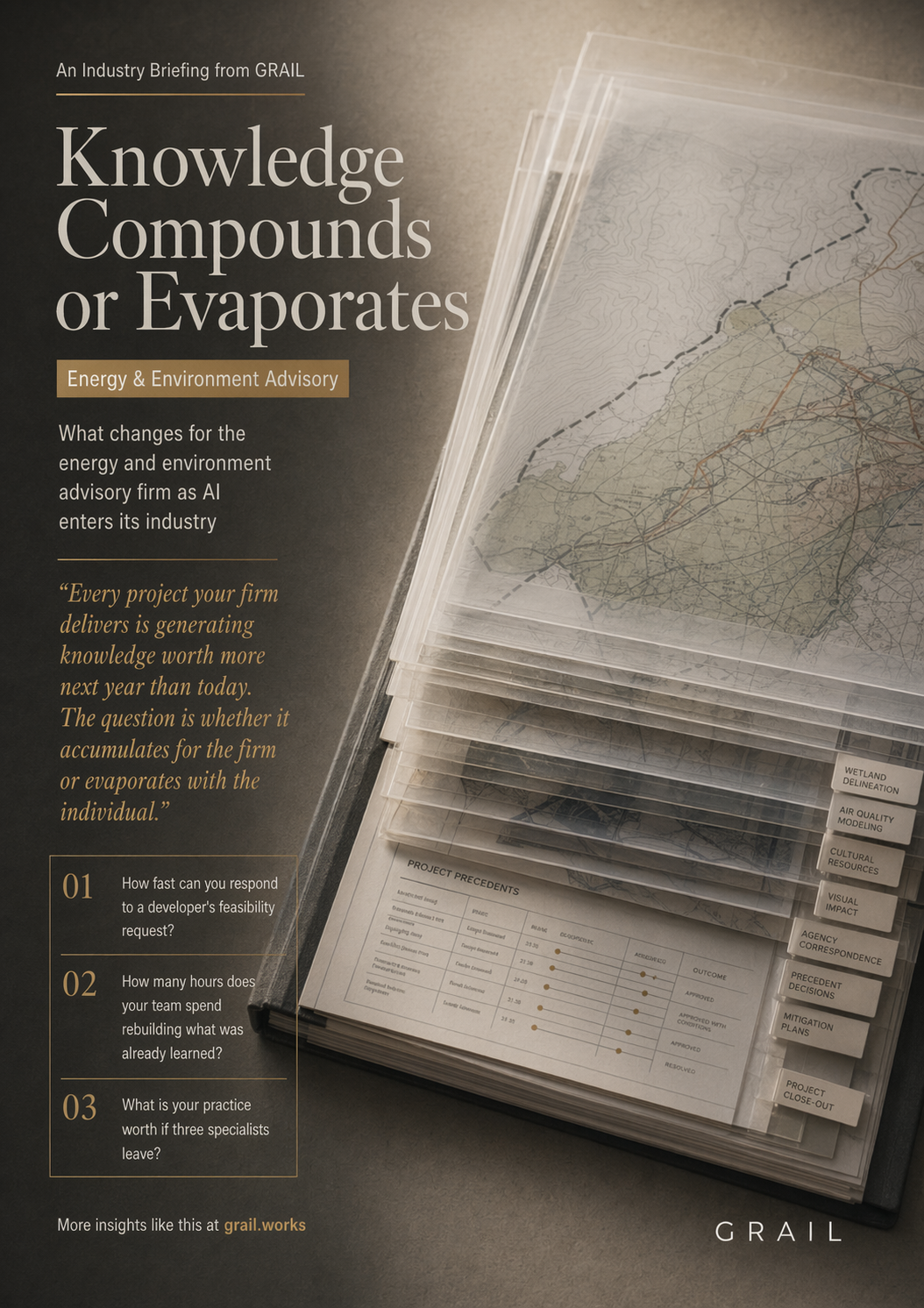
The 10-page briefing. Worth 20 minutes.
One email. One PDF. Worth twenty minutes of your week.
We send it once. Work emails only.
Energy transition advisory is generating frontier knowledge faster than any professional services sector in a generation. Offshore wind permitting, hydrogen pathway assessment, battery storage grid integration, carbon capture site selection. These specializations barely existed five years ago. Every major project creates regulatory and technical precedent that will govern commercial opportunities for the next twenty years.
Every project your firm completes in a novel technology area generates precedent worth more next year than today. The question is whether that precedent accumulates for the firm or disappears with the project lead.
The talent dynamics make this urgent. Developers, infrastructure funds, and large engineering consultancies are recruiting experienced energy transition specialists at 40% or greater salary premiums. Mid-market advisory firms are simultaneously building expertise through project work and losing it through departure. The knowledge is being created and destroyed at the same time.
For the CEO of an energy and environment advisory firm, this is not a knowledge management question. It is a revenue question, a profit question, and a valuation question.
Revenue. Profit. Valuation.
Three lenses. Three answers the management team needs before the next specialist departure forces the conversation.
Revenue
The firm with encoded precedent from comparable projects responds to developer feasibility requests in days with structured intelligence. The firm without it starts from scratch. Developers choose speed because their investment timelines are fixed. Every week of delay is a week closer to a competitor winning the mandate.
Profit
When every project kicks off by reconstructing the regulatory landscape, rebuilding the stakeholder map, and re-researching technical assessment approaches the firm has used before, the margin on that work compresses. The knowledge exists inside the firm. It is just not accessible. The profit leak is invisible because it looks like normal project startup.
Valuation
Acquirers and investors price advisory firms on the durability of their knowledge base. Regulatory precedent, technical methodology, and client relationships encoded into systems survive departures and create a premium. The same capabilities held in three people's heads create a discount. Same revenue, very different valuations.
What you'll get when you download
A 10-page report for energy and environment advisory CEOs and management teams. Designed to be read in one sitting before your next leadership meeting.
The strategic choice, side by side
The default path (automate reports, accept talent loss, treat knowledge capture as admin) and the repositioning path (compound project intelligence, build capture into methodology, compete on institutional depth), with the financial logic of each.
The four levers that compound
Build systematic capture into every frontier project. Use AI for cross-market regulatory monitoring. Make knowledge infrastructure a retention tool. Frame the precedent library as a twenty-year asset. Modest in isolation. Together, they convert knowledge acceleration into structural advantage.
Five questions for your leadership meeting
Diagnostic questions the CEO should test the management team against before the next specialist departure or developer request forces the conversation. The questions where the room cannot agree are the ones worth a longer conversation.
Calibrated for each seat at the table.