Cheaper.
Better.
Faster.
The triple threat that used to be a tradeoff is now table stakes.
This briefing tells you where the triple threat lands in energy and environment operations as AI rewrites the cost structure. Read it before your competitors decide who is table stakes.
The 10-page briefing. Worth 20 minutes.
One email. One PDF. Worth twenty minutes of your week.
We send it once. Work emails only.
Every Head of Delivery at a mid-sized energy and environmental advisory in Europe has had the same Tuesday morning. An offshore wind EIA where the permitting specialist spent two days reconstructing precedent the firm already earned on four comparable projects. A hydrogen pathway study where the client wants a first view by Thursday and the team needs ten days because the regulatory baseline does not exist in accessible form. A senior environmental specialist who mentions she had a call from a developer in London. You know what the call was about.
You have run this delivery engine through two technology cycles. Something changed. The energy transition generates new specialist knowledge through every frontier project, faster than any advisory firm in this sector has ever encoded it. Each offshore wind assessment, each BESS permitting engagement, each CCUS feasibility generates regulatory precedent worth more next year than today. Most of it lives in the heads of specialists being recruited at 40% salary premiums by the developers they advise.
Your CEO is already asking the question. This briefing is what you want in your hand before the next operations review.
When your team kicks off the next comparable project, do they start from everything the firm has learned, or do they start from scratch?
Most energy advisory firms cannot answer honestly. The ones that can have already made the shift, and they are closing the projects you thought were yours.
Project Margin. Knowledge Continuity. Delivery Speed.
Three questions every energy advisory COO is tracked against. None of them used to be the same question. They are now.
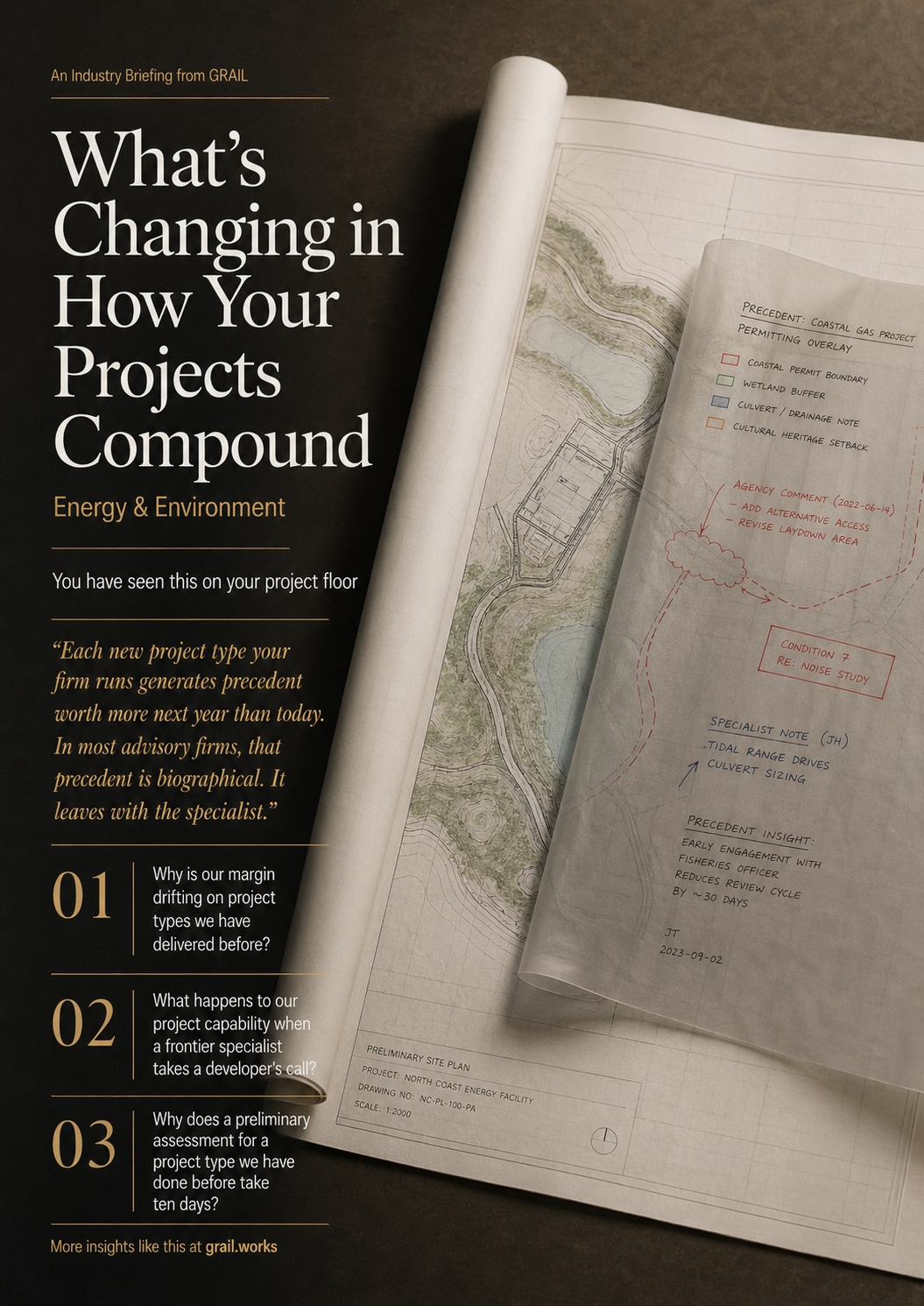
Why is our margin drifting on project types we have delivered before?
Your rate card has not changed. But clients arrive at tenders with benchmarks that already account for what AI-efficient delivery should cost. The analysis layer that justified mid-tier billing is compressing. The firms that hold margin on comparable work are the ones where each project costs less to deliver because the last one encoded something the next one can use.
What happens to our project capability when a frontier specialist takes a developer's call?
One of your BESS permitting specialists, or your offshore wind EIA lead, or your hydrogen pathway expert spent three years building regulatory intelligence the firm's next client in that technology area needs. When they join a developer's in-house team, it goes with them. You already know which conversations are coming.
Why does a preliminary assessment for a project type we have done before take ten days?
The team rebuilds the regulatory baseline and the technical methodology from the last comparable project because none of it is in a form accessible without the specialist who ran it. The firms closing comparable assessments in four to five days are the ones where each project made the next one faster. Not a productivity gain. A capacity expansion in a market constrained by specialist availability.
What you get when you download
An 11-page report for Chief Operating Officers and Heads of Delivery at mid-market energy and environmental advisory firms. Designed to be read in one sitting before your next operations review.
Your industry, your operations, and why they are one problem
What is happening in energy and environmental advisory as a sector. What is happening inside your delivery engine, your specialist bench, your senior experts, and your client continuity right now. And the intersection most operations leaders have not named yet: you do not have three problems, you have one. Pages 3 through 5.
Four moves across delivery, quality, bench, and client continuity
Concrete moves your operations team can start this quarter. Decompose each project type to the task level. Extract specialist reasoning from the artefacts of daily work. Redesign junior onboarding around encoded precedent. Build developer relationships on firm infrastructure. One move per part of the delivery engine. Page 8.
Five questions for your next operations review
The questions where your operations team cannot agree on an answer. How many days of your first project week go into reconstructing precedent you already own? Name the specialists whose departure would cost the firm the most. At the current rate, what does your senior bench look like in 2030? Page 11.
Calibrated for each seat at the table.