Moat.
Speed.
Allocation.
The platform moat that survives 2028 is being chosen this year.
This briefing tells you which platform moats survive 2028 in energy and environment as AI rewrites build economics. Read it before your R&D allocation locks for the decade.
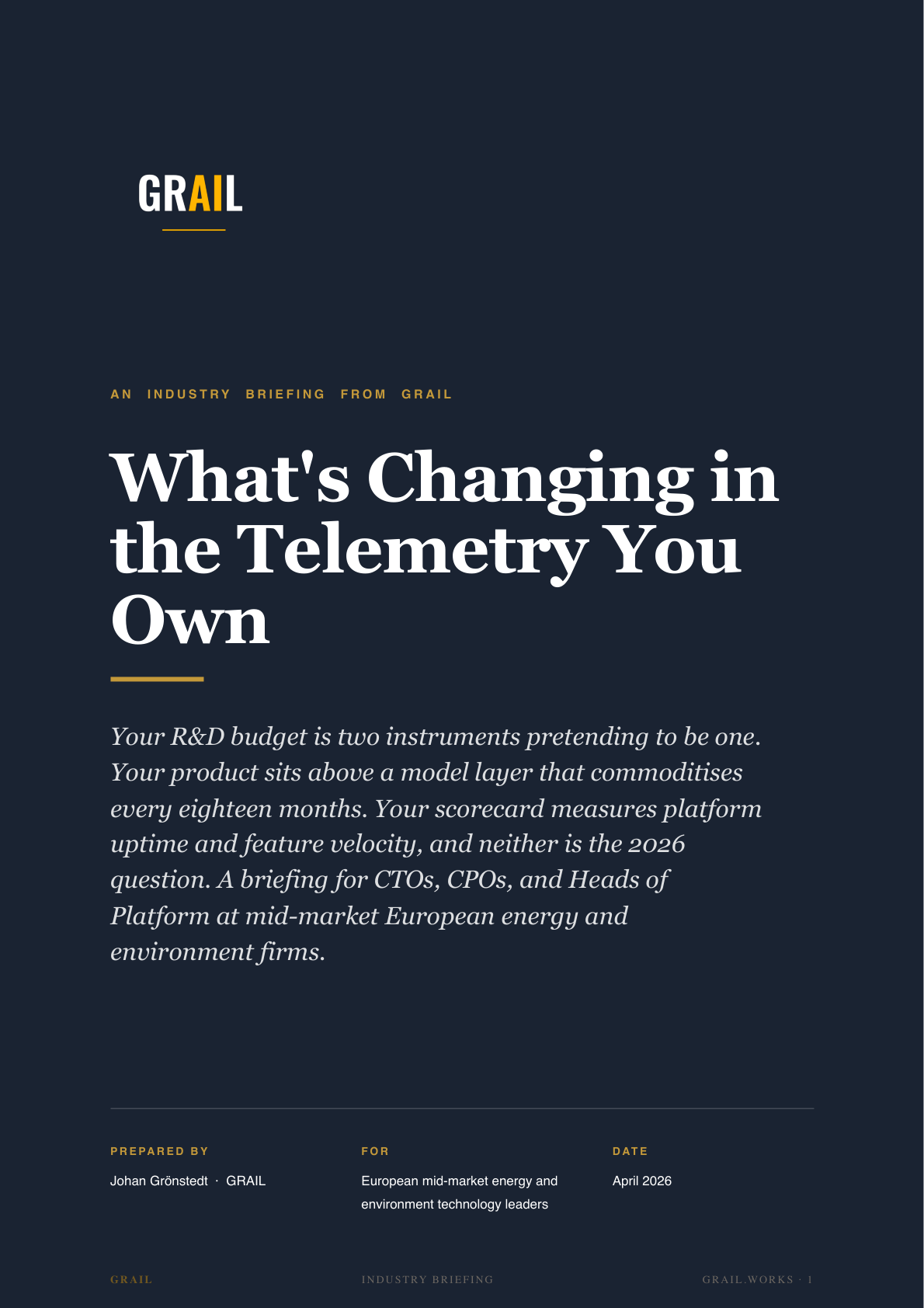
The 10-page briefing. Worth 20 minutes.
One email. One PDF. Worth twenty minutes of your week.
We send it once. Work emails only.
Monday 7:40, forecast review. Your dashboard shows balancing-interval error at one point eight percent, point-four wider than last week. Your duty controls engineer has left a note: two wind assets had a ramp-rate event Sunday the model did not predict. Your phone buzzes. Your biggest TSO customer: "Our board is looking at an AI-native pilot for forecast-error reduction, happy to talk before we shortlist." Your senior data scientist mentioned a recruiter call from a developer over coffee Thursday. Your CEO has a CAIO shortlist from the board on his desk.
You are not running one R&D function. You are running two, and only one is on your scorecard. One funds what you already ship. The other funds what has to exist by 2028: the asset-telemetry rights you have not renegotiated, the regulatory-precedent corpus you have not encoded, the integration depth into customer SCADA environments that outlasts three model swaps.
The integration depth you wrote off as technical debt is the moat you have already built.
This is the question your CEO is already asking. The briefing below is what you want in your hand before the next R&D review.
Build Velocity. Product Defensibility. R&D Capital Allocation.
Three questions every energy and environment CTO is tracking. The second is the crux. The first and third are how you earn the right to answer it.
Is our engineering speed shipping production-grade integrations, or demos that break at the first grid-stress event?
Copilot adoption at seventy percent. Cycle time flat. Ten-thousand-line PRs touching SCADA integration code, barely reviewed. Spotify spent four years on the platform that lets agents ship cleanly. You cannot replicate four years in eighteen months. Buy what the tool layer can carry. Own the discipline that makes it ship into a live customer environment.
What does our product do that an AI-native at ten percent of our unit economics cannot copy?
Your feature edge commoditises every eighteen months when the next foundation model rolls. Your asset-telemetry rights, your integration depth into customer SCADA environments, and your regulatory-precedent corpus compound. Your architectural reasoning sits in three senior heads, and a developer is offering two of them forty percent more.
Is our R&D budget one instrument or two?
One funds the existing product at lower unit cost. The other builds the 2028 moat. On one hurdle rate the first wins every quarter. On one scorecard the second does not exist. The CTO who walks in with one budget runs the same programme every peer is running.
What you get when you download
An 11-page report for CTOs, CPOs, and Heads of Platform at mid-market European energy and environment firms. Designed to be read in one sitting before your next R&D review.
Your industry, your R&D function, and why they are one problem
What is happening to mid-market European energy and environment: AI-natives at ten percent of your unit economics pitching into asset-ops optimisation, forecasting, and diligence automation; the feature layer commoditising every eighteen months; senior specialists recruited by developers at forty-percent premiums. What is happening inside your R&D function: Copilot adoption up, cycle time flat, the board AI-strategy ownership list your seat is not on. And the intersection: the integration depth you wrote off as debt is the moat you have already built.
Four moves across build engine, platform and data, product thesis, and R&D bench
Instrument review depth per line on integration code touching customer SCADA environments, and make ADRs and eval harnesses first-class infrastructure. Build the moat underneath the model layer through asset-telemetry data rights, a portable agent-memory store, and an integration-depth graph. Stand one outcome-priced line on protected P&L. Rebuild the junior pathway around senior and agent pairing on integration and regulatory work.
Five questions for your next R&D review
Is your R&D budget one instrument or two, and what is the kill criterion on each? Name the AI-native starting to pitch in your category. How many months to reconstruct integration and regulatory reasoning if your senior controls engineer leaves for a developer tomorrow? Where did the freed hours from seventy-percent Copilot adoption go? Is your Q1 boundary agreement with the CEO written?
Calibrated for each seat at the table.