Capacity.
Capability.
Promise.
The biggest talent transition of a career. Compete on capacity, not headcount.
This briefing tells you what the talent transition looks like in energy and environment as AI rewrites the firm-worker promise. Read it before someone else writes it for you.
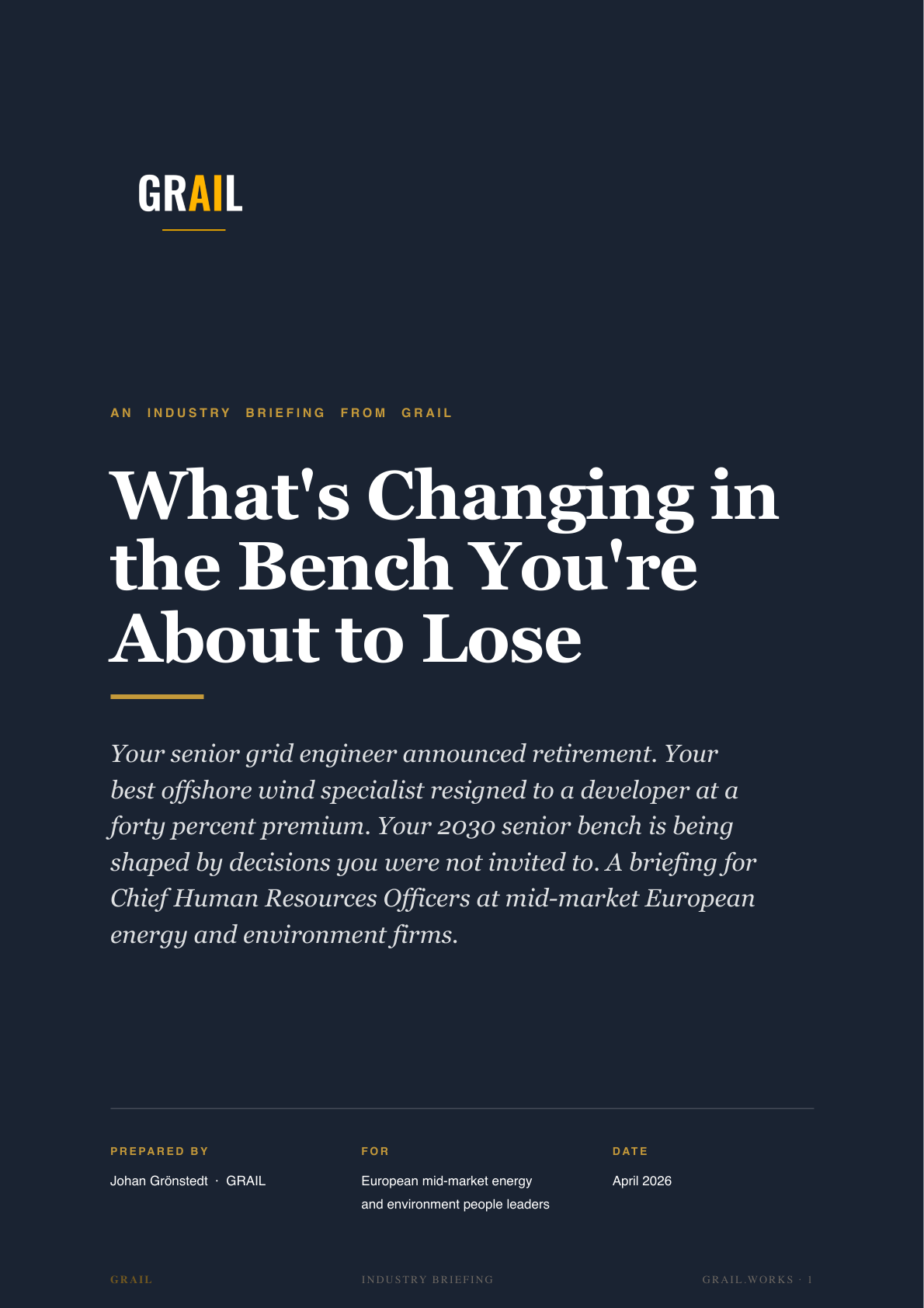
The 10-page briefing. Worth 20 minutes.
One email. One PDF. Worth twenty minutes of your week.
We send it once. Work emails only.
Every CHRO at a mid-sized European energy or environment firm has had the same Monday, 9:14 a.m. Three things in the inbox. Your Head of Talent forwarded Tuesday's resignation from your best 28-year-old offshore wind specialist. He went to a developer at a forty-five percent premium. Your Head of Asset Operations forwarded the retirement notice from your most senior grid engineer, the one who carries the regional system's failure-mode pattern library in his head. Your works council opened framework-agreement consultations on three agentic deployments in the trading desk and the permitting team that shipped without HR in the room.
You do not have a retention problem. You have a knowledge-architecture problem. Your firm has two demographic problems and they share one architecture. The senior engineer retiring in eighteen months and the specialist being recruited at a forty percent premium are the same problem in different decades.
Your firm has two demographic problems and they share one architecture. The senior engineer retiring in eighteen months and the specialist being recruited at a forty percent premium are the same problem.
This is the question your CEO is already asking. The briefing below is what you want in your hand before the next GMT.
Talent Gravity. Capability Compounding. Succession Readiness.
Three questions every CHRO is tracking. None of them used to be the same question. They are now.
Are your A-players staying because of you, or despite you?
Your best offshore wind specialist resigned on Tuesday to a developer at a forty-five percent premium. Your best lateral hire last quarter came from a peer who started rebuilding the pathway first. A-players watch which way you lean the first time something goes wrong. The ones who start looking quietly have already decided.
Is the median engineer sharper in December than they were in January?
The top decile is using AI daily on asset-optimisation, regulatory drafting, and trading-signal analysis, building judgment that compounds weekly. The rest is practicing not-knowing. Your L&D budget funds compliance modules and an annual conference. Neither moves the median.
Of your senior engineers retiring in 36 months, whose pattern library is encoded?
Your most senior grid engineer retires in eighteen months. His pattern library lives in his head. The junior who would replace him spent three years on analytical work that agents now do in seconds. The external senior hire in 2027 costs a forty percent premium and brings the previous firm's context.
What you get when you download
An 11-page report for Chief Human Resources Officers at mid-market European energy and environment firms. Designed to be read in one sitting before your next GMT.
Your industry, your people function, and why they are one problem
The analytical apprenticeship layer that agents have absorbed. The senior bench retiring across the next thirty-six months. Specialists being lifted out by developers at forty percent premiums. The works council opening consultations on shadow agentic use. The intersection most CHROs have not named yet: two demographic problems share one architecture.
Four moves across talent, L&D, succession, and trust
Publish the for-them memo the CEO co-signs in your first 100 days. Pair every retiring senior with a junior on real assets for eighteen months, with the senior's last twelve months fifty percent codifying the pattern library. Every frontier project produces a structured precedent map at close. Publish three rules, one escalation, one red line for agentic tools.
Five questions for your next GMT
What your three best people would say privately about whether the firm's AI strategy is being done for them or to them. The role redesigned at task level in the last twelve months. The senior engineers walking out the door in the next thirty-six months and whose pattern library is encoded. The deployment fragments you authored versus the ones you decoded after they shipped. The frontier-project closes that produced a precedent map versus the ones that lived only in the project lead's head.
Calibrated for each seat at the table.